

The rollout was announced by Discord co-founder and CTO Stanislav Vishnevskiy in a company blog post, together with a technical explainer of the estimation model. Engadget reported it the same day, and Dexerto, Dot Esports and Technobezz reported it independently. For Windows gamers and parents, what matters is what each age group blocks and where to check your own status.
Discord's age group system replaces February's face-or-ID plan
This is Discord's second attempt. In February, TechCrunch reported that Discord planned a global rollout where all users will be put into a "teen-appropriate experience" by default. Only users verified as adults will be able to change certain settings and access age-restricted content. At that point the only ways to confirm age were facial age estimation or an ID scan. Users objected, and Discord's own press release said the company had decided to delay the global rollout of age assurance until the second half of 2026 to expand verification options, increase vendor transparency, and publish detailed technical documentation, while continuing to meet regulatory requirements where needed.
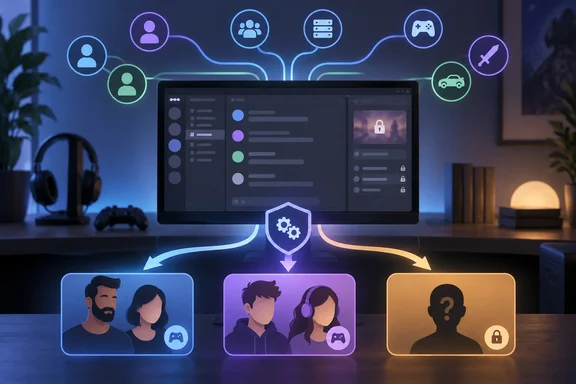
The new system flips the default. Nobody is treated as a teen until proven otherwise. Discord estimates an age group for each account, and only accounts it can't place with confidence go into a third bucket. According to Dexerto, users will fall into one of three categories: Adult Age Group for those 18 and older, Teen Age Group for users between 13 and 17, and Unconfirmed when Discord doesn't have enough information to decide. Discord says brand-new accounts stay Unconfirmed until it has enough information about them.
Vishnevskiy ties the change to regulation. He says Discord has already had to launch age assurance in Texas and Brazil, and that lawmakers from the European Union to Indonesia are pressing for stronger teen protections. Discord is choosing to apply its teen protections everywhere, including places where no law requires them yet. His stated aim is to get ahead of legislation that could force a less privacy-friendly method on the company.
The rollout is staged. Discord says it will reach accounts over the course of the week, so your status may take a few days to show up in the app. The announcement is internally inconsistent here: one line says automatic placement starts "tomorrow" and the FAQ says "today". Either way, a missing status in the first few days just means the rollout hasn't reached you yet. It doesn't mean something is wrong.
How Discord's XGBoost model and DERE embeddings pick an age group
The blog lists the signals in broad terms: account age, the communities, servers and games you're connected to, and general activity levels. Technobezz's summary matches: the sorting model draws on account age, the servers a person has joined, the communities they take part in, games they play, and how active they are. Discord says messages and content are never used as signals, and no single server decides anyone's age group.
The technical explainer goes further. The model is built on XGBoost, a gradient-boosted decision-tree method, and draws on five groups of inputs:
- Account metadata, such as account tenure, subscription history, and whether the email or phone number is verified.
- Engagement counts, such as active days in the past month, number of servers owned and number of messages sent. Discord uses the counts only, never message content.
- Community context based on server names and descriptions.
- System and platform metadata, including operating system, browser type and hardware platform.
- User embeddings produced by Discord Entity-Relationship Embeddings, or DERE.
Discord says DERE is the model's most predictive feature. It converts the connections between users, servers and games into a 32-dimensional number for each account. Accounts with strong connections to each other end up with similar numbers. Discord's reasoning is that teens mostly connect with teens and adults with adults, so where an account sits in the social graph says something about its likely age. The company says the embeddings are built only from the structure of those connections, not from usernames, bios or anything users write.
Discord also lists what the model excludes: message text, uploaded media, usernames, profile bios, facial scans, government IDs, and protected attributes such as race, gender and ethnicity. The training labels came from age checks users completed during earlier regional rollouts. Only the resulting teen-or-adult result was used for training, not the underlying selfies or ID documents.
Two design choices explain why the Unconfirmed group exists. First, the model outputs a probability that an account belongs to an adult and applies two thresholds. Scores above the upper one are classified Adult, scores below the lower one Teen, and anything in between is left unclassified. Discord says it would rather not guess, and admits that because most of its users are adults, most Unconfirmed accounts probably belong to adults. Second, classification uses scores averaged over a longer period, so one day of unusual activity won't flip an account.
The accuracy claims come only from Discord. The explainer says performance "meets or exceeds" widely used age-assurance methods on a held-out test set, but it gives no error rates. Vishnevskiy's post says plainly that the model will make mistakes. Discord's explainer also says the model isn't currently available to users in the UK and Australia, where separate age-assurance rules already apply. The "more than 90%" figure is Discord's estimate, not a result measured on this rollout.
Discord widens age confirmation beyond selfies and ID scans
If you're an adult sitting in Teen or Unconfirmed, the fix is in User Settings > Account Status. Which methods you see depends on your region and device. Discord lists seven:
| Method | What Discord says happens to your data |
|---|---|
| Credit card | k-ID sends card details to Stripe to confirm an adult owns and authorized the card. Discord and k-ID never see the card details. Stripe keeps the last four digits because payment-processor law requires it. A small temporary charge may be made and refunded within 14 business days. |
| Apple App Store | Apple shares your age range, not your birthdate. |
| Google Play Store | Google Play shares your age range, not your birthdate. |
| Google Wallet | Uses a passport-based ID pass you've already set up in Wallet. The ID details stay with Google. |
| AgeKey | A reusable age credential you set up once and can use on other participating services. |
| Video selfie | The selfie stays on your device. Discord receives only the estimated age. |
| ID scan | You scan a government ID and take a selfie to match it. Both are deleted after the check, and Discord receives only the age result. |
Google Wallet has the tightest limit. Technobezz notes that Google Wallet's ID pass is based on a passport and is limited to passports from Brazil, Singapore, Taiwan, the UK, and the US. People outside those countries, or without a passport, should plan on one of the other methods.
The credit card and app store options are the answer to February's main complaint, that the only choices were a face or an ID. If you've already given Apple or Google your age, sharing that age range is probably the least intrusive route, since no image or document is involved. Discord also says anyone already confirmed through its system during earlier regional rollouts doesn't need to confirm again.
Discord's Teen and Unconfirmed accounts lose adult spaces but keep core features
Teen accounts keep the basics: messaging friends, voice calls and non-age-restricted servers. Discord adds protections in three areas:
- Who can reach you. Messages from non-friends go to the Message Requests inbox, and switching that off requires adult confirmation. You'll also see a warning before accepting a friend request from someone you share no mutual friends or small server with. Existing conversations aren't affected.
- What you can see. Images flagged by Discord's sensitive content filters are blurred or blocked depending on where they appear. Age-restricted servers, channels and bot commands can't be accessed.
- What others can see about you. Your full profile details and activity, such as the game you're playing, are visible only to friends and people in smaller servers you belong to.
Unconfirmed accounts get the first two protections but a looser profile rule. Their full profile and activity are visible to friends and to people in all shared servers, not just smaller ones. Discord says some of these defaults can be changed without confirming age, while others require the Adult group, and that exact settings vary by region. The practical effect is that an adult stuck in Unconfirmed will notice the changes as soon as they try an age-restricted channel or bot command, or try to turn off message requests.
This matters to server admins and bot developers. Anything a server marks as age-restricted is now off-limits to a large new group of accounts, including every new account until the model can classify it. Discord's answer is spoiler channels, introduced earlier this year. They let communities mark spoiler content without age-gating a whole channel, which suits servers that used age restrictions for spoilers, politics or heavy topics rather than adult material. When this rollout was first announced in February, Discord's developer support site said: "We do not expect any action to be required from developers." Discord hasn't published anything newer on developers, but that February guidance described this same rollout.
Your age group is private. Discord says it isn't shown on your profile or to other server members, so server staff can't see who has been classified as a teen.
Discord's privacy promises rest on k-ID and retiring a breach-linked process
A lot of the skepticism traces back to a specific incident. Discord's FAQ says it has fully retired the manual review process run by a customer service vendor, the one that led to the September 2025 data breach. Technobezz reports the same, adding that manual reviews now go through k-ID, and Discord receives only an age group signal with no personal data. Discord's support FAQ also says its current age-assurance vendors were not involved in the September 2025 security incident involving our third-party customer service provider, and we no longer work with that provider.
Discord has also set rules for its vendors:
- Vendors may collect only what the age check needs and use it only for that check.
- Vendors must permanently delete submitted data immediately after the check.
- Any facial age estimation must run entirely on the user's device, so biometric data never leaves the phone. Discord says k-ID meets this requirement.
- The rules apply contractually to vendors' own third-party partners.
- Discord receives an age signal and limited related data, such as which method was used, but not your name, card, ID or face scan.
These are contract terms and policies, and no independent audit of vendor compliance has been published. Discord points to two transparency measures it now provides: a public list of every age-assurance vendor and its data practices, and age-assurance figures in its 2026 Transparency Report. That report, published in May, covers the UK and Australia launches. Vishnevskiy writes that users should judge the company on how accurate the estimates get, how quickly bad calls are fixed, and whether the data keeps being published.
What this means for you: check Account Status before you hit a wall
Most adults don't need to do anything. Check your status once the rollout reaches you, and only confirm your age if you land in the wrong group and actually use age-restricted servers, channels, bot commands or settings. Dot Esports summarized it the same way: users will not need to confirm their age simply to continue using Discord. Regular messaging, voice calls, and non-age-restricted servers will remain available, while unconfirmed accounts will have to verify their age to access adult content and certain settings.
If you're a parent, the Teen group's restrictions on messages, sensitive content and profile visibility apply automatically to accounts the model classifies as teens. Keep in mind the model can make mistakes in both directions.
- Open User Settings > Account Status in the Discord app after the rollout reaches your account. If nothing shows yet, wait a few days and check again.
- If you're an adult shown as Teen or Unconfirmed and need age-restricted access, choose the least intrusive method you have. Credit card and Apple or Google age-range sharing avoid selfies and ID documents.
- Google Wallet confirmation only works with passports from Brazil, Singapore, Taiwan, the UK and the United States.
- A credit card check may place a small temporary charge that Discord says is refunded within 14 business days, so don't mistake it for fraud.
- Users in the UK and Australia stay on their existing regional age-assurance process, because the estimation model isn't deployed there.
- Server admins who age-gated channels just for spoilers or sensitive discussion should consider switching them to spoiler channels, so new and Unconfirmed members aren't locked out.
Discord's revised age verification gives most people what they asked for in February: no selfie, no ID and, for most users, no prompt at all. The cost is a behavioral model that decides quietly and hasn't disclosed its error rates. The next real evidence will be the transparency report data Discord has promised to keep expanding, which will show how many users ended up Unconfirmed, which methods they used and how often the model handled things alone. That data, not the launch post, will show whether the 90% figure holds up.