

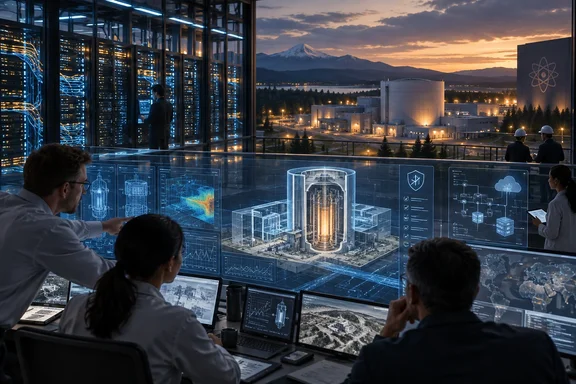
That distinction is important. The September 19 report describes the initial INL-Nvidia relationship as though it were newly announced. INL’s own record shows the partnership began seven months earlier; the material development since then is DOE’s selection of Prometheus as the first Phase II Genesis Mission project. DOE has framed the award as its largest initial nuclear investment under Genesis, an AI-for-science program meant to connect national-lab data, supercomputing, experimental facilities and commercial partners.
For Windows administrators, developers, and infrastructure teams watching the collision of AI demand and power availability, Prometheus is a concrete example of how GPU computing is being positioned upstream of the data-center electricity problem. It is not a reactor order, a construction approval, or a shortcut around nuclear licensing. It is a federally backed attempt to apply accelerated computing, simulation and agentic software workflows to the engineering and paperwork that slow nuclear projects long before concrete is poured.
From a Nvidia announcement to a DOE-funded program
INL originally said its Nvidia collaboration would accelerate the design, licensing, manufacturing, construction and operation of reactors through generative AI, digital twins and GPU-accelerated scientific codes. The plan explicitly named MOOSE, BISON, Griffin and Pronghorn, several of the laboratory’s established multiphysics and reactor-analysis codebases.
The DOE award expands that effort into a larger consortium. INL says Prometheus now includes Oak Ridge National Laboratory, Argonne National Laboratory, Sandia National Laboratories, academic partners and more than 20 companies, including X-energy, TerraPower and Oklo. X-energy separately identified Nvidia and Amazon Web Services as project leaders alongside INL, and said it would contribute its Xe-100 small modular reactor design and TRISO-X fuel data.
That partner list reveals what Prometheus actually is: a research and workflow-integration program, not a single Nvidia product deployment. Nvidia’s role centers on AI infrastructure and GPU acceleration. The national labs contribute reactor expertise, experimental facilities, code bases and decades of data. Reactor developers supply proprietary engineering problems and, in some cases, design data that can test whether AI-assisted workflows work outside a laboratory demonstration.
INL says the federal funding will support a three-year effort. The laboratory also reports more than $200 million in industry cost share and $30 million in industry capital. X-energy, however, describes more than $250 million in commercial commitments. Neither organization has published a complete partner-by-partner accounting that reconciles the figures, identifies what portion is cash versus in-kind computing or data access, or specifies how much Nvidia itself is committing.
That missing detail matters more than the headline number. A contribution of GPU capacity, model access or engineering time can be valuable, but it is not interchangeable with funds available to validate software against an operating reactor or prepare a licensing submission.
“Faster licensing” still means human review
Prometheus is aimed partly at nuclear licensing, a phrase that can easily be read as promising automated approval. The official material does not support that interpretation. Both INL and DOE describe human-in-the-loop workflows, and the Nuclear Regulatory Commission remains the authority that evaluates commercial reactor applications and safety cases.
The NRC’s current AI guidance is unusually direct on this point: it does not regulate AI as a standalone technology. Instead, it assesses AI-enabled tools when they are used in activities already under NRC jurisdiction. The agency has been studying whether its existing rules and guidance can accommodate AI and has identified areas where additional clarification may be needed.
Digital twins are the clearest example of the practical constraint. A reactor digital twin is not merely a 3D model or predictive dashboard. The NRC defines it as a digital representation synchronized with the physical plant closely enough to retain accurate awareness of the plant’s condition. If a model’s recommendation influences maintenance, safety analysis, diagnostics or control, its data quality, model assumptions, cybersecurity and human oversight become regulatory questions.
The NRC has researched digital-twin applications with INL and Oak Ridge, but it continues to evaluate the regulatory implications of more advanced implementations. Prometheus can potentially make licensing packages more searchable, traceable and internally consistent. It cannot erase the need for applicants to demonstrate that safety claims, design-basis assumptions and analytical results are valid.
For the project to create lasting value, its AI outputs will need to be reproducible and auditable. An AI system that drafts a licensing document quickly but cannot show which controlled records informed a claim would add a review problem rather than remove one. The same applies to AI-generated simulation surrogates: faster results are useful only when engineers can establish the uncertainty bounds and determine when the full physics model must still be run.
The first year is about proving where AI should not be used
Recent reporting by R&D World adds a useful reality check absent from the February announcement. Peter Suyderhoud, the INL principal investigator listed in DOE’s project-selection record, said the first year is intended to build the platform, test it and verify where AI agents provide a substantial advantage — and where they may cause harm.
That is the right order of operations for nuclear engineering. The attractive use cases are not necessarily autonomous reactor control. Many are closer to enterprise knowledge management and engineering productivity: extracting structured information from legacy records, tracking requirements across changing designs, identifying inconsistent assumptions, accelerating code execution, and helping specialists navigate a large body of controlled documentation.
Those tasks are technically difficult in a nuclear setting because the data is fragmented across decades, formats, classifications and ownership boundaries. A language model that summarizes a legacy calculation is not enough. Teams will need provenance for source documents, access controls for sensitive information, versioning for models and training data, and records that distinguish a machine suggestion from an approved engineering conclusion.
Prometheus does include more operational ambitions. INL has said it intends to evaluate on-premises Nvidia AI systems for real-time operations, while using DOE supercomputers for model training and large-scale simulations. The separation is sensible: central supercomputers can handle expensive training and calculation workloads, while plant-adjacent systems would need predictable availability, strict security controls and carefully limited roles.
The practical test is whether the consortium publishes validation methods rather than simply speed claims. DOE’s Genesis challenge sets an aspiration of at least a twofold schedule acceleration and more than 50% lower operating costs. Those are program goals, not demonstrated project results, and the agencies have not yet released a baseline schedule, a common cost methodology or early performance measurements for Prometheus.
MARVEL will be useful, but it is not ready this year
The submitted report identifies INL’s Microreactor Applications Research Validation and Evaluation project, or MARVEL, as a source of real-world data for validating digital twins. That role is plausible, but its schedule needs updating.
INL’s current MARVEL project page says final reactor assembly is expected in 2026, installation at the Transient Reactor Test Facility is planned for late 2026, and dry initial criticality is anticipated in 2027. The laboratory now expects transition to full-power operations in 2028, with process-heat demonstrations likely in 2029. The project page describes MARVEL as an 85-kilowatt-thermal sodium-potassium-cooled microreactor test bed.
In other words, Prometheus cannot rely on a fully operating MARVEL reactor for near-term validation during the first phase of the three-year award. It can use INL’s existing legacy data, non-nuclear test data, other operating facilities and simulation benchmarks, but MARVEL’s most valuable operating data will arrive on its own development schedule.
That does not diminish the project; it clarifies the timeline. Nuclear digital-twin work is strongest when it is continuously checked against instrumented physical systems. Prometheus can develop and test foundational workflows now, but a broader claim of real-time reactor validation should be measured against milestones beginning with MARVEL criticality in 2027 and full-power operation in 2028.
What IT and engineering teams should demand from Prometheus
The project’s early deliverables should be judged by evidence that the tools can be trusted in regulated engineering, rather than by the sophistication of the models or the number of GPU systems deployed.
- Prometheus should publish clear validation results showing which tasks improved in speed or quality, which tasks did not, and how expert human review changed the final result.
- Partners handling reactor, fuel or operational data should document provenance, access control, retention and model-isolation practices before connecting AI workflows to production-like systems.
- Any AI-assisted licensing workflow should preserve a reviewable trail from output back to controlled source material, assumptions, software versions and accountable engineers.
- GPU acceleration of MOOSE, BISON, Griffin and Pronghorn should be assessed on numerical agreement, reproducibility and portability as well as raw runtime reduction.
Nvidia’s involvement gives Prometheus substantial computing credibility, while DOE funding and laboratory participation give it a serious research base. The harder work is turning that combination into tools that nuclear engineers, utilities and regulators can independently inspect and trust.
The next meaningful milestone is not another partnership announcement. It is the first published evidence from Prometheus showing that an AI-assisted workflow can save time while preserving traceability, analytical rigor and human responsibility — the requirements that determine whether faster nuclear deployment is credible rather than merely computationally possible.
References
- INL teams with Nvidia in Prometheus project to accelerate nuclear deployment American Nuclear Society · 2026-09-19T01:42:11