

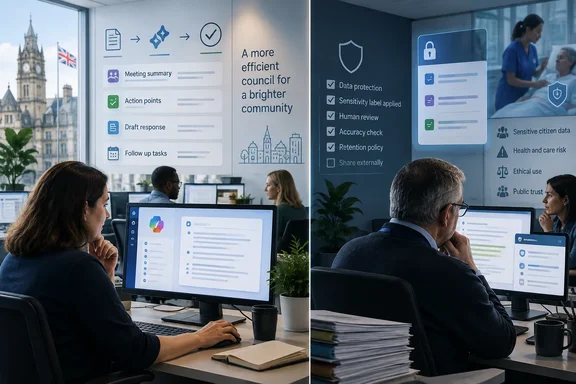
The useful development for IT administrators is not the broad claim that AI can save time. It is that Dorset has put several of the controls that public-sector Copilot deployments often lack into the record: approval requirements, human review, data-protection assessments, sensitivity controls and a policy covering AI embedded inside ordinary line-of-business systems as well as standalone chatbots.
Dorset’s own published material shows this is a multi-year programme rather than a sudden generative-AI rollout. Its 2024-25 Productivity Plan said the authority was experimenting with Microsoft AI tools to improve workforce productivity and with predictive modelling in customer-insight work. By 2025, an Audit and Governance Committee report recorded a data-protection impact assessment for Microsoft Copilot alongside AI communications mining and several health and care-related projects.
The missing piece is the one residents and finance teams will eventually need: Dorset has not published the number of Copilot licences, the departments using them, the cost, baseline administrative workloads or a council-wide estimate of hours saved. “Widely used” describes adoption, not evidence of a return on that investment.
Microsoft Copilot inherits the council’s data problems
Dorset told the Dorset Echo that Microsoft Copilot is secure because the council stays in control and information remains within the organisation. That is broadly consistent with Microsoft’s enterprise documentation: prompts, responses and grounded Microsoft 365 content are protected under commercial data-protection terms and are not used to train foundation models.
But that assurance has a condition which every Microsoft 365 administrator knows well: Copilot follows existing user permissions. It does not create a new permission boundary, and it does not repair years of loose SharePoint sites, stale Teams memberships, overly broad shared mailboxes or documents that were never assigned a sensitivity label.
Dorset’s 2025 governance report offers evidence that the council understands that dependency. It says it enabled data-loss prevention and email encryption tied to sensitivity labels in Microsoft Purview, while adding controls intended to identify outdated membership of shared inboxes. Those are mundane controls, but they are the foundation of a defensible Copilot deployment. If a staff member can already find a file through Microsoft 365, Copilot can potentially use that file while responding to a permitted prompt; if the authority has failed to control access, an AI assistant makes the discovery problem faster and easier to expose.
The council’s own AI policy is clearer on this point than the latest public comments. It applies not merely to tools branded as AI but to automation and algorithmic processing that may affect staff or residents. It warns of data breaches, biased source data, malicious manipulation and outdated information, and tells users to assess accuracy and sensitivity before use. That makes its framework more relevant than a generic promise to keep a human “in the loop.”
For Windows and Microsoft 365 administrators, Dorset’s approach points to the order of operations that matters: clean permissions, deploy Purview controls, complete a data-protection impact assessment, define what staff may submit, and audit use. Procuring Copilot licences before doing those jobs can expose material that already had weak access controls.
The Minute pilot has evidence, but it was still an alpha test
The most concrete Dorset AI project is Minute, the government-built meeting transcription and summarisation tool trialled by the council in 2025. Dorset Council said at the time that it was one of 25 local authorities selected for the pilot, run through the Government Digital Service’s Incubator for AI.
The Local Government Association’s subsequent review adds context missing from the broad efficiency claims. It says the pilot began with 25 councils selected from 52 applicants, but 22 remained active through the programme. More than 400 users tested Minute across those 22 councils, using it in areas including adult social care, children’s services, planning, finance, procurement, HR and democratic services.
Some reported major savings in note-taking and meeting recaps. The LGA says one council estimated a reduction of up to 90% in recap time, depending on meeting type, while other users reported that Minute halved the time spent taking notes. Dorset’s regional Innovation Hub newsletter reported its own encouraging result: nearly half of meetings in its pilot saved more than an hour of administrative time.
Those results are promising, but they should not be treated as a settled business case. Minute was an alpha-stage service, supplied free during the pilot, and the LGA found that councils still invested substantial staff time in assurance, onboarding, training, evaluation and feedback. Technical incompatibilities, VPN restrictions, lack of single sign-on, digital fatigue and uncertainty over long-term cost were among the reasons some authorities had not participated or struggled with adoption.
The LGA also found that 64% of participating councils rated workforce capability as at least a moderate barrier. The lesson is straightforward: an AI transcription tool can reduce the labour of writing minutes, but it does not remove the need to validate a record, handle consent, manage recordings, correct names and actions, or train staff to recognise a plausible but wrong summary.
Dorset’s current description of meeting transcription is therefore best read as a continuation of an evaluated pilot, not an announcement that AI-generated minutes have become authoritative council records.
Health and care proposals raise the stakes
Dorset’s most consequential disclosed area of interest is early health and care planning, where it says staff must synthesise large quantities of data in highly pressured services. That is precisely the sort of workflow where better retrieval and summarisation can help officers see the relevant history sooner. It is also where an inaccurate, incomplete or improperly shared summary has more serious consequences than a poorly drafted meeting note.
The council has not named the proposed AI tool, said whether it would be generative AI, identified the datasets involved, or explained whether the system would support professional judgement or make recommendations that could materially affect service users. It has not published a timetable, procurement path, impact assessment or an evaluation plan for this work.
Those gaps are important, rather than incidental. Dorset’s AI policy requires systems that directly or indirectly affect customers to be transparent and explainable, and it directs staff toward the government’s Algorithmic Transparency Recording Standard. If a health and care project progresses beyond internal exploration, the council should publish enough information for residents to understand the tool’s purpose, inputs, human decision-maker, error controls and appeal route.
Its existing governance process provides an avenue to do that. The council’s governance report says its Operational Information Governance Group received, challenged and approved 12 data-protection impact assessments during 2024-25. That is a stronger safeguard than allowing individual teams to adopt consumer AI tools on their own, but an approved internal assessment is not a substitute for public transparency where a system shapes frontline public services.
“Human in the loop” needs an operational definition
Dorset’s spokesperson told the Dorset Echo that every tool is assessed and approved, with people kept in the loop to guide decisions. That is the correct principle, but it is not itself an operating model.
For a document summary, meaningful review means the officer checks the source record before relying on the output, especially where the summary omits uncertainty or compresses conflicting evidence. For a committee-minute tool, it means a responsible officer remains accountable for the approved minutes. For Microsoft Copilot, it means staff understand that an answer can be fluent and still be wrong, and that its citations or links must be checked against the underlying files.
For a health or care workflow, the standard must be higher. Dorset will need to define who reviews an AI-generated assessment, when the original case record must be consulted, how staff record corrections, how errors are escalated and how a service user can challenge a decision influenced by automated processing. A general instruction to use AI responsibly cannot answer those questions after a disputed outcome.
Dorset’s published policy already acknowledges hallucinations, bias and the risk of redundant data. The practical test is whether those risks are built into configuration, training, audit records and service design rather than left as warnings in a policy document.
The next disclosure should be a scorecard, not another promise
Dorset Council has shown more governance maturity than many organisations that describe Copilot or AI assistants as an instant productivity fix. Its Microsoft Purview work, approval process, data-protection assessments and participation in the Minute pilot show that it has treated AI as an enterprise information-governance issue.
What it has not yet shown is whether the programme is delivering enough value to justify wider deployment. The authority should publish a basic scorecard for its principal AI uses: service area, tool, number of users, data category, accountable owner, human-review point, measured time saved, quality measure, error or correction rate, licensing and operating cost, and whether the system affects residents.
Until then, Dorset’s AI programme is credible as a controlled experiment in public-sector productivity. It is not yet proof that a more efficient workforce has been built.
References
- AI 'helping to build a more efficient workforce' at Dorset Council Dorset Echo · 2026-09-19T02:08:00+00:00