

The claim comes from a long personal essay titled "Why I Left a Future at EVGA." It adds an inside view to the story of EVGA leaving the graphics card business in 2022. It is also one person's memory and interpretation. NVIDIA has not confirmed it, and no contract language has been published.
What Hedrick actually claims
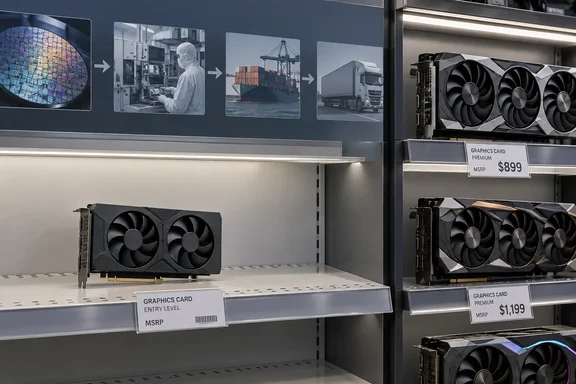
His wording is careful, and it matters. In Hedrick's words: "As I understood the arrangement, we were required to offer a model at NVIDIA's advertised starting price. If we did not, NVIDIA could reduce our allocation of GPUs, and it could be difficult to tell whether a reduction was a response to our pricing." He says the result was that EVGA needed to keep a loss leader—a card sold at a loss—to keep NVIDIA happy and protect its access to the chips.
Three details stand out:
- Uncertainty was part of the pressure. Hedrick doesn't describe a written rule that was openly enforced. He describes a perceived risk. If EVGA's allocation dropped, the company couldn't be sure whether pricing was the reason. That kind of ambiguity pushes a dependent partner toward caution.
- The cheap cards were hard to buy. Hedrick says these lower-priced cards were almost continuously sold out.
- The premium cards covered the losses. In his account, the models that did not lose money had EVGA's own better circuit boards and cooling, but carried a substantial premium, so to a customer comparing them with the advertised starting price, it could look as though EVGA was charging an enormous amount just for those additions. He sums it up this way: "The loss leader set the expectation; the cards with room for us to make money had to justify the gap."
TechPowerUp, which covered the essay, reads it as meaning that EVGA had to price the more premium cards even higher than the BOM, development, and logistics costs would otherwise require. That is TechPowerUp's interpretation, not a figure from EVGA's books.
Section summary: Hedrick says a required entry-price card protected EVGA's GPU supply, and more expensive custom cards had to make up the loss. He presents this as how he understood the arrangement, not as a documented policy.
Founders Edition: a supplier that was also a competitor
The second part of the account concerns NVIDIA's own branded cards. "When NVIDIA introduced the Pascal Founders Edition cards in 2016, I remember people at EVGA worrying about what that meant for us. We were used to selling NVIDIA's reference designs with our name on them."
Hedrick is careful about the history here too. He writes that NVIDIA had sold its own cards before, so Pascal was not the start of NVIDIA selling cards directly. For him, it was the point at which the conflict became obvious: the company that supplied EVGA's GPUs was also marketing finished cards straight to EVGA's customers.
He also gives launch-price context. According to his account, the announced entry price rose from 599 US dollars for the GTX 1080 to 699 US dollars for the RTX 2080, and the corresponding Founders Editions increased from 699 to 799 US dollars.
The essay includes other recollections from launch preparation. Hedrick says partners received GTX and RTX specifications at the same moment the public did. He also says NVIDIA took leaks very seriously. According to him, EVGA sent each online retailer a set of product images marked with a different colored dot in one corner, so a leaked image could be traced back to the retailer that received it. No one else has confirmed these details.
Why custom cards became harder to sell
Hedrick's broader argument is that the price premium on custom cards was getting harder to justify, apart from any pricing pressure. Over successive generations, he watched NVIDIA refine its reference board designs and the way its GPUs managed their clock speeds; technologies such as GPU Boost automatically adjusted clocks within power and temperature limits, and from where he sat, extra spending on custom circuitry and cooling was no longer buying the kind of everyday performance advantage that overclocking had once made possible.
This matches what PC builders have seen for years. Modern boost algorithms already push each chip close to its limits, so a more expensive board partner card usually runs somewhat cooler and quieter, with a slightly higher factory clock. It rarely turns a GPU into a different performance class. That's general industry knowledge, and it explains Hedrick's complaint: expensive engineering was producing gains many buyers couldn't see in their games.
He also describes the RTX 20-series launch as weak commercially. Ray tracing arrived before most games supported it, and demand felt softer than expected. EVGA was also stuck with aging GTX 1060 3 GB stock after mining demand collapsed.
Section summary: Hedrick argues that the custom cards EVGA made money on were losing their practical advantage while their price gap to the advertised starting price stayed large.
How this fits with EVGA's 2022 exit
Hedrick left almost three years before EVGA ended its GPU business. His firsthand account covers Pascal and the first RTX generation, not the final negotiations. The later public record does match his themes, though, and it is worth keeping the two separate.
In September 2022, PCWorld reported on GamersNexus's interviews with EVGA leadership, which EVGA later confirmed on its own forum. EVGA said NVIDIA gave it product information too late and didn't disclose chip prices until NVIDIA announced the MSRP of its own cards. EVGA also said NVIDIA set price floors and ceilings for partners, and that Founders Edition cards undercut partner cards. EVGA also said the market downturn was causing losses of "hundreds of dollars per video card" on high-end designs.
Hedrick himself says those later losses are a different issue from his loss leaders. Steve Burke's reporting, which Hedrick cites, said lower-tier cards such as the RTX 3060 were still profitable in 2022. The heavy losses were on RTX 3080 through RTX 3090 Ti cards. So the 2022 complaints support the general picture of tight pricing and direct competition from NVIDIA. They don't independently confirm Hedrick's specific claim that EVGA kept a loss leader to protect its allocation.
Ars Technica's coverage at the time added more nuance. EVGA CEO Andrew Han described the split as a matter of "principle" rather than money. Analyst Jon Peddie noted that board partner margins had been shrinking while GPU costs rose. Higher power, cooling and signaling requirements were also making high-end cards more expensive to build. The cost of goods, manufacturing, and marketing for EVGA and presumably other AIB partners went up, Peddie wrote in Electronic Design. NVIDIA's public comment at the time was polite: it thanked EVGA for a great partnership and wished Han well.
The dates are clear. EVGA's break with NVIDIA became public on September 16, 2022, four days before NVIDIA announced the RTX 40 series. EVGA said it would sell its remaining inventory and keep stock for warranty repairs.
How much weight to give the account
A few cautions are worth keeping in mind:
- It is one person's view. Hedrick worked in support, video production, product marketing and sales. He was not in EVGA's executive negotiations with NVIDIA.
- He doesn't claim to know NVIDIA's intent. He says he can't tell whether NVIDIA meant to squeeze partners out. His claim is only that the room EVGA had to operate in kept shrinking.
- Entry-price rules are common. PCWorld noted in 2022 that price floors and ceilings are a common practice in electronics, meant to protect how a product's value is perceived. The difference Hedrick describes is that the entry-price requirement was tied, in his understanding, to how many GPUs EVGA received.
- Some of it is memory from years ago. He is describing events from 2016 to 2019, written down in 2026.
Even so, the account is consistent with what EVGA's leadership said publicly in 2022. It also explains something buyers have seen at many GPU launches: a cheap entry model that is almost always sold out, surrounded by partner cards that cost much more.
What this means for GPU buyers
Hedrick's account suggests the advertised starting price at a launch can work mostly as a reference point, not a price most buyers will actually pay. Some practical points, based on general industry knowledge:
- Treat the launch MSRP as an anchor. If entry-price models are supplied in small numbers, the price you'll realistically pay is often the next tier up.
- Ask what the premium buys. Better cooling, quieter fans and stronger power delivery are real benefits. With automatic boost behavior, though, the gain in frame rates is often small. Compare noise and temperature reviews, not just factory clock speeds.
- Don't assume a partner is gouging you. Hedrick's account suggests part of a custom card's premium may cover the costs of the cheap model, not just the added hardware.
- Skipping a generation is a real option. Hedrick notes that buyers can wait a generation, while a board partner that did the same could be financially ruined.
The GPU business still depends on relationships between NVIDIA and its board partners. Hedrick's essay is a rare look at that relationship from inside one of the best-known partners, from someone careful to say where his knowledge ends.
References
- Former EVGA manager says NVIDIA pricing rules forced some GeForce cards to be sold at a loss - VideoCardz.com VideoCardz.com · 2026-09-29T07:55:53+00:00
- Former EVGA Product Manager Recounts NVIDIA FE Squeeze and Leaker Witch Hunts | TechPowerUp techpowerup.com
- Report: EVGA is ditching graphics cards completely | PCWorld pcworld.com