

For IT administrators, the immediate operational lesson is straightforward: this is a disruption of an attack marketplace, not evidence that the DDoS capacity it drew on has disappeared. NightmareStresser’s users could previously select targets and launch Layer 4 TCP or UDP floods and Layer 7 application attacks through a browser panel, according to 2023 research from Searchlight Cyber. A seized domain can interrupt payments, customer access, and command workflows; it does not necessarily mean every botnet, rented server, reseller account, or copied interface behind a service has been dismantled.
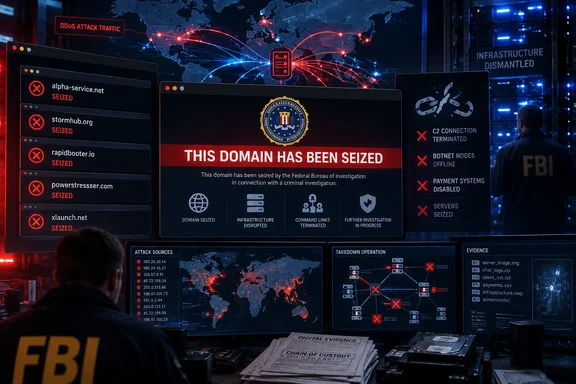
BleepingComputer first reported that visitors to NightmareStresser’s domains now see an FBI seizure banner. The Department of Justice confirms the court-authorized domain seizures and says they are part of Operation PowerOFF, the multinational effort against so-called booter and stresser services.
What the FBI seized — and what it did not disclose
The Justice Department’s September 15 announcement is specific on one point: it seized internet domains associated with NightmareStresser. It is notably less specific on several others. The release does not name the domains, identify the operators, announce arrests, describe server seizures, or say whether investigators obtained customer records, payment information, attack logs, or backend control infrastructure.
That omission matters. In cybercrime takedowns, a domain seizure can be either a narrow interruption or the visible end of a much deeper operation. The public record so far supports the former description: authorities have taken control of the service’s web addresses and disrupted infrastructure used to facilitate attacks. It does not establish that the people running NightmareStresser have been arrested or that the devices used to generate attack traffic have been neutralized.
The Record reported that the Justice Department declined to say whether the operation involved arrests. That is an important difference from several earlier Operation PowerOFF waves, which paired site seizures with named criminal charges, searches, arrests, or user-identification campaigns.
The FBI and DOJ are also treating the platform as an alleged criminal attack service rather than accepting the familiar “network stress-testing” label. The FBI’s public guidance says booter and stresser services have no legitimate use when they enable customers to overwhelm targets they do not own or control. The point is practical as well as legal: these services lower the skill threshold for disrupting a school portal, game server, small business, remote-access gateway, or public-sector site.
The 566,000-user figure is old intelligence, not a new FBI finding
Some coverage has repeated striking statistics that NightmareStresser had more than 566,000 registered users, 52 servers, 28 attack methods, and a maximum apparent capacity of 200 Gbps. Those figures trace back to Searchlight Cyber’s November 2023 analysis of the platform, not to the FBI’s 2026 seizure announcement.
Searchlight Cyber described a service that had been active since at least 2020 and sold tiers ranging from €25 to €19,999. Its researchers observed a panel offering targets by IP address or URL, port selection, concurrent-attack controls, and categories for UDP, TCP, and application-layer attacks. The firm characterized 200 Gbps as an apparent maximum rather than an independently verified, sustained attack capability.
That distinction should temper how readers interpret the numbers. A registered-user count is not an attack count, and an advertised server total is not proof that all systems were online, under the operator’s control, or available simultaneously. But the design Searchlight Cyber documented is enough to explain why a single web service can cause broad harm: it packaged DDoS capabilities into a subscription product usable by people who could not build or operate botnets themselves.
The DOJ’s current claim rests on a different record: the seizure-warrant affidavit. It says NightmareStresser was used for hundreds of thousands of attacks or attempted attacks since 2022. Federal authorities have not published the affidavit’s underlying methodology, victim list, or breakdown between completed attacks and attempts, so that figure should be understood as an investigative assertion cited by prosecutors, rather than a public measurement set available for independent review.
The 2022 case explains why this seizure is not a clean ending
NightmareStresser has been in the government’s sights before. On December 14, 2022, the Justice Department announced the seizure of 48 booter-service domains, one of which was nightmare-stresser.com. That broader Operation PowerOFF action also brought charges against six defendants.
But the record does not show that those six people were charged as NightmareStresser’s operators. The 2022 DOJ release tied the defendants to other named services, including RoyalStresser, SecurityTeam, Astrostress, Booter.sx, IPStresser, and TrueSecurityServices. The agency’s announcement listed NightmareStresser among seized domains, but did not identify it as one of the six defendants’ platforms.
That is more than a historical footnote. The platform’s reappearance through other domains after the 2022 action illustrates the basic limitation of domain-focused disruption. A service can move to a new top-level domain, change hosting providers, use a new payment channel, rebuild its front end, or operate through private channels. The September 2026 action may therefore prove more consequential if investigators also reached the service’s accounts, operators, data, or supplier relationships — details the DOJ has not yet disclosed.
The 2022 action did show that law enforcement can test and document these services instead of merely relying on advertising claims. DOJ said the FBI posed as a customer and conducted test attacks against the booter platforms charged in that case. No equivalent technical detail has yet been released about the latest NightmareStresser seizure.
Operation PowerOFF has become a campaign against both operators and customers
The NightmareStresser action sits inside Operation PowerOFF, a continuing international campaign that Europol describes as targeting DDoS-for-hire infrastructure. The program began with coordinated seizures in late 2018 and has continued through subsequent waves involving European and North American authorities.
The Alaska U.S. Attorney’s Office says prosecutors and investigators in Alaska and Los Angeles have charged 12 defendants and seized more than 100 DDoS-for-hire domains over the past eight years. Recent operations have also expanded beyond administrators. The Record reported that an April 2026 operation involving more than 20 countries resulted in four arrests, 25 searches, more than 50 domain seizures, and identification of roughly 75,000 users of DDoS-for-hire services.
That broader focus is deliberate. Taking down one service can temporarily suppress available capacity and create distrust among customers. Identifying users, payment flows, hosting arrangements, and reseller networks raises the cost of returning under another name. It also puts people who treat a “booter” subscription as a low-risk prank on notice that a customer account may become evidence.
For defenders, however, a law-enforcement seizure is not a reason to downgrade DDoS preparation. The service’s disruption can scatter customers to competing platforms, which may briefly make attack attribution and intelligence tracking harder rather than easier.
What Windows and enterprise administrators should check now
DDoS attacks are often discussed as a problem for enormous consumer websites, but the exposure is much wider. Windows-based workloads can be affected when public-facing IIS applications, VPN portals, Remote Desktop gateways, DNS infrastructure, game servers, voice services, or cloud-hosted applications are saturated upstream. A firewall can be working exactly as designed and still be unable to help if the internet link is exhausted before traffic reaches it.
Administrators should use the NightmareStresser case as a prompt to verify whether their response plan accounts for both volumetric and application-layer attacks:
- Confirm which public hostnames, IP addresses, VPN endpoints, DNS providers, and cloud regions are covered by a DDoS mitigation service or by an upstream carrier agreement.
- Verify that the organization has current escalation contacts for its ISP, cloud provider, CDN, managed security provider, and domain registrar, including an after-hours path that does not depend on the affected network.
- Review web-server, reverse-proxy, firewall, and CDN logs for baseline request rates and geographic patterns so incident responders can distinguish normal demand from an application-layer flood.
- Test whether remote administration and incident communications will still work when the primary website, public VPN, or voice platform is unavailable.
- Preserve relevant logs and timestamps during an attack, because DDoS-for-hire investigations depend on victim telemetry, provider records, and evidence of targeting.
The seizure banner on NightmareStresser’s former domains is a visible win for Operation PowerOFF. The more important measure will be whether the disruption produces operator cases, usable intelligence for victims, or follow-on seizures that cut into the infrastructure and financial arrangements needed to relaunch under the next name.
References
- US takes down NightmareStresser DDoS-for-hire platform BleepingComputer · 2026-09-17T07:33:35-04:00