

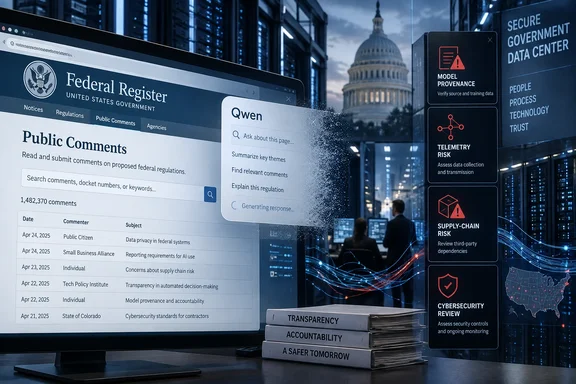
Those unanswered questions are central because the FBI, NSA, and CISA had issued a joint cybersecurity advisory only eight days earlier naming Alibaba among six China-based companies alleged to have conducted industrial-scale distillation of U.S. frontier models. The advisory specifically says Alibaba used that activity to improve the Qwen family. Alibaba and China’s government have disputed the allegations, with China calling the broader U.S. claims groundless.
For federal IT teams, the episode is a reminder that an “open-weight” model is not automatically a low-risk or domestically controlled deployment. The distinction is whether the model ran inside a government-controlled environment, whether any visitor queries or telemetry reached Alibaba-controlled infrastructure, and whether the agency could account for the specific artifacts it put into production.
A federal search feature vanished before its architecture was explained
Reuters reported that the Qwen option appeared alongside other ways to browse public comments on the Federal Register, the official daily publication for proposed rules, final rules, notices, and other federal documents. It was removed around the time social-media posts drew attention to it. The National Archives, which administers the site, did not provide a public technical explanation before the report was published; neither did the White House or FBI.
That absence leaves the material facts unestablished. “Using Qwen” can describe several dramatically different designs: a fully self-hosted model whose weights were downloaded and run on an agency or contractor’s servers; a managed cloud API; a third-party search vendor calling a remote service; or a retrieval system that sends document excerpts and user prompts to an external inference endpoint.
Those designs have different consequences. A locally hosted open-weight model can keep prompts, retrieved documents, and operational logs inside a defined boundary—subject to the ordinary risks of the hosting environment and the software supply chain. A remote API arrangement can expose prompts, metadata, IP addresses, usage patterns, or document fragments to another operator, depending on the contract and configuration. The National Archives has not said which arrangement applied.
Reuters quoted Georgetown law professor Anupam Chander saying the Federal Register use did not appear to create an immediate cybersecurity risk, because the material being searched was public. That is a sensible assessment of the content involved. Public comments on proposed regulations are not a store of classified or ordinarily sensitive agency records.
But “the corpus was public” is not a complete security review. Even a public-facing search system produces operational data: search terms, timestamps, browser and network metadata, rate patterns, user-agent strings, error reports, and service logs. A government agency needs to be able to state whether any of that information crossed into an Alibaba-operated system, a cloud provider, or a subcontractor’s infrastructure. It has not done so.
The FBI advisory makes Qwen a policy issue, not proof of a breach
The September 8 joint advisory from the FBI, NSA, and CISA makes unusually direct allegations. It says China-based AI companies, including Alibaba, extracted billions of tokens across millions of requests from U.S. models since at least late 2024, using mechanisms such as API access, cloud providers, aggregators, proxy services, account pools, and techniques intended to evade provider controls. The agencies characterize that activity as malicious and say Alibaba used industrial-scale distillation to develop its Qwen models.
The advisory is an allegation by U.S. national-security and law-enforcement agencies, not a finding that the Federal Register site was compromised or that the Qwen search tool transmitted federal data to China. Conflating those points would overstate what the public record establishes. The available reporting does not identify malware, unauthorized access, or a data exfiltration event connected to the Federal Register deployment.
It does, however, create an obvious governance contradiction. The same federal government that warned AI developers about allegedly unauthorized extraction of proprietary U.S. model capabilities had an independent federal agency expose visitors to a search option branded around one of the model families named in that warning.
The contradiction is sharper because the advisory asks U.S. AI companies to increase detection of anomalous usage, watch for account and network patterns, make targeted response changes, and share intelligence across model providers and cloud platforms. Those are supplier-risk concerns. A federal agency adopting a model from a vendor named in the advisory should have documentation ready to show how it assessed the model, its provenance, its deployment location, vendor access, logging, update process, and exit plan.
There is no public indication that the National Archives failed to conduct such a review. The problem is that it has not shown one. Pulling the feature may have limited the immediate political fallout, but it does not answer whether the deployment was reviewed before it reached a public federal website.
“Open-weight” does not answer the question administrators need answered
Reuters correctly described Qwen as an open-weight model family, meaning developers can obtain major components and adapt them for their own use. That property can be valuable to enterprises and public agencies: it permits local inference, enables stronger control of data handling, and can reduce dependence on an external model API.
It can also lead to a dangerously incomplete conversation. Downloadable weights do not eliminate the security and compliance work. Administrators still need to know where the package came from, which repository and cryptographic hashes were used, whether the model files and serving stack were scanned and approved, how vulnerabilities are patched, who can alter prompts and retrieval settings, and which third-party libraries enter the production image.
For public deployments, the inference service is only one component. A regulation-comment search feature may include a web application, identity and rate-limiting services, a document ingestion process, vector embeddings, a vector database, retrieval logic, a prompt template, model serving software, analytics, observability tooling, content moderation, and a fallback search path. Any one of those components can create its own data-sharing or supply-chain question.
The deployment model also determines whether a vendor relationship is even involved at runtime. A self-hosted Qwen instance could make no connection to Alibaba after the model’s acquisition. A service marketed as Qwen search could instead place an Alibaba or intermediary endpoint directly in the request path. Without a technical architecture, a data-flow diagram, and a list of sub-processors, the public cannot distinguish between those possibilities.
That is why Senator Mark Warner’s point to Reuters is more useful than blanket declarations that a Chinese model is inherently unsafe or harmless. The deciding question is whether U.S. data left the government security boundary and was processed by Alibaba-controlled systems. In this case, the National Archives has not publicly answered it.
Federal AI procurement needs an inventory before it needs another slogan
The immediate operational lesson is straightforward: agencies should be able to produce a machine-readable inventory of every production AI service, model family, version, hosting location, supplier, and permitted data classification. A public agency should not have to reconstruct those facts after an online screenshot forces the issue.
For Windows and enterprise administrators, the same standard applies to internal copilots and local-model pilots. “Runs locally” should be verified rather than taken from a product page. Confirm that inference endpoints resolve only to approved hosts, inspect outbound network rules, identify telemetry destinations, retain software bills of materials for the serving stack, and record the exact model-weight revision and hash deployed to each environment.
A sensible control set for externally visible AI search services includes:
- The organization should publish or internally retain an architecture diagram showing every inference, logging, analytics, retrieval, and moderation destination.
- The production approval record should identify the model release, its source repository, integrity checks, license terms, hosting region, and process for revoking or replacing the model.
- Network controls should deny unapproved egress from inference and retrieval infrastructure, rather than relying solely on a vendor assurance that data remains local.
- Logs should distinguish user content from diagnostic metadata and specify retention, access controls, and whether either category is exported to a supplier.
- A rollback path should preserve conventional keyword search so that withdrawing an AI feature does not impair access to public records.
These are mundane controls, but their absence becomes visible only after an agency has to remove a feature under scrutiny. The Federal Register incident did not reveal a confirmed breach. It revealed something nearly as uncomfortable for public-sector technology governance: a federal service adopted a politically and security-sensitive AI brand without leaving the public enough information to determine what, precisely, had been deployed.
The removal settles only the public-facing part
As of Friday, September 18, the Qwen search option is gone from the Federal Register site, according to Reuters’ reporting on the September 16 removal. What remains unresolved is more important than the feature itself: when it was introduced, who supplied the integration, whether it was self-hosted or remote, whether any data or telemetry crossed the agency boundary, and whether the National Archives has reviewed other AI components used on its public services.
The agency can close this episode quickly by publishing those technical facts and its review process. Until then, the strongest conclusion supported by the record is narrow but significant: a federal website briefly used Alibaba’s Qwen in a public search feature while federal security agencies were publicly accusing Alibaba of malicious model distillation, and the agency has not explained the deployment architecture that would determine the real security and privacy implications.
References
- US government website used Chinese model the FBI called "malicious" Ars Technica · 2026-09-18T17:28:50+00:00