

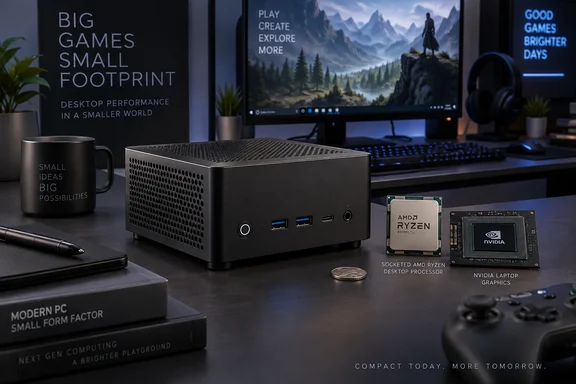
FEVM FA80G Puts a Desktop Ryzen 9 9950X3D and RTX 5090 Laptop GPU in 2.6 Liters
FEVM launched two mini PCs at the same time. The FA80G uses AMD and the FN80G uses Intel. The Chinese outlet IT Home reported on September 3, 2026 that both machines had officially gone on sale, and that every price it listed was for a bare-bones unit without RAM or SSD. The chassis measures 180 × 168 × 88 mm, giving it a volume of around 2.6 liters. The computer can be installed horizontally or vertically.
What sets the FA80G apart is that it uses a desktop processor. The FA80G switches to AMD's AM5 platform. Available CPUs include the Ryzen 7 9700X, Ryzen 7 7800X3D, Ryzen 7 9800X3D and Ryzen 9 9950X3D. These desktop CPUs are socketed instead of soldered mobile chips. Most mini PCs use laptop silicon soldered to the board, so a socketed AM5 chip is a real difference in how this machine is built.
The FA80G comes in seven configurations. IT Home lists them from a Ryzen 7 9700X with an RTX 5060 8GB at ¥7,599, through Ryzen 7 7800X3D and 9800X3D versions paired with the RTX 5080 Laptop GPU (16GB), up to a 9800X3D with the RTX 5090 Laptop GPU at ¥20,399. The flagship Ryzen 9 9950X3D and RTX 5090 Laptop GPU model tops the range. Notebookcheck describes it as a direct follow-up to the FA65G. FEVM has done this before: it has been building compact systems around desktop processors and mobile GPUs for several generations, and before that it released the FAEX1, a mini PC built around AMD's Ryzen AI Max 395 chip, better known by its Strix Halo codename, fitted into a one-litre enclosure.
The Ryzen 9 9950X3D is AMD's 16-core, 32-thread desktop flagship. It boosts to 5.7GHz and carries 144MB of combined cache thanks to AMD's 3D V-Cache stacking, which is why AMD aims the X3D line at gamers.
The RTX 5090 in the FA80G Is Nvidia's 150W Laptop Chip
The name causes the most confusion, so it is worth being precise. The FA80G uses the GeForce RTX 5090 Laptop GPU. Nvidia specifies it with 10,496 CUDA cores, 24GB of GDDR7 and 896GB/s of memory bandwidth, and lets manufacturers set its power anywhere from 95W to 150W. The desktop GeForce RTX 5090 has 21,760 CUDA cores and 32GB of GDDR7, and Nvidia rates it at 575W of total graphics power. The two chips share a number but belong to different power classes.
FEVM runs the laptop chip at the top of its allowed range. The RTX 5090 configuration operates at up to 150W, while FEVM claims up to 250W combined CPU and GPU power. IT Home describes this as "full-blooded" 150W operation. That matters because laptops using the same GPU often ship with lower power limits, so the FA80G should sit toward the high end of RTX 5090 Laptop performance. That last point is an inference from the power figures; nobody has measured it.
The mobile chip is also a useful gaming part in its own right. The FPS Review notes that with 24GB of VRAM vs the 16GB found in the RTX 5080, and using the same GPU but with lower clock rates and power draw, the RTX 5090 mobile has proven itself an apt gaming GPU for both 1440p and up to 4K. The whole RTX 50 generation supports DLSS 4 with Multi Frame Generation, ray reconstruction and hardware ray tracing. On Windows, those features are what most modern AAA games are tuned for.
A 90W Cap Changes What the Ryzen 9 9950X3D Delivers Inside the FA80G
The CPU also runs below its normal specification, which reviews of the chip elsewhere will not show. FEVM lists up to 90W CPU power and up to 150W GPU power for the AMD system. AMD's default TDP for the Ryzen 9 9950X3D is 170W. Inside the FA80G the chip gets a little over half of its standard power budget.
For gaming this matters less than it sounds, because games rarely keep all 16 cores fully busy, and the chip's large cache helps regardless of power. Heavy multithreaded work is a different story. Code compilation, rendering and video encoding push every core, and a 90W limit will cost performance there compared with a normally powered tower. That is a general inference from how power limits behave; nobody has benchmarked the FA80G at 90W. Any Ryzen 9 9950X3D benchmark you find should be assumed to come from a desktop running at full power, not from this box.
The lineup also raises a buying question. IT Home's list shows a Ryzen 7 9800X3D with the same RTX 5090 Laptop GPU for ¥20,399, about ¥1,800 less than the flagship. The 9800X3D has eight cores and also uses 3D V-Cache. For a machine bought mainly for games, the extra eight cores of the 9950X3D, limited to 90W, may add little to frame rates. If you also compile or render, the added cores could still be worth paying for.
FEVM's Cooling, Memory and Port Claims for the FA80G
FEVM splits the cooling between the two main chips. The company uses separate four-heatpipe cooling assemblies for the CPU and GPU, for eight heatpipes in total. The company claims full-load noise of 42 dB, with the CPU remaining below 85°C and the GPU below 80°C. Every outlet covering the launch repeats these numbers, but they all come from FEVM. No independent lab has checked noise or temperatures, and nobody has tested whether the chips hold their power limits during long gaming sessions. That question decides whether a 2.6-liter box like this is good or merely interesting. As one write-up puts it, any cooling shortfall shows up quickly as thermal throttling.
Memory and storage use standard parts, which you will have to buy anyway given the bare-bones pricing. Both systems support up to 128GB of DDR5 memory through two SO-DIMM slots and provide two M.2 2280 NVMe slots with official support for up to 4TB per drive. There is also an M.2 2230 slot for wireless connectivity. SO-DIMM is the laptop-size memory module, so desktop DIMMs from an old tower will not fit.
FEVM's two models differ in their networking. The FN80G includes Thunderbolt 4, 10GbE and 2.5GbE networking, while the FA80G uses dual 2.5GbE instead. FEVM also equips the systems with HDMI 2.0, HDMI 2.1, two DisplayPort 2.0 outputs, USB-C, USB-A, an SD card reader and audio connectivity. IT Home's more detailed description of the Intel model mentions Thunderbolt 4 at 40Gbps, a rear USB-C port carrying the discrete GPU's signal, and support for up to six 4K displays. Those details are documented for the FN80G. Do not assume the AMD FA80G has Thunderbolt or 10GbE.
Three Prices for One FA80G Flagship
Reports disagree on what the top model costs. IT Home lists the Ryzen 9 9950X3D and RTX 5090 Laptop GPU configuration at ¥22,199. TechRadar gives ¥22,299, about $3,300. Notebookcheck reports that the top-end option with Ryzen 9 9950X3D and RTX 5090 is going for CNY 24,199, about $3,605. Technetbook's figure matches Notebookcheck's, but its coverage looks derived from the same report, so it does not confirm the number independently. XiaomiToday's roughly $3,310 is closer to IT Home. The ¥2,000 gap could reflect a price change or a different listing. Whichever figure is right, every source agrees the price excludes RAM and SSD.
The entry price is consistent across reports. Notebookcheck says the barebone configuration with Ryzen 7 9700X and RTX 5060 costs around CNY 7,599, around $1,132, which matches IT Home.
Availability is limited to China for now. FEVM has not yet announced global availability for the FA80G or FN80G, so they are currently only available in China. XiaomiToday adds that international pricing has not been announced, and the final cost is expected to be higher if these mini PCs launch in other markets. The dollar figures you see are currency conversions, not US retail prices.
The M5 Ultra Mac Studio Comparison Compares Platforms, Not Benchmarks
The claim that the FA80G "should beat" Apple's M5 Ultra Mac Studio in gaming is based on comparing platforms, not on measured frame rates. Apple announced the M5 Ultra Mac Studio on August 25, 2026, and availability began September 22. Apple's top configuration has a 36-core CPU, an 80-core GPU, up to 512GB of unified memory and 1.2TB/s of memory bandwidth, along with hardware ray tracing, Neural Accelerators and a 32-core Neural Engine. Apple aims it at professional graphics, video and on-device AI work.
Those numbers cannot be compared directly with the FA80G's. GPU core counts mean different things across Apple and Nvidia architectures. The Mac's unified memory is one pool shared by CPU and GPU, while the FA80G's 24GB of GDDR7 is dedicated graphics memory. Neither spec sheet tells you which machine runs a given game faster. No one has published matched testing with the same game, resolution and settings on both machines.
The argument that does hold up is about the gaming platform. The FA80G uses the standard Windows gaming setup: an AMD desktop CPU, an Nvidia GPU, and Nvidia's DLSS 4 and frame generation stack, which is what most PC games target. Mac gaming runs on Apple's Metal graphics API with MetalFX upscaling. Apple's Game Porting Toolkit helps developers bring Windows games to macOS, but whether a game is available and how well it runs depends on each title. A Windows gamer is far more likely to find their library running natively on the FA80G. That is a real advantage, and it is about compatibility, not proof of higher frame rates.
The comparison also works the other way. For large AI models, huge memory footprints and professional video pipelines, the M5 Ultra's up to 512GB of unified memory puts it in a different class from a mini PC with two SO-DIMM slots topping out at 128GB and a 24GB GPU. The two machines are built for different jobs.
What this means for you
If you want a Windows gaming PC that fits on a shelf and you can import from China, the FA80G is worth watching. The sensible move is to wait for independent thermal and noise testing before spending around $3,500 once RAM and storage are added. The FN80G is the better pick if you need Thunderbolt 4 or 10GbE, and the Ryzen 7 9800X3D version deserves a close look if you only game. Mac Studio shoppers choosing for creative or AI work should decide on memory capacity and macOS workflow, not on this comparison.
- The FA80G's "RTX 5090" is the RTX 5090 Laptop GPU with 10,496 CUDA cores and 24GB of GDDR7, running at up to 150W, not the 575W desktop card.
- FEVM limits the Ryzen 9 9950X3D to 90W against AMD's 170W default TDP, so desktop benchmarks of the chip overstate what this box will do in multithreaded work.
- Flagship prices of ¥22,199 to ¥24,199 are for bare-bones units only, and you must add DDR5 SO-DIMM memory and M.2 2280 NVMe storage.
- The AMD FA80G has dual 2.5GbE and no documented Thunderbolt, while the Intel FN80G adds Thunderbolt 4 and 10GbE.
- The 42dB noise figure and the sub-85°C CPU and sub-80°C GPU temperatures are FEVM's own claims, and no independent testing has checked them yet.
- No matched gaming benchmark against the M5 Ultra Mac Studio exists, so treat "beats the Mac" as a statement about Windows game compatibility, not measured speed.
The FA80G is a new high point for how much desktop-class gaming hardware fits in 2.6 liters. It pairs a socketed Ryzen 9 9950X3D with the fastest laptop GPU Nvidia sells, running at full power. Whether it earns the "most powerful mini PC" title depends on how well that eight-heatpipe cooler holds 240W of combined load under real games, and on whether FEVM brings the machine outside China at a price close to its domestic listing. Until reviewers test those two things, you are buying a spec sheet and FEVM's word on its cooling.
References
- Could this be the most powerful mini PC ever? FEVM mini PC pairs Ryzen 9 9950X3D with 24GB RTX5090 GPU and should beat Apple's M5 Ultra Mac Studio in gaming TechRadar · 2026-09-24T20:20:00+00:00
- New FEVM mini PC pairs desktop AMD processors with up to Nvidia RTX 5090 - Notebookcheck News notebookcheck.net