

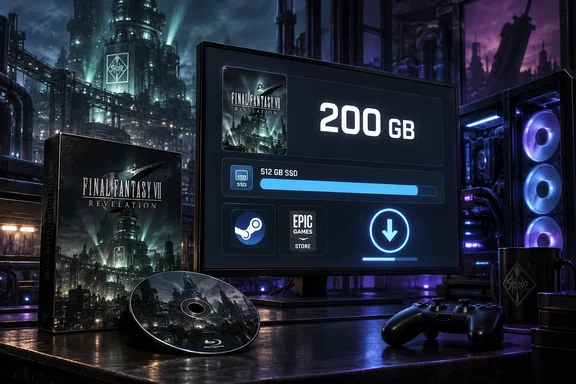
VGC obtained Hamaguchi’s estimate while asking about the game’s physical editions, and PC Gamer highlighted the obvious PC consequence: a single-player RPG at that scale will consume a substantial share of a 512GB SSD once Windows, applications, saves, and free-space headroom are included. Hamaguchi also made clear that the number remains under development, saying the team is still working out the details.
The number is credible as a statement of the project’s intended scope. It is not enough, however, to conclude that the PC version will require precisely 200GB of free space, that its download will be 200GB, or that all versions will have identical footprints. Those are three different measurements, and Square Enix has not yet separated them.
A director’s estimate is not a Steam specification
Hamaguchi’s wording matters. “Around 200GB of game” is a development estimate offered in a discussion about the limits of physical media, rather than the familiar PC-store declaration that a game needs a specific amount of “available space.”
Steam’s listings for the first two entries show why that distinction deserves attention. Final Fantasy VII Remake Intergrade currently lists 100GB of available storage, while Final Fantasy VII Rebirth lists 155GB and explicitly requires an SSD. Those figures are reservations a PC owner should have available before installation; they are not audited reports of the exact disk space every installation will use after updates, optional content, or changes to language data.
Revelation’s estimate may end up matching its eventual Steam requirement. It may also change before launch, differ between platforms, or be presented as a larger free-space figure to accommodate installation and patching. Square Enix has not stated whether the 200GB estimate includes every voice language, high-resolution assets, launch updates, shader compilation data, or other platform-specific files.
That uncertainty is normal for a game more than six months from release. It does mean that headlines declaring a settled 200GB PC install requirement go beyond what has actually been announced. For now, the defensible conclusion is narrower: Square Enix is planning a game whose total content footprint is in the 200GB range, and PC buyers should plan their storage accordingly.
The physical-disc dispute is the firmer warning
The stronger, more concrete news is that physical console copies will still require an additional download. VGC reported that Hamaguchi said the team did not want to compromise the game to fit it fully on the available disc media. Siliconera subsequently reported a further Hamaguchi statement acknowledging physical-media capacity limits and defending the decision to offer a boxed edition even though it will not contain the complete game.
That is a preservation and access issue, not simply a collector’s complaint. A disc that cannot install a complete launch version without online data is less useful to buyers with slow or capped broadband, and it is dependent on Square Enix maintaining the required download infrastructure. The company has explained its design trade-off—retain the project’s size rather than reduce it to fit—but it has not disclosed the size of the mandatory download, whether it will be needed before play can begin, or whether the physical editions will contain a meaningful playable portion.
The problem is especially sharp because the earlier remake releases established a different expectation. Final Fantasy VII Remake and Final Fantasy VII Rebirth used multiple PlayStation discs, and their PC versions became sizable downloads rather than partial physical-media installs. Revelation appears to mark a line Square Enix will not cross for this finale: physical packaging remains available, but the disc is no longer a self-contained delivery mechanism.
Hamaguchi’s “overcome the hardware” remark frames the matter as a capacity constraint. The record so far does not establish that two or more discs were technically impossible; it establishes that Square Enix has chosen not to ship the entire game that way. That difference will matter to buyers deciding whether a physical edition is worth paying for.
The trilogy’s 455GB figure needs a correction
PC Gamer’s arithmetic—100GB for Remake Intergrade, 155GB for Rebirth, and an estimated 200GB for Revelation—produces a 455GB total. It is a useful signal of the trilogy’s escalating storage appetite, but it should not be treated as a measured installed size.
The first two values come from Steam’s “available space” requirements, while the third is Hamaguchi’s approximate project-size estimate. Combining them produces a 455GB planning figure, not a verified count of files on an SSD. It also assumes all three titles are installed at once, which many players will not do.
Still, the progression is difficult to ignore. Square Enix’s present PC requirements rose from 100GB for the 2022 Steam release of Remake Intergrade to 155GB for Rebirth, and Revelation is now being discussed in the 200GB range. A player keeping all three installed could reasonably need a dedicated 1TB game drive once room for Windows, other games, saved data, updates, and ordinary SSD free space is considered.
That is where the headline has practical value. A nominal 200GB install on a 512GB system drive is not merely “a big game”; it can force users to uninstall other major titles or operate with little spare capacity. Windows itself works best when the system drive is not packed to its limit, and game launchers can need additional working room when decompressing or replacing files during updates.
What PC players should plan for now
There is no reason to buy new storage solely on this preliminary number today. There is every reason to audit the drive where Steam or the Epic Games Store installs large games, particularly if it is a 500GB-class SSD shared with Windows.
A sensible target is to preserve substantially more than 200GB of available space before installing Revelation, rather than planning around a drive that barely meets the estimate. The final store listing may require extra room, and post-launch patches could alter the footprint. Moving older games to a secondary SSD is generally a cleaner answer than filling the Windows system partition to its last few gigabytes.
Players should also watch for the actual PC system-requirements page rather than relying on the console-disc debate as a proxy. Square Enix’s official product page currently confirms the April 8, 2027 release date and lists Steam, Epic Games Store, and Xbox on PC among Revelation’s platforms, but it does not yet publish processor, GPU, memory, storage, or operating-system requirements.
Square Enix has made a clear choice: Revelation’s final content will not be scaled down to preserve a fully self-contained physical edition. For PC owners, the consequence is less philosophical and more immediate—reserve room for a game in the 200GB class, but wait for the storefront specification before treating that estimate as the final number.
Update: Hamaguchi reportedly outlines two Revelation story DLCs (September 20, 2026)
Tom’s Hardware reports that Naoki Hamaguchi also discussed two planned character-focused DLC stories for Final Fantasy VII Revelation: one centered on Vincent and another on Sephiroth. Square Enix has not yet independently published details, release timing, pricing, or platform availability for those expansions.
If confirmed, the DLC plans further complicate any attempt to treat the “around 200GB” estimate as a complete long-term storage figure. That estimate concerns the base game’s developing footprint; optional story content, patches, language packs, and high-resolution assets could push a fully updated PC installation beyond it.
Tom’s Hardware speculates that the finished package could reach roughly 215GB to 220GB, but that is not an announced requirement and should not be read as a Steam or Epic Games Store specification. PC players should continue to regard 200GB as a planning baseline rather than a final capacity number.
References
- Final Fantasy 7 Revelation is apparently a super heavyweight 200GB installation: 'We need to overcome the hardware to a certain extent' PC Gamer · 2026-09-18T21:55:19+00:00
- Final Fantasy VII Revelation might use upwards of 200 GB and requires an additional download — latest entry in the series of remakes may set a new record for the size of a base install Tom's Hardware · 2026-09-20T13:30:00+00:00