

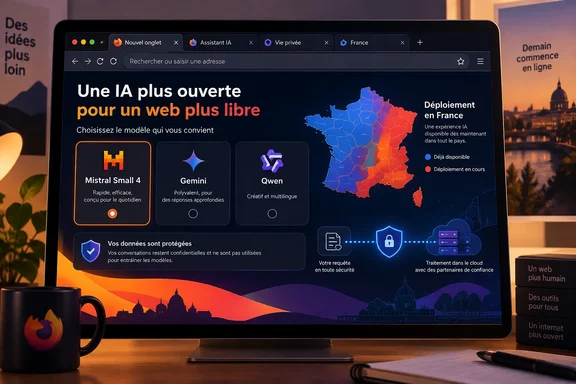
Neowin first framed the September 16 announcement as Mozilla picking Mistral “to power” Smart Window. The joint Mozilla–Mistral release uses similarly broad wording, saying Smart Window is now powered by Mistral models. But Mozilla’s product documentation is more specific: Mistral Small 4 is one of several selectable providers, not a replacement for the other models already available in the beta.
For Firefox users, that distinction matters. This is a provider addition paired with a regional rollout, rather than Mozilla handing Smart Window’s entire AI stack to Mistral. For admins and privacy-conscious users, it also means the actual data path and behavior depend on which Smart Window model is selected — and whether Smart Window is enabled at all.
Mistral Small 4 joins, rather than replaces, Smart Window models
Mozilla says it selected Mistral Small 4 after evaluating its Smart Window beta performance, with multilingual capability playing a central role in the decision. The model is positioned as the “Personalized” option in Mozilla’s French Smart Window model documentation, alongside Gemini 3.1 Flash Lite as the speed-oriented choice and Qwen3-235B as the flexible option.
That documentation matters more than the partnership language because it describes what Firefox users can actually configure. Smart Window lets users change the model in Firefox’s AI Controls, and the in-chat picker can override the default choice for a single conversation. More advanced users can point Smart Window at their own model endpoint, although Mozilla cautions that custom endpoints may not work as expected.
Mistral therefore gains a prominent distribution channel inside Firefox without Firefox becoming a Mistral-only AI browser. Mozilla retains the ability to add or remove providers as models change, and says it evaluates candidates for performance on browser tasks, handling of sensitive material, usefulness in real browsing scenarios, and hosting cost.
The cost point is not incidental. Mozilla’s support material confirms that Smart Window has a per-user usage quota which resets daily, but it does not publish the size of that quota. The company’s model-selection criteria explicitly include the cost of hosting and running the models. Users who expect an unlimited replacement for a standalone AI subscription should temper that expectation: Smart Window remains a managed beta service with limits Mozilla has not quantified publicly.
France is the first expansion beyond North America
The immediate functional rollout is France. Mozilla’s Smart Window post, updated September 16, says France is the first market outside North America to receive the beta, and Firefox support documentation ties availability to Firefox 155 for French users. The feature had begun rolling out to U.S. and Canadian users with Firefox 150.
The United Kingdom and Germany are planned for later in 2026, according to the joint Mozilla–Mistral announcement. Mozilla has not provided a Firefox version, firm release date, or rollout schedule for either country. That leaves Smart Window limited, for now, to en-US, en-CA, and French users — and the staged availability means an eligible user may not necessarily see it immediately.
Smart Window is a distinct Firefox window type rather than a background enhancement applied to every browsing session. A user can create a new Smart Window, convert an existing classic window, or keep classic, Smart, and Private Windows open together. Firefox can also be configured to open Smart Windows by default beginning with Firefox 151.0.2, though Mozilla says the setting remains unavailable until the feature is enabled and onboarding is complete.
That design gives Firefox a clearer boundary than browser-wide assistants that operate across every session by default. It also creates an operational question for organizations: a user can move an ordinary browsing session into a Smart Window while retaining its open tabs. The feature is opt-in, but once it is in use, it can incorporate context from tabs, history, and locally stored preferences.
The privacy claim is real, but it has a defined scope
Mozilla and Mistral emphasize a zero-data-retention commitment: they say model partners do not store users’ conversations after processing them to generate a response, and Mozilla says it does not train models on Smart Window interactions. Mozilla’s support documentation says chats may be briefly processed by the model provider but are not retained afterward.
That is a meaningful protection, especially compared with AI products that reserve the right to retain prompts for training or service improvement. Mozilla also proxies requests to its supported LLM partners: its privacy notice says the model provider sees a Mozilla IP address rather than the user’s own IP address. The provider receives the prompt content required to answer, but not an identifier directly linking that request to the user.
Still, zero retention does not mean Smart Window is local-only, nor does it mean Firefox never processes browsing-related data. Mozilla’s Smart Window privacy notice says that, when the user asks for assistance, Firefox can process queries, browsing context, relevant Memories, page content, language preference, and inferred location. The full prepared prompt is sent to a Mozilla server, which forwards it to the selected third-party model.
Mozilla also says Smart Window can infer interests from browsing activity in both Smart and classic windows, excluding Private Windows. Those inferred “Memories” are stored locally on the device and can be reviewed, deleted, or disabled. But the inference itself is processed on a Mozilla server by default before the resulting Memory is stored locally.
The practical reading is straightforward: model providers such as Mistral are contractually barred from retaining chats, while Mozilla still operates the service layer that prepares prompts and creates optional browsing-based Memories. That is more privacy-preserving than handing a browser history directly to a third-party chatbot account, but it remains cloud-assisted browsing.
Users should also distinguish model-provider retention from Firefox’s own local chat history. Mozilla’s Smart Window help page says chats are saved automatically and can be accessed later from New Tab or the application menu; users can delete them. Those saved chats are not the same thing as server-side model retention.
Smart Window reaches beyond summaries
Smart Window’s value proposition is broader than page summarization. Mozilla describes it as an assistant for comparing information across tabs, planning tasks from open tabs, generating recommendations, recovering pages from browsing history, grouping related tabs, and closing duplicates or unwanted tabs through natural-language requests.
When its on-device intent classifier determines that a request is better handled as chat, Firefox can gather relevant Memories and browser context before preparing a prompt. For history-related requests, Mozilla says Smart Window may search page titles and URLs, open potentially relevant pages in the background, and include relevant content in the request. Users can limit that by deleting pages from history or bookmarks, or by closing tabs when the assistant is working only with open-tab context.
Smart Window can also trigger web searches automatically when the model and the user’s existing context do not provide enough information. That function is handled by Exa, another Firefox partner announced in August. Mozilla says Exa retrieval can return current web information with visible sources, while Mistral Small 4 supplies one of the selectable language-model back ends.
Those separate partnerships explain why calling Mistral the system that “powers Smart Window” misses key pieces of the implementation. Firefox itself handles the window, browser-context selection, local intent classification, account integration, and proxying; Exa can supply web retrieval; and users can choose among multiple LLMs. Mistral’s role is important, but it is one layer in a deliberately modular arrangement.
What Windows and enterprise users should do
Smart Window is available on Firefox desktop and requires a Mozilla account. IT teams that permit Firefox but have policies around browser history, research material, regulated data, or third-party AI services should treat it as a new cloud-connected capability, not merely a cosmetic browser feature.
Before enabling it for work use, administrators and users should verify a few practical points:
- Smart Window can use relevant activity from classic Firefox windows to create Memories unless that capability is disabled, though Private Window activity is excluded.
- Requests to supported models are routed through Mozilla before reaching the selected provider, so prompts can contain the browsing context the user explicitly or implicitly allows Firefox to include.
- Custom model endpoints bypass Mozilla’s routing layer, and their operator’s privacy terms apply instead.
- Smart Window has a daily usage quota, but Mozilla has not disclosed its numerical limit.
Mozilla’s Mistral partnership gives Firefox a credible European model option and a French-language launch that aligns with the company’s stated focus on choice. But the more consequential fact is that Firefox is building Smart Window as a broker between several model, retrieval, and browser-context services. Users who want Mistral Small 4 can choose it; users who do not can select another offered model, supply their own endpoint, or keep using classic Firefox windows without Smart Window at all.
References
- Mozilla picks Mistral to power its Firefox Smart Window AI feature Neowin · 2026-09-16T17:56:01+00:00