

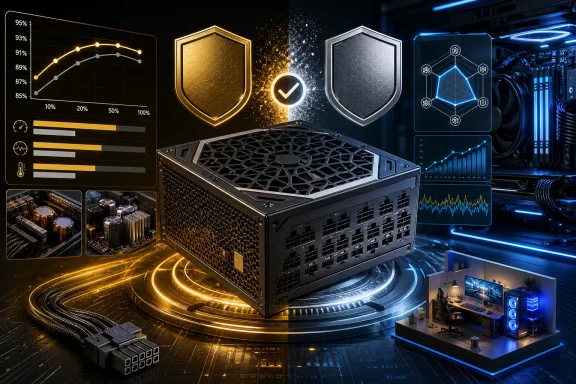
For a Windows PC builder planning a flagship gaming rig, GPU-heavy creator workstation, or compute system, the MEGA GM 1200W has substantial strengths. It also has meaningful caveats: the available evidence does not support one universal full-load efficiency figure, filtering is compliant rather than exceptional, and protection coverage has two specific omissions worth understanding before purchase.
The hardware: modern capacity in a compact chassis
The MEGA-1200GM is a fully modular 1,200 W ATX12V v3.1 PSU measuring 150 × 150 × 86 mm. That 150 mm depth is useful in practical system integration: it should leave more cable-management room than many longer high-wattage units, although a compact case can still become tight once the stiff high-power GPU cable and modular leads are installed.
It uses a single +12 V rail rated at 100 A. In ordinary terms, this means the supply’s primary power budget is not divided among multiple labeled +12 V rails. That can simplify planning for a PC with a high-draw graphics card and modern CPU, but it does not remove the need for sound cable installation and sensible component selection.
The connector provision is appropriately focused on contemporary high-end systems:
- One native 600 W PCIe 12V-2x6 cable for current-generation graphics cards.
- Two EPS 4+4-pin CPU power cables.
- Three conventional PCIe 6+2-pin cables.
- Ten SATA and six Molex peripheral connections.
That is a flexible complement for a workstation with several drives, pumps, fan hubs, or legacy accessories. The pair of EPS cables is particularly helpful for motherboards that use two CPU power inputs. Still, users should connect the native 12V-2x6 cable correctly, avoid severe bends near its connector, and fully seat it at the graphics card. A 1,200 W rating does not compensate for a poorly installed high-current connector.
FSP lists a 10-year warranty. Long coverage is valuable for a PSU because it is one of the few components likely to outlast multiple GPU or platform upgrades. A warranty, however, should be viewed alongside retailer support and local availability, especially where the product is not broadly stocked.
An FSP-built platform, with reassuring but bounded teardown evidence
The available technical evidence identifies FSP as the OEM rather than leaving the underlying platform anonymous. The inspected design uses a half-bridge LLC resonant primary stage and DC-DC conversion for the minor rails. That is a familiar modern topology for a quality high-output consumer PSU, designed to support efficient conversion and regulation across varied loads.
An independent inspection of the tested unit also documented Japanese-brand capacitors, including brands such as Nippon Chemi-Con, Rubycon, and Nichicon. This aligns with a quality-focused component strategy and is more useful than a generic marketing statement alone.
There are two boundaries to keep in mind. First, board-level findings from a sample are not a production-wide bill of materials guarantee. FSP promises Japanese bulk capacitors, but the evidence does not establish that every capacitor in every retail lot is identical. Second, soldering quality should not be generalized too aggressively. An early-production sample was reported to have poor soldering, while the reviewer explicitly expected retail samples to be better. Without comparable teardown evidence across later retail units, neither a blanket condemnation nor a blanket all-clear is justified.
Gold on the product page, Platinum in certification records
The MEGA GM 1200W’s certification story is the central complication in assessing its value.
FSP’s live product page lists 80 PLUS Gold, Cybenetics Gold, and Lambda A++ acoustic certification. Yet a published 80 PLUS verification and testing report for the FSP MEGA-1200GM, dated May 5, 2025, identifies the tested model as 80 PLUS Platinum compliant. It records 93.08% efficiency at 50% load and 89.72% at full load. Cybenetics’ certification record for the MEGA GM 1200W likewise reports Platinum efficiency and A++ noise results at both 115 V and 230 V.
That means it is incorrect to say that Cybenetics is the only independent efficiency credential for this model. An 80 PLUS report exists for the exact model name. It also means buyers should resist reducing the PSU to either a Gold or Platinum label without qualification: the manufacturer’s current page and the certification documents conflict.
There is no published explanation in the available material for why FSP’s Gold labeling differs from both the 80 PLUS report and the Cybenetics record. Possible differences involving regional authorization, production lots, marketing choices, or documentation timing would be inference, not established fact. The practical conclusion is simpler: a shopper should verify the box, regional listing, warranty terms, and current product documentation for the exact unit being purchased rather than assuming every label tells the same story.
Efficiency is strong, but voltage and methodology matter
The measured results broadly support the view that the MEGA GM 1200W is an efficient high-wattage PSU. They do not support treating one lab result as the sole definitive number.
Cybenetics reports average efficiency across more than 1,450 load combinations of 90.431% at 115 V and 92.589% at 230 V. Its results illustrate the expected advantage of 230 V input for this kind of power supply. For North American Windows PC owners using 115 V-class mains power, the 115 V result is the more relevant general reference point.
At a 1,200 W load, test results vary. One measurement recorded 87.731% at 115 V. Another reported 91.7% at full load, while the 80 PLUS report recorded 89.72% at 100% load. These are not necessarily contradictory product failures; efficiency changes with input voltage, ambient temperature, load setup, instrumentation, and laboratory methodology.
The real-world consequence is thermal. At 1,200 W DC output, even a few percentage points of efficiency can translate into a substantial difference in heat that must be exhausted from the PSU and case. A user who regularly renders, compiles, simulates, or runs GPU compute workloads near the unit’s maximum rating should prioritize adequate case airflow and avoid interpreting a certification tier as a guarantee of identical behavior under every workload.
For more typical gaming use, where instantaneous demand can be high but sustained system draw is often well below 1,200 W, the PSU has ample headroom. That does not mean 1,200 W is automatically the right choice: a lower-capacity unit may be better value for a system that will never approach this range. The MEGA GM makes the most sense where expansion headroom, a power-hungry GPU, multiple devices, or sustained heavy work gives that capacity a real purpose.
Acoustics and electrical output: good results with caveats
Cybenetics reports exceptionally low average noise output across its broad test sweep: 14.44 dBA at 115 V and 13.05 dBA at 230 V. The PSU uses a 135 mm hydro-dynamic-bearing fan with selectable semi-passive operation, which helps explain why light and moderate loads can remain quiet.
Noise at the top of the power range is less uniform between testing environments. One full-load result measured 35.4 dB(A), while another reported roughly 55.0 dB(A) at 1,200 W in an approximately 45 °C test environment. Those figures should not be read as directly interchangeable. Hot-box testing can reveal a more demanding scenario than a cooler open-bench measurement, and it is the hotter sustained case that is more relevant to a crowded workstation during a long render.
In short, the MEGA GM is likely to be unobtrusive at modest loads, but a buyer who expects continuous near-maximum output should plan for audible cooling behavior. The surrounding case, intake temperature, and system fan profile will materially affect the result.
Ripple testing also lands in the competent rather than class-leading category. At full load and 115 V, independent results measured 37.4 mV on +12 V, 25.8 mV on +5 V, and 29.8 mV on +3.3 V, all within specification. The same assessment judged the +12 V and +5 V results as not especially competitive and regarded +3.3 V ripple at 115 V as an area that could be improved.
This is not evidence of an out-of-spec unit. It is instead a useful distinction for enthusiasts comparing expensive 1,200 W supplies: passing ripple tests and delivering reliable everyday power are important, but the MEGA GM does not clearly lead every electrical quality metric in its class.
Load regulation tells a similarly nuanced story. Cybenetics measured +12 V, +5 V, and +3.3 V regulation below 1% on its tested sample at 115 V. Another test measured 1.5% on +5 V. The conflict means it is not justified to declare that every MEGA GM fails a claimed ±1% target on the minor rails. It is more accurate to say that results differed by sample or methodology, while neither finding suggests an ordinary PC compatibility concern by itself.
Protection coverage has two notable gaps
Testing confirms functioning over-current, over-power, over-temperature, short-circuit, under-voltage, no-load, and related safeguards in the tested unit. Those are core protections for a premium high-output PSU.
However, the protection set is not complete in every respect. Fan-failure protection is absent, and there is no per-pin over-current protection on the 12V-2x6 connector. The latter does not mean the connector lacks all protection; it means the more granular per-pin safeguard was not present in the tested design.
These omissions deserve more weight in a PSU intended for a high-power GPU than broad phrases such as “full protection suite” imply. They are not, on their own, proof that the unit is unsafe or unsuitable. But a buyer choosing between otherwise comparable models can reasonably prefer a design with fan-failure monitoring and more granular connector protection, particularly for a system regularly operating under sustained load.
Exact OCP and OPP trip figures should also be treated cautiously. Different independent tests reported materially different trigger points, so these should be regarded as sample- and protocol-specific observations rather than fixed retail specifications.
Who should consider the MEGA GM 1200W?
The FSP MEGA GM 1200W is a credible option for users building a high-draw Windows PC who value a compact 1,200 W ATX 3.1 design, two EPS leads, native 12V-2x6 support, an FSP-built platform, and a 10-year warranty. The certification evidence points to strong overall efficiency, including results that meet Platinum thresholds, even though FSP’s own current page calls the product Gold.
The better buying decision is not to assume that the label discrepancy automatically creates a bargain. Compare the actual local price, stock, warranty channel, connector needs, and competing models’ protection features. U.S. availability and a stable street price were not firmly established in the available evidence as of September 7, 2026, despite a reported $229 MSRP and earlier global-launch information.
For a mainstream gaming PC, this supply may be more capacity than necessary. For a flagship GPU system or serious creator workstation, it offers a sound feature set and encouraging test performance, tempered by non-leading ripple results, potentially higher noise under hot full-load conditions, and the two protection omissions. Its most unusual attribute remains the documentation conflict: measured and certified Platinum-level evidence exists, but buyers should purchase based on the exact regional product and its current support terms—not on an unresolved badge dispute alone.