

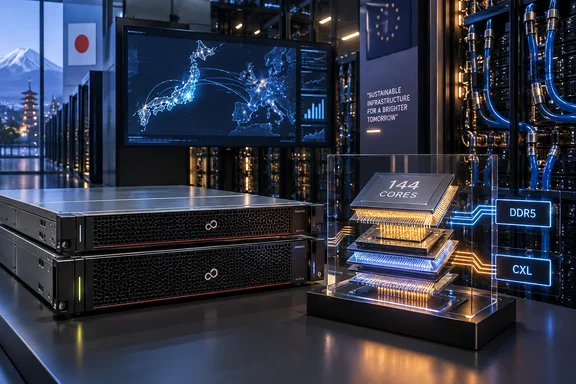
The Register first reported the shift from a long-discussed 2027 processor to a November sales start. Fujitsu’s September 14 announcement confirms the chip will be offered separately rather than reserved for its own machines, a significant departure from the Fugaku-era model in which its Arm silicon was tied to a flagship supercomputer. But the same announcement says standalone MONAKA supply to cloud, data-center, and server-vendor customers begins in the fourth quarter of Fujitsu’s fiscal 2026, while server shipments in Japan and Europe commence sequentially from April.
That makes MONAKA real commercial competition for Arm server silicon, but not an immediately available alternative to x86 systems or proprietary Arm offerings from the largest cloud providers.
November sales and 2027 deliveries are different milestones
Fujitsu’s release uses the language of a November launch for both FUJITSU-MONAKA and the Fujitsu MONAKA Server. It also says selected finance, telecommunications, and manufacturing customers will receive servers during the second half of fiscal 2026 to expand use cases. Then, in its future-plans section, it places broader server shipments in Japan and Europe from April 2027.
ITmedia’s Japanese reporting describes the same schedule: sales begin in November, early customers receive systems first, and shipments to the Japanese and European markets follow from April. That is the clearest reading of the rollout, and it matters for procurement planning. An organization that needs inference capacity installed before the end of 2026 cannot assume a November order turns into a delivered rack server within weeks.
Fujitsu has also not published a public price list, a general availability date for every MONAKA configuration, or named external chip customers. The company says the standalone processor will become globally available, including in the United States and Asia-Pacific, in its fiscal fourth quarter. Because Fujitsu’s fiscal year ends in March, that window runs from January through March 2027.
For prospective server makers, this means the opportunity is real but time-bounded. Fujitsu is offering the CPU to potential OEM rivals while simultaneously keeping the first complete-system line under its own brand. A vendor can design a MONAKA server, but Fujitsu arrives first with validated 1U, 2U, and high-density multi-node designs — and controls the early platform story in the markets it is targeting.
A server CPU designed around memory movement and inference
MONAKA’s commercial pitch is not that it replaces a GPU for large-model training. Fujitsu is targeting CPU-led AI inference, AI agents, conventional enterprise processing, and selected high-performance computing workloads where memory capacity, data movement, cooling limits, or hardware provenance matter as much as raw accelerator throughput.
The processor uses Armv9-A and has 144 cores. Fujitsu has described a 3D-stacked design that combines 2nm compute silicon with separate 5nm SRAM and I/O silicon. It supports DDR5 memory at up to 8,800 MT/s, PCI Express 6.0, CXL 3.0 capabilities, Arm Confidential Compute Architecture, and Arm SVE2 vector processing.
The design is materially different from the A64FX processor used in Fugaku. A64FX emphasized supercomputing with 512-bit Scalable Vector Extension units and high-bandwidth memory. MONAKA moves toward a data-center layout using DDR5, PCIe 6.0, CXL expansion, stacked cache, and narrower dual 256-bit SVE2 units. Fujitsu’s past association with Fugaku explains the project’s pedigree; it does not mean MONAKA is simply a Fugaku processor repackaged for enterprise racks.
Tom’s Hardware’s report from Hot Chips 2026 adds technical detail Fujitsu’s launch statement leaves out. It reported two initial power and frequency profiles: a 350W air-cooled model with a 2.1GHz base frequency and a 500W liquid-cooled model with a 2.9GHz base frequency. Fujitsu lists a maximum frequency of 3.8GHz, which should not be confused with either processor’s base clock.
Fujitsu says MONAKA can deliver twice the AI inference throughput of competing CPUs and cut the number of required servers and power consumption in half for equivalent workloads. Those are vendor claims, not independently reproduced benchmarks. The company has not publicly identified the rival processors, model sizes, batch sizes, precision formats, memory configurations, or software stacks behind its “twice” comparison. Until third-party systems ship and are tested, there is no way to determine whether the claim holds against Intel Xeon, AMD EPYC, AmpereOne, Nvidia Grace, or a particular cloud Arm instance.
Cooling is a practical differentiator, but not a free one
Fujitsu’s server lineup turns MONAKA’s power profiles into a more practical deployment argument. The company plans a 1U system with one or two CPUs, a conventional 2U dual-CPU system, and a 2U multi-node model that places four dual-socket nodes in one chassis for academic and HPC installations.
According to The Register’s configuration details, the 1U platform can use either 2.1GHz or 2.9GHz processors. Fujitsu says it can operate in air-cooled facilities at ambient temperatures up to 40 degrees Celsius, or at 45 degrees Celsius with liquid cooling. That could appeal to operators with constrained cooling headroom, particularly where adding dense GPU infrastructure would require a broader data-center upgrade.
The second 2U server is an air-cooled dual-socket system using the 2.1GHz chips. The high-density 2U multi-node design uses the higher-frequency liquid-cooled processors and is aimed at HPC and academic workloads. In other words, “MONAKA can run in an air-cooled data center” applies to particular system configurations. The densest performance-oriented box still requires liquid cooling.
That division is more useful than treating air cooling as a blanket property of the platform. A 350W CPU is still a high-power component by ordinary server standards, especially in a dual-socket 1U chassis. Fujitsu’s potential advantage lies in serving inference and general compute workloads in facilities that cannot accommodate GPU-heavy racks, rather than eliminating the thermal and electrical consequences of dense compute.
The 1U model also introduces Fujitsu’s composable disaggregated infrastructure approach through CXL, allowing memory and accelerators to be allocated outside the physical server boundary. If it works as described, that can help a CPU platform whose target workloads are frequently constrained by memory capacity and bandwidth. It also adds a software, firmware, and fabric-management requirement that will matter to enterprise IT teams more than the processor’s core count alone.
“Made in Japan” is a supply-chain claim with limits
Fujitsu is placing sovereign AI infrastructure at the center of MONAKA’s launch. It says the systems are designed, developed, and manufactured in Japan, with server production at its Kasashima plant, and argues that this gives customers traceability into component origins and manufacturing history. That message is aimed at public-sector, defense, regulated-industry, and nationally sensitive deployments in Japan and Europe.
There is a key distinction in the record: the server’s Japanese manufacture is not the same thing as every chip layer being fabricated in Japan. Technical coverage from Hot Chips identifies MONAKA’s 2nm compute die as TSMC N2P and the SRAM and I/O dies as TSMC N5. Fujitsu’s “made-in-Japan” formulation accurately describes its design work and its server manufacturing program, but it should not be read as proof of a wholly domestic semiconductor supply chain.
That does not make the sovereignty pitch meaningless. For customers focused on system integration, factory traceability, long-term support, and the location of final assembly, Fujitsu can offer something different from a U.S.-designed CPU installed by a local integrator. But buyers whose definition of sovereignty includes the foundry, packaging chain, firmware ownership, board supply, and component-origin controls will need more documentation than Fujitsu has published in its launch announcement.
The company also highlights hardware-backed confidential computing using Arm CCA, designed to protect data and applications in memory from privileged software such as operating systems and hypervisors. This is relevant to multi-tenant and regulated deployments, though it should be evaluated as an implementation and operations feature, not simply checked off because the architecture supports it. Organizations will need to verify guest OS support, hypervisor support, attestation workflows, key management, and how any accelerators or CXL-attached memory participate in the trusted-computing boundary.
Fujitsu is entering a difficult Arm server market
Selling MONAKA chips to other server makers signals that Fujitsu wants more than a niche proprietary appliance business. A standalone CPU can create a broader software and hardware base, give hyperscale buyers more choices, and spread platform-validation costs across OEMs and cloud operators. It can also make Fujitsu’s Arm roadmap more durable than an approach dependent on a single national supercomputing program.
The challenge is that the Arm server market has repeatedly struggled with availability, software certification, enterprise support, and channel commitment. Amazon’s Graviton processors have succeeded inside AWS because the cloud provider controls the hardware, platform, price, and deployment environment. Nvidia Grace benefits from an accelerator-led AI strategy. Ampere has pursued cloud and OEM channels for years. MONAKA enters this market with credible engineering, but without announced launch customers, public pricing, independent performance numbers, or a disclosed list of supported operating systems and enterprise software.
For WindowsForum’s enterprise audience, MONAKA is therefore more relevant to Linux, cloud-native infrastructure, CXL pooling, confidential-computing planning, and AI inference capacity than to conventional Windows Server consolidation. Fujitsu has not announced Windows Server support, Windows virtualization certification, or Microsoft Azure availability. Those omissions are expected for an Arm server processor aimed first at Japan and Europe, but they sharply limit its near-term relevance for organizations whose estate is built around Windows Server applications.
Fujitsu’s November announcement moves MONAKA from roadmap to procurement conversation. The decisive date, however, is April 2027, when broader server shipments are due to begin. By then, the company will need to show not only that its stacked 2nm CPU is technically distinctive, but that customers can buy it, run supported software on it, and measure its inference-per-watt advantage outside Fujitsu’s own benchmark environment.
References
- Fujitsu ready to sell its custom ‘Monaka’ Arm chip, maybe to rival server-makers The Register · 2026-09-17T06:20:33+00:00