

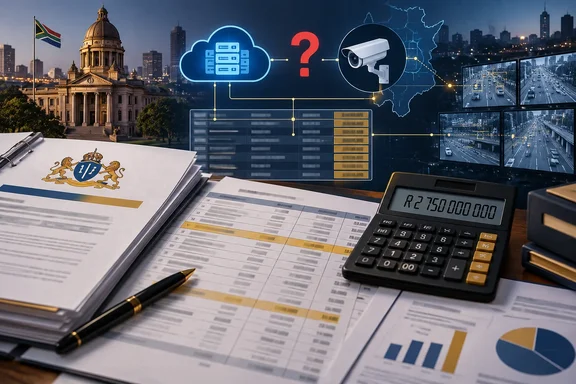
The DA says its figures come from written replies to questions in the Gauteng Provincial Legislature. Independent confirmation of the new spending totals and alleged supplier-description error was not available for this report. The underlying replies are important: the party’s account raises a specific reconciliation question, but does not establish who received the disputed payment or what the contract actually covered.
What the spending figures establish—and what they do not
According to the DA, disclosed payments to a group of suppliers totalled approximately R1.38 billion against an adjusted departmental budget of approximately R1.94 billion. The party identifies approximately R642.6 million paid to the State Information Technology Agency, or SITA, as one of the largest amounts.
The arithmetic supports the stated comparison: R1.38 billion divided by R1.94 billion is approximately 71%. However, that is a comparison between the reported supplier payments and the adjusted budget. It is not independently verified evidence that outsourcing consumed precisely 71% of actual expenditure, nor does it measure the quality of services delivered.
The DA also says the disclosure does not cover every supplier. Its planned follow-up questions seek a complete external-service-provider total and the number and value of contracts awarded through deviations and single-source procurement.
The claim that this spending delivered no real value goes further than the available evidence. Assessing value requires the contracted deliverables, their cost and evidence of delivery. A large supplier-payment total alone cannot establish waste, just as it cannot demonstrate successful service provision.
Why the Azure–Vumacam description needs reconciliation
The DA’s statement describes two camera arrangements:
- An earlier reply reportedly identified a R78,629,760 Vumacam contract for access to 6,000 cameras across the Gauteng City Region, starting on February 1, 2024.
- A later disclosure reportedly identified a further R61.96 million Vumacam contract for access to 7,271 cameras from April 1, 2026.
The party alleges that the latest supplier reply instead describes a roughly R78.6 million contract with Microsoft Azure to lease 6,000 cameras. The similar amount and camera count explain why it is asking whether the records refer to the same arrangement. They do not, by themselves, resolve the discrepancy.
For enterprise IT procurement, the supplier, service description, contract value and payment amount need to remain distinct. Access to camera feeds, leasing camera equipment and purchasing cloud services describe different deliverables. A label in a supplier table cannot safely establish which was purchased.
A useful reconciliation would therefore identify the legal supplier and payment recipient, match the entry to its contract and purchase order, and specify whether the deliverable was camera access, equipment, hosting or a combination. It should also distinguish the full contract value from payments made during a particular financial year.
The further contract beginning April 2026 must likewise be kept separate from the reported 2025/26 spending total unless the accounting records establish a connection. Adding every figure in the statement together would mix different reporting periods and financial measures.
Licensing debt and internal capacity are separate questions
The DA also says unpaid Microsoft licensing debt previously reached R631 million because invoices arrived late or were not processed on time. That is a claim about accumulated unpaid liabilities, rather than the same measure as annual supplier payments. It should not be added to the R1.38 billion total without a reconciliation showing whether, and when, those liabilities were paid.
Internal capacity is another part of the party’s challenge. In a separate July 21 statement, the DA reported that the department had six internal cybersecurity employees supported by an outsourced Security Operations Centre. That provides context for its scrutiny of external provision, but the staffing claim comes from the same political source and does not independently corroborate September’s spending allegations.
For IT administrators, the immediate relevance is contract and invoice governance rather than a change to Azure or Microsoft licensing. The statement establishes no Microsoft service interruption, licence cancellation or technical action that customers should take.
The DA says it will ask MEC for e-Government Bonginkosi Dhlamini for a detailed expenditure reconciliation, clarification of the disputed Microsoft Azure description and assurance that other supplier information submitted to the legislature has been checked. Those answers would determine whether the apparent discrepancy is a reporting error and provide the records needed to assess what Gauteng actually purchased.
Update: Gauteng disclosures detail R1.84 billion in Microsoft contracts (September 23, 2026)
MyBroadband reports that Gauteng’s Department of e-Government has supplied the DA with a spreadsheet listing two Microsoft software-maintenance contracts with a combined value of R1.84 billion.
The records reportedly show a R719.6 million single-source contract running from March 2022 to February 2025, followed by a R1.12 billion Microsoft Enterprise Agreement intended to run through February 2028. The department recorded R82 million in payments under the Enterprise Agreement during 2025/26, alongside earlier annual payments of about R94.3 million and R95.7 million.
This provides more specific contract-value and payment information than was previously available, while also reinforcing the need to distinguish multi-year contract ceilings from spending in a single financial year. It does not establish that the full R1.84 billion has been paid.
MyBroadband also reports that the department’s spreadsheet still labelled the R78.63 million, 6,000-camera entry as “Microsoft Azure.” The reported contract details support the DA’s view that this is likely a misattribution involving the separate Vumacam camera-access arrangement, rather than a Microsoft camera-leasing deal.
References
- Microsoft received R1.84-billion payday from South Africa’s richest province - MyBroadband MyBroadband · 2026-09-23T09:00:06+00:00
- Gauteng e-Government spends R1.38 billion outsourcing services without any real value for money - dagauteng.org.za dagauteng.org.za · Mon, 21 Sep 2026 10:33:20 GMT