

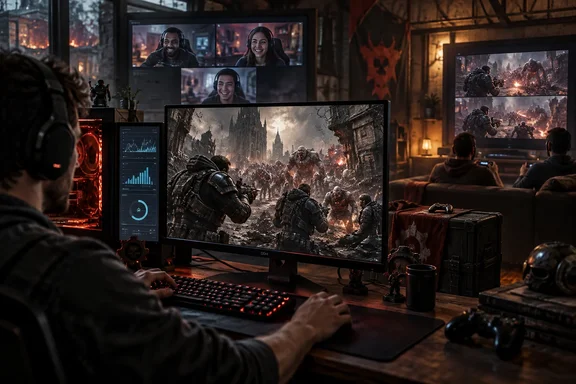
The more useful story goes beyond a demanding graphics preset. Official Xbox documentation also clarifies two details that deserve attention before players organize a co-op session: split-screen is console-only, and Horde Siege classes have bonuses beyond their equipment. Both distinctions sharpen the picture presented by WorthPlaying’s multiplayer-focused review.
Early-access impressions, not a post-launch verdict
Xbox lists the standard release for October 6, 2026, with Premium Edition early access beginning October 1. The game is coming to Xbox Series X|S and PC through the Microsoft Store and Steam, with day-one access through Game Pass Ultimate and PC Game Pass. WorthPlaying’s October 5 review therefore describes conditions before the broader launch.
That distinction matters when interpreting multiplayer observations. A review-period experience can tell readers what happened during those sessions; it cannot establish how matchmaking, server performance or stability will behave after the full audience arrives.
PC graphics: resist the maximum-settings reflex
WorthPlaying’s desktop results suggest that the highest graphics settings deserve scrutiny rather than automatic selection. The reviewer also reports an approximately 13-minute initial shader-compilation wait. Neither observation establishes performance across other hardware, and the review does not identify a specific Windows build or driver version.
The sensible takeaway is to treat Ultra as a comparison point, not assume that pushing every option higher delivers a worthwhile improvement. Based on the reviewer’s figures, the performance cost was substantial while the perceived image-quality gain was small. That is an interpretation of the published results, not independent WindowsForum testing.
For portable players, the warning is different: WorthPlaying reports stable Linux play with Proton Experimental, but repeated benchmark failures on Steam Deck despite low settings and a dynamic-resolution 30fps target. Desktop Linux compatibility should not be mistaken for dependable handheld performance.
Co-op: check the platform boundary
Xbox confirms campaign support for up to four players online, but its product-page footnotes explicitly restrict two-player split-screen to console. PC players planning a couch-co-op evening should not interpret the general split-screen feature description as a Windows capability.
The official page also advertises Xbox Play Anywhere with shared progression and achievements across Xbox console and PC. That is a distinct feature from multiplayer compatibility: carrying progress between devices and joining another player’s session answer different questions.
Horde Siege has more class depth than the review suggests
WorthPlaying awards the game 8/10 and identifies Horde Siege as its strongest multiplayer component. Its enthusiasm centers on cooperation rather than competitive combat.
The Coalition’s multiplayer deep dive confirms the underlying structure: 12 players arranged into three squads, each pursuing its own mission on a shared battlefield. Squads can encounter equipment and fortifications left behind by earlier groups. This supports the review’s description of a battle that feels partly persistent, without implying an indefinitely running world.
There is also an important qualification to the review’s description of classes as primarily equipment choices. The Coalition explicitly lists additional combat bonuses:
- Assault: increased damage while in cover.
- Breacher: improved resistance to status effects and melee damage.
- Marksman: increased critical-hit damage.
- Medic: faster health regeneration.
Those bonuses make class selection more consequential than simply choosing a gadget. The official guide estimates Blitz missions at 15–20 minutes and Siege missions at 20–40 minutes, providing a useful planning guide rather than a guaranteed session duration.
No battle pass does not mean no purchases
The Coalition confirms there is no battle pass and says nearly all customization can be earned through play. However, premium currency called Iron remains available, and some content is purchase-only, including Premium Edition items and charity offers. Seasonal challenge rewards are intended to return to the Barracks for Coins or Iron. The distinction is straightforward: fewer battle-pass obligations, not an absence of monetization.
The practical PC takeaway
The strongest conclusions are narrower than a blanket recommendation. WorthPlaying’s review gives desktop players a reason to compare graphics presets carefully and handheld players a reason for caution. Official documentation adds clearer boundaries for local co-op and a more complete account of Horde Siege classes.
For Windows users, those details are more actionable than the score alone. A maximum-settings checkbox is not a quality guarantee—and a co-op feature is only useful when it works on the platform sitting in front of you.
References
- PC Review - 'Gears of War: E-Day' - Worthplaying Worthplaying · Mon, 05 Oct 2026 07:15:00 GMT
- Gears of War: E-Day – Available 10/6/2026 on XBOX and with Game Pass | XBOX xbox.com
- Gears of War | Gears of War: E-Day Multiplayer Deep Dive gearsofwar.com