

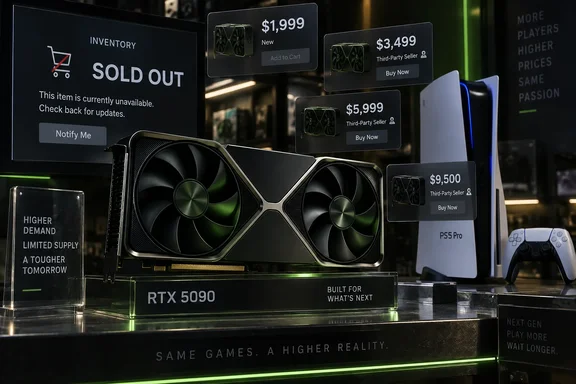
BGR highlighted Newegg listings around $9,000 and above during the week of September 13. A check of Newegg’s RTX 5090 catalog supports the broader finding: MSI RTX 5090 models have appeared around $8,699 and $9,299, while listed alternatives reach $9,000 or more. Tom’s Hardware and PC Gamer separately reported that mainstream online retail availability has largely evaporated and that third-party sellers were asking roughly $6,500 to $9,500.
For buyers, the practical conclusion is simpler than the headlines: an RTX 5090 listed at $9,000 is not a sensible consumer purchase for gaming. It is a scarcity price attached to a product Nvidia still officially values at $1,999, not evidence that the card’s underlying value has suddenly multiplied.
The $9,000 figure is real, but it is not Nvidia’s price
Nvidia announced the GeForce RTX 5090 on January 6, 2025, with a U.S. starting price of $1,999 and a January 30 launch date. Nvidia’s own marketplace still displays the Founders Edition at $1,999, although the card is out of stock. That distinction is central: the official MSRP has not become $9,000.
The listings BGR cited are better understood as marketplace scarcity pricing. Newegg hosts both products sold directly by Newegg and products offered through third-party sellers. A shopper who sees a five-figure or near-five-figure RTX 5090 listing should inspect the “sold by” field, warranty terms, return policy, and actual availability before reading the number as a normal retail price.
This is not merely semantics. A third-party seller can post a card at a price so high that it effectively functions as an invitation only for buyers who have no viable alternative. The listing tells us that the seller believes someone might pay it; it does not prove that cards are routinely selling at that figure.
Tom’s Hardware reported this week that the lowest price it had tracked at the start of September was about $5,199, before listings climbed into a $6,500-to-$9,500 range. PC Gamer likewise found that a Newegg Gigabyte RTX 5090 it had recently identified as the least expensive option had reached $5,700. Those figures still represent an extraordinary premium over MSRP, but they also show why the $9,000 headline should not become shorthand for the entire RTX 5090 market.
Sony’s $899 PS5 Pro provides scale, not a direct hardware comparison
Sony currently lists the PlayStation 5 Pro at $899 in the United States, after raising the console’s price in April 2026. At the upper end of the current RTX 5090 marketplace, one GPU can therefore cost roughly 10 times the console’s full price.
That comparison is effective because it exposes how detached flagship-GPU street pricing has become from normal gaming budgets. Yet it should not be mistaken for an apples-to-apples performance calculation. The PS5 Pro is a complete, tightly integrated console with a custom AMD processor, graphics hardware, 2TB of storage, memory, controller, enclosure, cooling, operating system, and platform software. The RTX 5090 is a single 32GB add-in graphics card designed for a PC that also needs a processor, motherboard, memory, storage, power supply, case, display, and operating system.
The RTX 5090 is also built for workloads that a console is not intended to serve: high-resolution PC gaming with demanding ray tracing settings, professional rendering, GPU compute, local AI inference, and development work. Nvidia rates it at 3,352 AI TOPS, a marketing measure that cannot be converted cleanly into console performance, but one that signals why the card attracts buyers outside the traditional enthusiast-gaming market.
Still, the performance argument does not justify current asking prices. The RTX 5090 was already Nvidia’s premium consumer GPU at $1,999. A price near $9,000 buys no extra GPU memory, no additional CUDA cores, no higher official performance tier, and no expanded Nvidia support entitlement. It buys access to a card that is hard to obtain through normal channels.
The shortage is the story, not a formal price increase
The material development is not that Nvidia has repositioned the RTX 5090 as a luxury $9,000 product. It is that retail supply has thinned sufficiently for marketplace sellers to test prices normally associated with workstation hardware or a full high-end workstation build.
Reporting from PC Gamer, Tom’s Hardware, TechRadar, and Digital Citizen points to the same immediate pattern: dwindling stock at major U.S. retailers and a higher share of listings from third-party sellers. TechRadar identified a Newegg Asus ROG Astral RTX 5090 listing at $9,659 but noted that it was not sold directly by Newegg. This is precisely the detail absent from many social-media screenshots and price-comparison claims.
There is no public Nvidia statement establishing why the retail channel is so constrained or explaining which customers are receiving available supply. Reports have pointed to demand from AI-focused buyers and system builders, but the public evidence does not establish how many GeForce RTX 5090 units are being diverted from gaming retail, nor whether any particular company is responsible for the shortage.
That absence matters. Demand from local-AI users, professional creators, boutique workstation builders, and gamers can all tighten supply. Without distributor allocation data or a statement from Nvidia, asserting a single cause would be speculation. What is documented is the outcome: normal retail availability is difficult to find, while reseller asks have become detached from the official price.
A complete PC can make more sense than the standalone card
At $6,000 to $9,000, the RTX 5090 stops competing only with other graphics cards. It competes with complete systems containing the same GPU, with professional RTX workstation cards, and with multiple high-performance gaming PCs.
That changes the buying decision for anyone who actually needs Nvidia’s fastest consumer GPU. A prebuilt system can sometimes provide better availability, a full-system warranty, and a less distorted effective GPU price than buying a standalone card from a marketplace seller. That does not mean every prebuilt is a bargain; system builders can also pass scarcity premiums along. But it makes direct comparison essential.
Buyers should also resist treating every RTX 5090 model as interchangeable. Board-partner designs differ in cooling, physical dimensions, power requirements, noise, warranty handling, and factory overclocks, but none of those differences explain a several-thousand-dollar premium. An expensive liquid-cooled or extreme-overclocking model can command more than a baseline card. It does not transform a $1,999-class GPU into a $9,000-value component.
For gaming-only builds, the better question is not whether an RTX 5090 can outperform a PS5 Pro. It obviously can in the right PC and game. The question is whether the intended display resolution, refresh rate, game library, and settings actually require Nvidia’s top card. In most cases, they do not.
What prospective RTX 5090 buyers should do now
The current listings call for a procurement decision, not fear of missing out.
- Buyers should treat Nvidia’s $1,999 Founders Edition MSRP as the reference point, even if stock is unavailable, rather than accepting marketplace listings as the card’s new normal value.
- Buyers should verify whether a listing is sold and shipped by the retailer or by a marketplace seller, and should read return, warranty, and cancellation terms before ordering.
- Buyers who need 32GB of VRAM for production or local AI work should compare a full prebuilt, a professional workstation GPU, cloud compute, and used hardware rather than assuming a $9,000 consumer card is the least expensive route.
- Gamers should price complete alternatives around the display they already own. Spending several thousand dollars above MSRP on one GPU can leave less budget for the CPU, power supply, monitor, and storage that determine the rest of the PC experience.
Nvidia has not announced a U.S. price increase for the RTX 5090. Until the company restores retail supply or formally changes its pricing, the $9,000 figures should be read as a warning about inventory conditions and reseller behavior—not as the cost of entry to high-end PC gaming.
Update: First-party RTX 5090 pricing averages $4,880, not $9,000 (September 26, 2026)
GamersNexus now reports that the RTX 5090’s average price across its tracked in-stock, first-party Newegg listings was $4,880—about $900 higher than six months earlier and 144% above Nvidia’s $1,999 MSRP. That still represents an extraordinary near-$3,000 premium, but it also reinforces that the $6,500-to-$9,500 figures are the most extreme scarcity and marketplace asks rather than the prevailing price of every available card.
Its retail snapshot found three or fewer RTX 5090 models in stock, underscoring that supply remains exceptionally limited even where listings are sold directly rather than through third-party marketplace sellers.
GamersNexus attributes much of the broader GPU inflation to escalating graphics-memory costs, particularly for high-memory products using GDDR7. The outlet’s data also found that Nvidia current-generation cards averaged 70% above MSRP, compared with 28% for AMD and 21% for Intel. For buyers, the practical takeaway remains unchanged: even a comparatively “normal” in-stock RTX 5090 price is far above MSRP, and a $9,000 reseller listing should not be treated as a rational benchmark.
References
- NVIDIA Has GPUs If You Have Coin - GamersNexus GamersNexus · 2026-09-25T18:09:00+00:00
- This Nvidia GPU Costs 10x More Than A PlayStation 5 Pro bgr.com · 2026-09-19T10:32:00+00:00