

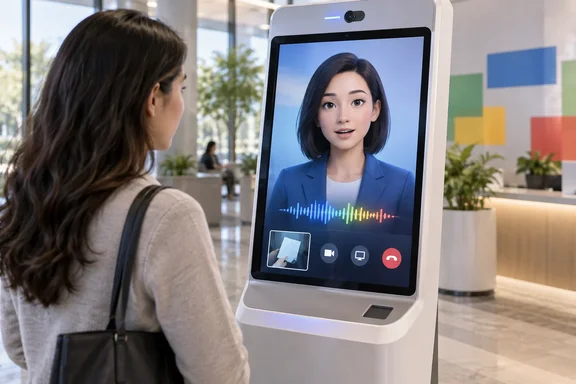
Gemini 3.8 Live Avatar gives Google's voice agent a face
Google describes the product as a video layer added to Gemini's live dialogue models. Its launch post says that by pairing near real-time video generation with speech, the Live Avatar feature creates an experience that listens, sees, and speaks with a dynamic visual persona. The post was written by Google DeepMind research scientist Shuo-yiin Chang and Gemini software engineer CJ Zheng. Google names engaging customer service or delivering interactive walkthroughs as the target uses.
The Google Cloud blog, in a post by Fabien Blanc-paques, group product manager for Gemini Live, says the feature is now generally available in Gemini Enterprise. First previewed at Google Cloud Next 2026, the technology is now officially ready for enterprise production. The target surfaces are conversational video agents across web, mobile, and interactive kiosks.
The timing is part of a fast release run. Unite.AI reports that the launch follows Google's September 15, 2026 launch of Gemini 3.8 Live and Gemini 3.8 Live Extended Thinking. Android Headlines notes that the same week Google also debuted its audio-focused Gemini 3.8 Flash TTS and Flash-Lite TTS models. Extended Thinking is still limited: Gemini 3.8 Live Extended Thinking remains in private preview. Live Avatar is the part of the family that is production-ready today.
The Register, which first covered the release with a skeptical eye, put it bluntly: Google's researchers are still studying how humanlike AI affects people, and Google's enterprise product has already shipped.
How Live Avatar streams lip-synced video from the Gemini Live API
The developer documentation shows what "generated video" means in practice. Google's developer guide says 3.8 Live can generate synchronized, 24 FPS MP4 video streams (response_modalities=["VIDEO"]) directly from the model. The generated avatar's facial expressions and lip movements sync with the synthesized speech in real time. The face is produced by the model itself. Developers do not have to feed audio into a separate animation engine; they request video as an output type, just as they would request audio.
The same guide calls Gemini 3.8 Live our real-time conversational model, engineered for ultra-low latency, bidirectional voice and video interactions, and face-to-face Live Avatar synthesis. The guide also covers integration through the Google Gen AI SDK, mandatory API rules, and migration from legacy Gemini Live API models. Teams already on an older Gemini Live model should expect some migration work rather than a drop-in change.
Input runs in both directions. The Cloud post says Gemini 3.8 Live already delivers a native speech-to-speech foundation. Its visual understanding can process live camera feeds and screen shares at the same time as audio. As Android Headlines explains it, this allows interactive avatars to see user camera feeds or screen shares and have natural conversations. In effect, it is a video call with an agent that can watch what the customer shows it.
Google also points to a developer path through its Agent Development Kit (ADK). Its demo shows developers using ADK to define agents, manage runners and session memory, and stream real-time audio straight to the Gemini Live API. No traditional speech-to-text pipeline is involved, which cuts out one of the handoffs that usually add latency to voice bots.
Asynchronous tool calling keeps the Gemini avatar talking while it works
Voice agents often go silent while a backend lookup runs. Live Avatar is designed to keep talking through that gap. Google's launch post says that with asynchronous tool calling, Live Avatar can trigger tool calls and fetch data in the background while it keeps the dialogue going. Google demonstrated this with a hotel guest check-in. The Cloud post describes the same behavior: the model executes tools and API calls in the background while continuing the conversation, so the model can acknowledge requests and keep chatting while tasks finish in the background.
The more detailed demo is an insurance claims intake. As Android Headlines summarizes it, a user can show damage on camera while the AI checks policies, verifies rules, and creates an adjuster packet in the background without pausing the video call. Google says the backend in that demo is an ADK agent team and that it has published the code as open source.
Google's customer quotes show where the product is heading. Cox Automotive built an Autotrader shopping assistant that uses live screen highlighting and tool calling to walk car shoppers through vehicle search, comparison, and financing. Salesforce's Agentforce team says it is exploring Gemini 3.8 Live for customer service. Some of the testimonials are about the underlying Gemini 3.8 Live model, not the avatar specifically. Equal AI's CEO, for example, credits it with better interruption handling, multilingual conversation, and tool-call reliability on a service that handles over a million calls a day across nine Indian languages. These are customer endorsements published by Google, not independent benchmarks.
Google's 97-language lip-sync claim still needs outside testing
Language coverage is Google's biggest scale claim. The launch post says Live Avatar supports native multilingual speech-to-speech synchronization and can move across 97 languages without degrading video fidelity or introducing "visual drift." It can also switch languages mid-conversation. The Cloud post adds automatic language detection.
For now, that claim comes from Google alone. Technobezz notes that Google also gives no independent evaluation of the lip-syncing or turn-taking quality it describes. Nothing published so far breaks down quality by language. Anyone deploying outside the major languages should test their own target languages before putting an avatar in front of customers.
Pricing is also unclear. Technobezz reports that Google did not announce a consumer rollout or a price. The Cloud post points customers to Google's pricing page and to sales representatives for provisioned throughput. Budget holders should get a quote before assuming video output costs the same as audio-only sessions.
Custom avatars, allowlisting, and SynthID are Google's Live Avatar safeguards
There are two ways to get an avatar. Customers can choose from Google's library of preset characters, which Google says come in a wide range, each with its own look, voice, and presence. They can also generate a custom avatar from a reference image. Google's launch post says developers can create a fully animated avatar that preserves "reference likeness, brand styling, or character identity." In the Cloud demo, a custom avatar is built by adding system instructions, uploading a single reference photo and audio file sample.
A single photo plus a voice sample is enough to animate a talking likeness of a real person, so access to that feature is the main identity control. Google says customers can deploy from a library of curated, pre-built avatars, while custom avatar creation is gated behind a strict enterprise allowlisting and verification process. Access runs through Google Cloud sales representatives. Google has not published the verification criteria or explained how it confirms that a customer has the right to use a particular person's face.
The second safeguard is watermarking. Google says all generated audio and video streams carry imperceptible SynthID watermarks, ensuring AI-generated content remains transparent and verifiable. SynthID is invisible by design. It helps detection tools identify generated content after the fact, but it does not tell the customer at a hotel kiosk, in the moment, that the friendly face is synthetic. That disclosure is the deploying organization's job.
The data-handling claims are short on detail. Google says Live Avatar is available with US and EU endpoints, with provisioned throughput, enterprise compliance, and strict data governance. The launch materials do not list specific certifications, retention terms, or service-level commitments. Compliance teams will need those from Google directly before approving a deployment that streams customers' camera feeds.
Google DeepMind's own research flags the overtrust risk in humanlike agents
The tension around this launch comes from Google's own research. In December 2021, DeepMind published Ethical and social risks of harm from Language Models, a survey by Laura Weidinger and 22 co-authors that sorted 21 risks into six areas. One of those areas was harms from human-computer interaction. The paper warned that anthropomorphizing language models "may inflate users' estimates of the conversational agent's competencies." It said people may assume a humanlike agent has a coherent identity, empathy, or reasoning ability, and may place undue trust in it as a result.
A face adds to that effect. The 2021 paper focused on humanlike language, and the Register points out that anthropomorphism covers visual imitation as much as speech and text. Live Avatar layers expressions, lip-sync, and natural turn-taking on top of fluent speech.
Google Research came back to the question in December 2025. In How Tech Workers Contend with Hazards of Humanlikeness in Generative AI, Mark D??az, Renee Shelby, Eric Corbett, and Andrew Smart ran focus groups with 30 tech professionals across six job functions. Participants worried that humanlikeness creates a false sense of reliability. In the authors' words, fluid, natural language and tone "can obscure errors." The study is qualitative. It reports concerns from practitioners and does not measure how any product affects users.
The Register also points to an outside example. In August 2025, Adam Raine's parents sued OpenAI, alleging that ChatGPT contributed to their son's suicide and criticizing its "anthropomorphic mannerisms calibrated to convey human-like empathy." Those are unproven allegations against a different company and a different product. They show that humanlike design is now being argued over in court. They are not evidence about Live Avatar.
None of this research shows that Live Avatar causes harm. It does mean that a team deploying the feature is making a choice Google's own researchers have flagged, and the safeguards Google ships (allowlisting and invisible watermarks) do not cover the overtrust problem those researchers described.
What this means for you
Adopt Live Avatar only where a face measurably improves the task, and treat disclosure and error handling as your responsibility, not Google's. Teams building customer-facing agents on Google Cloud can start with preset avatars today. Anyone who wants a custom likeness faces a sales-gated verification process with unpublished criteria. Organizations standardized on other clouds lose nothing by waiting for independent quality and pricing data.
Voice-only Gemini 3.8 Live deployments remain a reasonable default. The video layer adds bandwidth, cost that is not yet published, and the trust questions described above. Pilot it in narrowly scoped workflows such as check-ins or claims intake, where a wrong answer can be caught before it causes damage.
- Live Avatar is generally available only in Gemini Enterprise as of September 24, 2026, with US and EU endpoints, and Google has not announced consumer availability.
- Developers request avatar video through the Gemini Live API as a 24 FPS MP4 output stream synchronized to synthesized speech, and teams on legacy Gemini Live models should budget for migration.
- Custom avatars can be generated from a single reference photo and audio sample, but only after enterprise allowlisting and verification arranged through Google Cloud sales.
- SynthID watermarks are invisible, so show users a clear, visible notice that they are talking to an AI.
- Test the 97-language lip-sync claim in your own target languages, because no independent evaluation has been published.
- Get pricing, retention terms, and compliance documentation from Google before streaming customer camera feeds or screen shares through the service.
Live Avatar is a capable piece of engineering: generated video, background tool calls, and camera and screen input combined into a single streaming API. It shipped while Google's own researchers still describe the effects of humanlike AI as unsettled. For now, the enterprises deploying it will be the ones who find out how customers respond to a convincing synthetic face, and they will have to decide for themselves how clearly to disclose it.
References
- Google Gemini can present cartoon or lifelike avatars to lip-sync generative chatter The Register · 2026-09-24T23:57:01+00:00
- Gemini 3.8 Live with Live Avatar is now generally available | Google Cloud Blog cloud.google.com
- Developer's guide to Gemini 3.8 Live | Gemini Enterprise Agent Platform | Google Cloud Documentation docs.cloud.google.com