

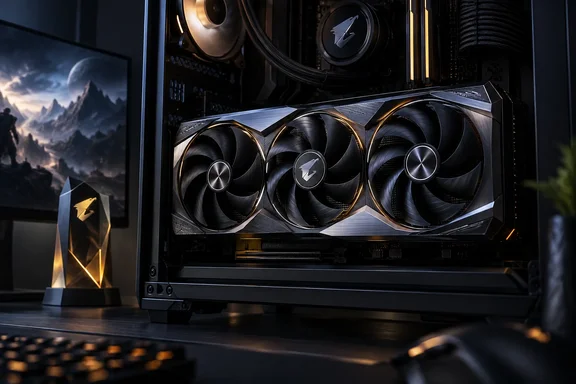
The important distinction is between a particularly well-equipped RTX 5080 and a fundamentally different GPU. Gigabyte adds a factory overclock and an elaborate cooling system, while retaining the RTX 5080’s 10,752 CUDA cores and 16GB of GDDR7 memory. Its official specifications provide useful checks that go beyond the review’s praise.
What PCMag’s verdict establishes—and what it does not
PCMag’s reviewer, Michael Justin Allen Sexton, praises the INFINITY’s gaming performance, factory overclock and thermal design. The publication lists a $1,899 MSRP and positions the card as an enthusiast-grade option rather than a budget-conscious RTX 5080.
Its “fastest tested” distinction has a specific boundary: PCMag’s tested cards, not every RTX 5080 available. The accessible review material also does not include the benchmark tables needed to quantify its lead over cheaper models. Consequently, the award supports an attributed recommendation, but not a claim that buyers receive a particular percentage improvement for their money.
That distinction matters. An excellent graphics card can still be an expensive way to obtain a modest advantage.
What Gigabyte adds to the RTX 5080
Gigabyte lists a 2,805MHz core clock against a 2,617MHz reference value, with 30Gbps memory on a 256-bit interface. The board uses PCI Express 5.0 and offers three DisplayPort 2.1b outputs plus one HDMI 2.1b output.
Those clock specifications establish a factory overclock; they do not establish an equivalent percentage increase in gaming performance. Gigabyte itself cautions that actual performance varies with system configuration. Treat the higher clock as a hardware characteristic, not a universal frame-rate multiplier.
The other major differentiator is the WINDFORCE HYPERBURST cooling system. Gigabyte describes a combination of Hawk fans, an additional Overdrive fan, a vapor chamber and composite copper heat pipes. This is a substantial part of the INFINITY’s premium positioning, rather than merely a decorative shroud. Manufacturer descriptions explain the design, however; they are not independent evidence of noise levels or cooling superiority.
Read the 4K results carefully
A separate September 16, 2026 review by Technopat provides useful corroborating measurements. It reports a FurMark average temperature of 78.5°C, a maximum of 79.1°C and maximum power consumption of 361W. These are results from Technopat’s setup, not PCMag’s measurements or guaranteed temperatures inside another case. Technopat’s accompanying video description also carries an advertisement tag, a disclosure worth retaining when weighing its findings.
Its Cyberpunk 2077 testing illustrates why headline frame rates need their settings attached:
- 4K, ray tracing Ultra, DLSS Auto, frame generation off: 87 FPS average.
- The same listed settings with frame generation on: 239 FPS average.
Those numbers describe different rendering configurations. NVIDIA explains that DLSS Multi Frame Generation creates additional frames using AI; the larger displayed-frame count should therefore not be interpreted as an equivalent increase in conventionally rendered performance. NVIDIA also treats responsiveness separately through Reflex. A benchmark without its DLSS and frame-generation settings is missing essential context.
Check the case before checking out
For an upgrade, the most immediately actionable evidence is Gigabyte’s compatibility information:
- Dimensions: 330 × 145 × 65mm.
- Recommended system PSU: 850W.
- Power connection: one 16-pin connector.
- Included accessories: a 12V-2x6-to-three-PCIe-8-pin adapter and a graphics-card support kit.
Use those measurements—not a generic RTX 5080 clearance figure—when assessing your case. As a practical inference, the card’s dimensions and power connection mean checking both available installation space and the room needed to route its cable.
The 850W recommendation concerns the whole system’s power supply, not an assertion that the graphics card consumes 850W. NVIDIA’s RTX 5080 user guide likewise specifies an 850W minimum system PSU and supported power-cable configurations.
The value question remains price-dependent
PCMag reports approximate street prices of $1,600 for entry-level RTX 5080 models and $4,800 for the least expensive RTX 5090 models in its review. Those are the publication’s market observations, not independently established nationwide prices here. They explain its preference for the RTX 5080, but do not automatically establish this premium Gigabyte model as the best value.
The balanced conclusion is straightforward: PCMag strongly recommends the INFINITY as a deluxe RTX 5080, while Gigabyte’s specifications expose the installation requirements buyers must satisfy. Before paying the premium, look for a measured advantage in the games and settings you actually use—and make sure the card, power supply and cable arrangement suit your PC. The award is persuasive; the tape measure still gets a vote.
References
- Gigabyte Aorus GeForce RTX 5080 Infinity 16G Review: A Soaring Spitfire of a Gaming Card - pcmag.com pcmag.com · 2026-10-03T20:00:00+00:00
- Jet motoru değil, ekran kartı! GIGABYTE AORUS GeForce RTX 5080 INFINITY 16G İncelemesi - Technopat technopat.net
- AORUS GeForce RTX™ 5080 INFINITY 16G Graphics Card Specifications - GIGABYTE Global gigabyte.com