

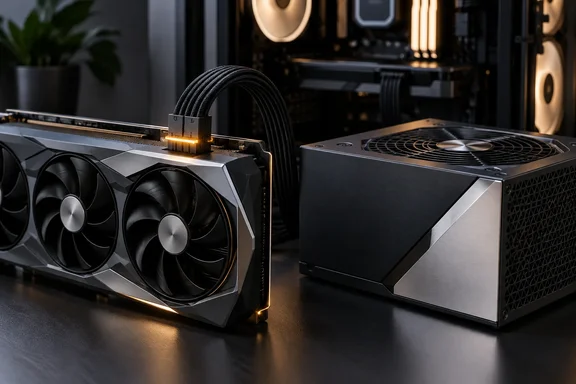
What Gigabyte built, and who actually built it
Like most PC brands, Gigabyte doesn't make its own power supplies. This one is built by HEC, a long-established Taiwanese OEM. Tom's Hardware sees the Gaming GM PG5 series as Gigabyte's newest attempt to cover the upper mainstream, and treats the 1000W model as a follow-up to the popular UD1000GM PG5.
The 1000W model is only the largest in the range. TechPowerUp reported at launch in April 2026 that the new Gigabyte GAMING series is fully compliant with ATX 3.1 and PCIe 5.1 standards, available in 750 W, 850 W, and 1000 W capacities. It comes in both Black and Ice editions, and the white version is sold as the 1000GM PG5 ICE.
Key specs from the review:
- Output: 1000W total. The +12V rail is rated for 83.3A (1000W). The +3.3V and +5V rails are rated at 20A each, with 120W combined. +5Vsb is 3A and −12V is 0.3A.
- Input: 100–240 VAC, 50–60 Hz
- Dimensions: 150 × 150 × 86 mm (L × W × H)
- Fan: Hong Hua HA13525H12SF-Z, a 135 mm fluid dynamic bearing fan
- Cabling: Fully modular, including the 24-pin. Connectors are one ATX 24-pin, two EPS 4+4, one native 12V-2x6 (rated for 600W), four PCIe 8-pin, eight SATA and four Molex
- Warranty and price: Ten years, and $170 when Tom's Hardware reviewed it
The box contents are sparse. Tom's Hardware found only the AC cord, four cable ties and a manual. There were no Velcro straps, no cable combs, and its sample didn't even include mounting screws. That doesn't affect how the PSU works, but it's worth knowing before you start a build.
Section summary: This is a mainstream 1000W HEC platform with ATX 3.1/PCIe 5.1 compliance, full modularity and a native 600W GPU cable. The only 1000W-specific trade-off to plan for is its 150 mm length.
T-Guard: how it works and what it requires
T-Guard is the main difference from the older UD1000GM PG5. Tom's Hardware describes it as a thermal monitoring system for the 12V-2x6 connector that can cut power to the graphics card if the connector starts overheating.
Gigabyte's product page says T-Guard monitors the 12V-2x6 cable for abnormal heat and cuts power to the GPU if it detects a risk. Its footnote says keeping the system usable then requires integrated graphics and a display connected to the motherboard, and a reboot restores GPU power. Gigabyte's separate explainer instead describes capping GPU power. Neither page provides a measured trip threshold or a fault-injection result for this model.
What this means in practice (our reading, based on Gigabyte's footnote):
- Your CPU needs integrated graphics. Many Intel desktop chips have it, and so do recent AMD desktop processors, but some CPU SKUs don't. Check the spec sheet for your exact model.
- Most gamers plug the monitor into the graphics card. If T-Guard behaves as the product page describes and cuts GPU power, a monitor connected only to that card could lose its picture even while the PC stays on. Gigabyte's explainer describes a different, power-capping response, so the exact display behavior has not been established by an independent trip test.
- To keep the "save your work" fallback, you need a display connected to the motherboard's video output, as Gigabyte specifies.
Gigabyte's own descriptions differ: the product page says GPU power is cut, while its explainer says T-Guard caps GPU power. Tom's Hardware describes a cut-off; Abit.ee describes reduced power limits. Without a published fault-injection test or clarification from Gigabyte, we cannot say which response this model uses in every overtemperature case.
Tom's Hardware gives T-Guard a fair verdict but adds a caveat. The concept should work, the reviewer says, unless the connector heats up very suddenly and the sensor's position doesn't let it react in time. The review didn't include a fault-injection test, so there are no measured trip thresholds or response times. T-Guard adds a layer of protection. It doesn't guarantee a connector can never fail.
Gigabyte also added a simpler, low-tech fix. The 12V-2x6 dual-color cable design lets users verify when the cable is securely plugged in. A partly seated plug is widely considered a common cause of melted connectors, so a light-grey band that stays visible when the plug isn't fully in is a practical cue.
Section summary: T-Guard watches connector temperature, which ordinary OCP limits cannot measure. Gigabyte's product page says an iGPU and a motherboard-connected display are needed to keep working after a GPU power cut; its explainer describes power capping instead. We have not found an independent trip test establishing the response for this model.
Gold on the box, Platinum on the bench
Tom's Hardware's efficiency results at 25°C:
| Condition | 230 VAC | 115 VAC |
|---|---|---|
| Average (nominal load range) | 92.6% | 90.6% |
| Peak | 93.8% (~50% load) | 92% (~30% load) |
| Sustained 1000W | 91.0% | 88.5% |
In the roughly 45°C hotbox, averages fell by only 0.8 percentage points to 91.8% (230 VAC) and 89.8% (115 VAC). Full-load results were 89.9% and 87.4%.
The review says the unit holds 80 PLUS Platinum from CLEAResult and ETA Platinum from Cybenetics. Gigabyte's own pages advertise only part of that. The official product page calls it a 1000W, 80 PLUS Gold, fully modular ATX 3.1 power supply. Gigabyte's US AORUS listing mentions both 80 PLUS Gold certified Cybenetics ETA Platinum & LAMBDA A- certified. The LAMBDA A- rating is Cybenetics' noise certification, which is a useful extra data point the review doesn't cover.
Why would a vendor under-badge its own product? The review calls it "anyone's guess." One common industry explanation is certification timing or price segmentation between product lines, but that's speculation, and Gigabyte hasn't explained. Either way, the buyer gets more efficiency than the box promises.
Section summary: The measured efficiency matches Platinum certifications from two separate bodies, and it holds up well in heat. The Gold badge undersells the unit.
Noise, heat and electrical quality
At 25°C, the semi-passive fan stays off up to about 300W, which covers most desktop and light gaming use. After it starts, Tom's Hardware measured:
- ~33 dB(A) at 500W
- 36.4 dB(A) at 600W
- ~41 dB(A) at 800W
- 48.2 dB(A) at a sustained 1000W
The hotbox changes things. Noise reached 38.3 dB(A) at 500W, 47.2 dB(A) at 800W and 54.5 dB(A) at 1000W, which is essentially the fan's top speed. The primary and secondary heatsinks hit 88°C and 82°C at full load. The reviewer considered that reasonable for full output at 45°C ambient and concluded that Gigabyte prioritized longevity. If your case runs hot and your GPU pulls a lot of power for long stretches, expect to hear this PSU.
Electrical results:
- Regulation: 0.5% on both the 3.3V and 5V rails, which is excellent. The 12V rail managed 1.3%, which is average.
- Ripple: 48 mV peak on 12V against the 120 mV ATX limit. The minor rails stayed at or below 26 mV against a 50 mV limit.
- Protections: All of them triggered correctly. OCP tripped at 136% (27.2A) on the 3.3V and 5V rails and at 120% (100A) on 12V. OPP shut the unit down at about 1160W (116%).
Inside, Tom's Hardware found a half-bridge LLC primary with synchronous rectification on 12V and DC-to-DC converters for the minor rails. It also confirmed Gigabyte's all-Japanese capacitor claim: the bulk capacitor is a 105°C Toshin Kogyo 680 μF/400 V unit, and the secondary-side capacitors are TK parts too.
Section summary: Electrical performance is solid but not class-leading. Noise is well controlled at room temperature and gets loud in heat. The component choices favor a long service life.
How it fits in the 1000W market
Tom's Hardware names the Corsair RM1000x, MSI MAG A1000GL PCIE5 and Montech Century II 1050W as competitors in the same price range. It says to expect about the same regulation and ripple from all of them, with the Gigabyte ahead on efficiency. It didn't publish head-to-head numbers, so treat that as the reviewer's judgment rather than a measured comparison. T-Guard-style protection is spreading, too. Abit.ee reports that MSI has two models with comparable protection at this point.
Who it suits:
- Good fit: Gamers with a 12V-2x6 GPU who want Platinum-class efficiency, a long warranty, and connector monitoring as a backup to careful cable seating.
- Think twice: Builders using very compact ATX cases (because of the 150 mm length), people whose CPU has no integrated graphics (they lose T-Guard's keep-working fallback), and anyone running sustained heavy loads in hot rooms who cares about noise.
Bottom line
Tom's Hardware's review gives Gigabyte a well-built HEC unit that outperforms its own Gold branding. It has all-Japanese capacitors, quiet operation at typical loads, and a connector-temperature safeguard aimed at the way 12V-2x6 connectors actually fail. Its weaknesses are a bare accessory bundle, average 12V regulation, and loud fan noise when pushed hard in heat. At its $170 review price with ten years of coverage, it's a sensible choice rather than the best in every category. If you rely on T-Guard, find out now whether your CPU and monitor setup will let you keep working after it trips, not after it has.
Correction (September 27, 2026): We updated the T-Guard section to reflect two different descriptions from Gigabyte: its product page says GPU power is cut, while its explainer says GPU power is capped. We also qualified the expected display behavior because no independent trip test was cited.
References
- Gigabyte 1000GM PG5 1000W power supply review: Impressive Platinum-level efficiency with T-Guard thermal protection Tom's Hardware · 2026-09-27T13:00:00+00:00
- GIGABYTE GAMING 1000GM PG5 ICE Power Supply - GIGABYTE Global gigabyte.com
- Gigabyte T-Guard: Temperature Sensor Inside the Cable to Prevent 12V-2x6 GPU Fires abit.ee