

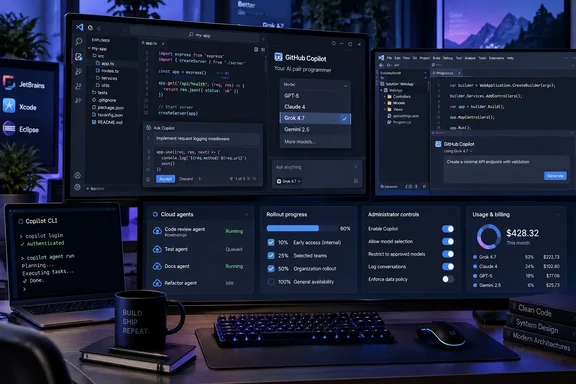
GitHub describes Grok 4.7 as xAI’s latest reasoning model, building on Grok 4.6 and designed for agentic coding and complex, multistep workflows. Separately, Unite.AI reports availability in Cursor and Grok Build as part of the model’s broader release. That reporting supports the wider launch context; GitHub’s announcement establishes the Copilot rollout.
Where you can select Grok 4.7
GitHub says Grok 4.7 will appear in the model picker in these Copilot environments:
- Visual Studio Code and Visual Studio.
- Copilot CLI.
- GitHub Copilot cloud agent and the GitHub Copilot app.
- JetBrains IDEs, Xcode, and Eclipse.
For Windows developers, the announcement therefore covers both Visual Studio’s integrated development environment and Visual Studio Code, alongside command-line and cloud-agent workflows. GitHub does not provide minimum client versions or a rollout completion date in this announcement.
If you have an eligible individual subscription, the supported action is to look for Grok 4.7 in the model picker. If it is missing, GitHub advises checking again later as the rollout progresses. Its absence on launch day does not, by itself, establish a client fault.
The announcement positions Grok 4.7 for work involving multiple connected steps, rather than providing evidence of a specific performance improvement. It contains no benchmarks or feature-level comparison with Grok 4.6, so it does not establish that switching models will produce better results for a particular repository or task.
Organization access can be enabled by default
Copilot Business and Enterprise administrators can manage Grok 4.7 through the model policy in Copilot settings. GitHub says new models are automatically enabled under default model enablement, unless an administrator has turned off the global default or explicitly disabled the individual model.
For organizations that require approval before developers use a new model, this is the immediate administrative decision: review the default-enablement policy and the Grok 4.7-specific setting. Waiting for someone to request access is insufficient if the organization’s existing policy already permits new models automatically.
An organization user who cannot see Grok 4.7 has two relevant boundaries to consider: the staged rollout and the administrator-controlled model policy. Repeatedly checking the picker will not resolve a policy restriction.
Access and cost are separate decisions
GitHub explicitly states that Grok 4.7 is billed at provider list pricing under usage-based billing. The release announcement does not include its numerical rates, so it cannot support a cost comparison with Grok 4.6 or other Copilot models.
That makes subscription eligibility only the first check. Before adopting Grok 4.7 for routine or long-running agent work, establish the applicable rates and your account’s spending controls; there is no basis here to assume the same cost as your current model.
Developers can select Grok 4.7 once it reaches their account and permitted client. Administrators should review model access now, because the default policy may make it available without a separate enablement action.
Update: Reported API pricing and benchmark claims emerge for Grok 4.7 (September 21, 2026)
According to WindowsReport, xAI has published additional Grok 4.7 launch details beyond GitHub’s Copilot notice, including reported API list prices of $2 per million input tokens and $6 per million output tokens. The outlet says a faster variant is also available at double the output speed and double the price. This adds numerical context that GitHub’s Copilot announcement did not provide, although Copilot users should still verify how GitHub applies provider pricing and usage charges to their own plan.
WindowsReport also reports xAI claims Grok 4.7 uses a larger base model and longer reinforcement-learning process than Grok 4.6, with an emphasis on extended, multistep coding and knowledge-work tasks. Reported benchmark results include 46.3% on CursorBench 4.0, versus 40.4% for Grok 4.6, and 71.0% on DeepSWE v1.1 in a high-effort setting.
These are vendor-reported figures rather than GitHub Copilot performance measurements. They do not establish equivalent results inside Visual Studio, VS Code, Copilot CLI, or GitHub’s cloud agent, where task setup, context, tool access, and billing controls can differ.