

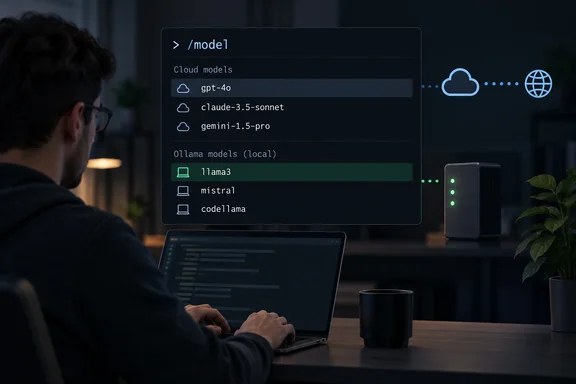
/model picker, instead of wiring them up by hand with environment variables. Copilot CLI can already connect to your own model provider or run fully local models instead of GitHub-hosted model routing. The new feature is a discovery layer on top of that capability, and it comes with some privacy caveats.
What changed
GitHub's October 7, 2026 changelog entry says the feature starts in Copilot CLI version 1.0.94-0. Running /model now surfaces supported models from a running local Ollama instance. They appear next to your configured models and the cloud models GitHub Copilot provides.
Discovery is not automatic enrollment. The flow works like this:
- Start Ollama and make sure the model you want is already pulled.
- Open
/modelin a Copilot CLI session. - Pick a discovered model and review its provider and endpoint.
- Confirm either Add and use for this session or Add without switching.
You can use the model in your current session without restarting the CLI. If a provider connection fails, the picker shows the failure with an explanation. GitHub doesn't list every failure cause, and it doesn't promise automatic repair.
What discovery doesn't do
- It doesn't install anything. Ollama and the model must already be installed. The flow won't download a runtime or a model.
- It has model requirements. Models must support tool calling and streaming. GitHub doesn't name specific qualifying Ollama models, so you may need to try a few.
- It doesn't guarantee a large context window. GitHub's general provider documentation says that you need either an API key from a supported provider or a local model running, such as Ollama. The same documentation recommends a context window of at least 128k tokens for best results. That is a recommendation for provider setups generally, not a stated minimum for the discovery flow.
Before and after: the manual route
Before this change, the documented path for a local Ollama instance was environment variables. The documentation shows setting COPILOT_PROVIDER_BASE_URL=[url]http://localhost:11434[/url] and COPILOT_MODEL=YOUR-MODEL-NAME, replacing the placeholder with a model you've pulled in Ollama. Its example is llama3.2.
The October 7 announcement doesn't say this route has been removed. It remains useful for scripts, containers and CI, where there's no interactive picker. Discovery mainly helps interactive use, where you'd rather browse than remember exact model tags.
Third-party guides show other approaches. Ollama's own documentation describes an ollama launch copilot quick-setup command. That is a separate Ollama-side integration and not part of GitHub's discovery announcement.
"Local model" does not mean "offline"
This is the most important caveat in the announcement. Choosing a local model doesn't turn on offline mode, and it doesn't disable GitHub telemetry. Offline mode is still a separate, explicit setting: COPILOT_OFFLINE=true.
GitHub's documentation says offline mode stops the CLI from contacting GitHub's servers. It only guarantees full network isolation if the provider is also local or inside the same isolated environment. If the provider endpoint is remote, prompts and code context still go over the network to that provider.
GitHub's April 2026 BYOK announcement said that you can operate in air-gapped environments with this setup. That claim depends on offline mode being enabled. Picking a discovered model alone doesn't deliver it.
Three things are easy to conflate, so check each one:
| Question | What to check |
|---|---|
| Where does the model run? | The provider and endpoint shown in the confirmation step |
| Where does the provider endpoint live? | Whether the URL points to your machine or a remote host |
| Is the CLI contacting GitHub? | Whether COPILOT_OFFLINE=true is set |
The reviewed material doesn't describe what a given model runtime stores or retains. This article makes no claims about Ollama's data handling.
Enterprise context
GitHub announced in June 2026 that models configured by enterprise administrators appear in the CLI's /model picker. The October announcement is about local Ollama discovery. It doesn't state any new enterprise policy, entitlement or administrator requirement. Admins who care about where code context goes should still review their own provider configuration and offline settings.
The Copilot app and intelligent routing
GitHub says the CLI update builds on the Copilot app's provider experience. In the app, you add a supported provider under Settings > Model providers. The changelog doesn't claim the app has the same Ollama discovery interaction.
GitHub also announced "intelligent routing with local models" and pointed to a Microsoft Command Line blog post, saying to stay tuned for availability. The linked post wasn't available for review. Treat routing as announced but not yet available, and not as part of the 1.0.94-0 feature.
Practical takeaways
- Update Copilot CLI to 1.0.94-0 or later before looking for the discovery option.
- Start Ollama and pull a tool-calling, streaming-capable model first.
- Read the provider and endpoint in the confirmation step before you add anything.
- Set
COPILOT_OFFLINE=trueexplicitly if you need to keep the CLI from contacting GitHub, and confirm the provider is local. - Keep the environment-variable method for automation.
This is a modest but sensible quality-of-life change. It lowers setup friction for local models, and GitHub is careful to keep model choice separate from network and telemetry behavior. Developers working on sensitive codebases should keep those two things separate in their own checks as well.
References
- Discover local models in GitHub Copilot CLI GitHub Changelog · 2026-10-07T15:46:13+00:00
- Adding LLM models to GitHub Copilot CLI - GitHub Enterprise Cloud Docs docs.github.com
- Adding LLM models to GitHub Copilot CLI - GitHub Docs docs.github.com