

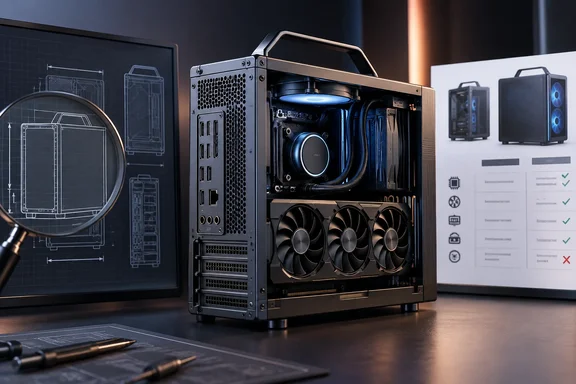
GMKtec NEO-X1 Pro Puts a Desktop RTX 5070 Beside a Laptop-Class Ryzen 9 9955HX3D
The NEO-X1 Pro is built on what GMKtec calls MoDT. MoDT, or Mobile on Desktop, combines a mobile processor with a desktop motherboard and discrete graphics card. The CPU comes from AMD's laptop "Fire Range" family, but it sits on a custom desktop board with desktop-style power delivery instead of inside a notebook chassis. GMKtec says the custom motherboard uses a 13-phase power design and supports up to 160W of processor power delivery. GMKtec's Amazon listing also describes the processor as soldered, so the CPU cannot be upgraded later.
What sets the machine apart is the graphics card. GMKtec does not install a GeForce RTX 5070 Laptop GPU, but rather a desktop GeForce RTX 5070. It offers 6,144 CUDA cores and 12 GB of GDDR7 memory on a 192-bit memory interface. Igor's Lab points out that this clearly distinguishes the NEO-X1 Pro from many compact gaming PCs that rely on mobile GPUs or integrated graphics solutions due to limited space.
The processor is the X3D variant, with AMD's stacked cache. The X3D processor has 128MB of L3 cache, compared with 64MB on the standard Ryzen 9 9955HX. That 9955HX is the chip in the cheaper sibling model: the standard NEO-X1 combines the Ryzen 9 9955HX with a desktop GeForce RTX 5060 Ti 8GB. Both chips offer 16 cores, 32 threads and boost clocks up to 5.4GHz, according to GMKtec's UK store.
"Mini PC" is how GMKtec and Geeky Gadgets describe the machine, but the size puts it in a different class from palm-sized boxes. The metal case measures 350 × 165 × 265 mm without the handle and weighs around seven kilograms. GMKtec is positioning the computer between conventional mini PCs and significantly larger gaming desktops. "Small-form-factor desktop" is the more accurate label. It is portable in the sense that it has a handle, not in the sense that it fits in a bag.
ETA Prime's NEO-X1 Pro Benchmarks Are Strong, and They Come From One Test Run
These are the numbers Geeky Gadgets attributes to ETA Prime's testing:
| Test | Reported result |
|---|---|
| Geekbench 7 | 394 single-core, 27,379 multi-core |
| Cinebench R24 | 127 single-core, 2,212 multi-core |
| 3DMark Time Spy | 20,755 |
| Forza Horizon 6, 1440p ultra | Over 110 FPS |
| Crimson Desert, 1440p ultra | 81 FPS |
| Cyberpunk 2077, 1440p ultra | Described as smooth, no figure given |
The write-up does not say which of GMKtec's power modes was active. It also leaves out whether upscaling (DLSS), frame generation or ray tracing were on for each game. It mentions ray tracing and multi-frame generation in general terms, and either one can change frame rates a lot. Treat these figures as one reviewer's results on one unit, not a baseline you should expect from every NEO-X1 Pro.
Other testing points the same way on overall capability, though nobody else has published matching figures. On September 16, reviewer zWORMz Gaming posted a 20-game test of the same configuration: Ryzen 9 9955HX3D, 64 GB of DDR5-5600, desktop RTX 5070 and Windows 11 Pro. That test ran in GMKtec's 85W Balanced mode, and the video description does not include a results table. A public Geekbench 6.3.0 upload from September 5 for a NEO-X1 Pro shows 3,388 single-core and 21,788 multi-core under the Windows "Balanced" power plan. It reports a maximum clock of 5,656 MHz and 64 GB of dual-channel DDR5. Geekbench 6 and Geekbench 7 scores sit on different scales, so the two results can't be compared directly.
GMKtec's own performance claim is broader. Its Amazon listing says the pairing crushes 1440p gaming with 100-110 FPS in most modern titles, while DLSS 4 and Frame Generation push performance even higher. ETA Prime's Forza Horizon 6 result lands in that range. Beyond that, the claim is still marketing.
Two spec details in the Geeky Gadgets recap don't match other records. It lists a 3.8 GHz base clock, while the public Geekbench record reports a base frequency of 2.50 GHz. It also gives the RTX 5070 a 170-watt TGP, yet VideoCardz notes that the RTX 5070 has 6,144 CUDA cores, a 192-bit memory interface and a 250W reference power rating. 170 watts is the CPU's peak figure in GMKtec's materials, so the recap looks to have mixed up the CPU and GPU numbers. GMKtec has not published a lower GPU power limit for this system.
The 500W Power Supply Claim Collides With GMKtec's 850W Spec Sheet
The Geeky Gadgets piece says twice that the NEO-X1 Pro has a 500W SFX power supply. Independent launch coverage says otherwise. Igor's Lab describes the machine as combining the Ryzen 9 9955HX3D with a desktop GeForce RTX 5070, liquid cooling, and an 850-watt SFX power supply. VideoCardz reports an 850W fully modular 80 Plus Gold power supply, and GMKtec's UK store lists an internal 850W 80 PLUS Gold SFX power supply.
GMKtec's US product page is inconsistent. Its detailed spec table lists an 850W SFX 80 PLUS Gold unit for both NEO-X1 models, while a headline bullet higher up the page says "Built-In 500W Power Supply." The 500W figure in the hands-on recap may have come from that bullet. Every detailed source says 850W, and that is the figure to plan around.
The difference affects upgrades. Basic Tutorials notes that the fully modular 850-watt power supply with 80 Plus Gold certification also leaves room for future GPU upgrades. A 500W unit would rule out most higher-end cards. If swapping in a bigger GPU later is part of your plan, check the label on the PSU when the machine arrives. Physical card length and cooler thickness are separate limits, and GMKtec has not documented them.
GMKtec's power figures are also easy to confuse. The CPU modes are clear: 54W Silent, 85W Balanced or 160W Performance mode, with up to 170W peak power. The US product page also mentions up to 250W of "total system power" in a bullet but does not explain how that relates to the CPU modes or to a desktop RTX 5070 rated at 250W on its own. Take the mode table as CPU limits, not whole-system draw.
Cooling and Display Outputs: Where the NEO-X1 Pro Recap and the Spec Table Disagree
The hands-on recap describes a 240mm liquid cooler with two 120mm fans. It reports an average CPU temperature of 59.3°C and a GPU temperature of 70°C during long gaming or rendering sessions. GMKtec's spec table describes CPU liquid cooling with a three-fan design. Its Amazon listing is titled with "Liquid Cooling 3-Fan Design," and the UK store lists liquid CPU cooling, a three-fan system. GMKtec does not give the radiator size in the material reviewed. The temperatures are ETA Prime's readings on one unit, with no stated power mode or room temperature, and should not be read as typical operating temperatures.
The display output list has a bigger error. The recap says the rear panel has four DisplayPort 2.1 outputs plus one HDMI 2.1 port. GMKtec's spec table splits the outputs into two groups:
- The RTX 5070 provides three DisplayPort 2.1b outputs and one HDMI 2.1b output, each listed at up to 8K/60Hz.
- The motherboard's rear I/O adds one HDMI 2.1 TMDS port (listed at 4K/60Hz) and one DisplayPort 1.4 port (listed at 8K/60Hz). These are driven by the processor's integrated graphics.
- GMKtec states support for up to four displays in total.
Igor's Lab confirms the GPU side: for monitors, the graphics card provides three DisplayPort 2.1b ports as well as HDMI 2.1b. GMKtec's UK store lists the onboard graphics as Integrated AMD Radeon™ 610M Graphics • 2 graphics cores. That gives you six physical video ports, and only four of them are on the RTX 5070. Plug gaming monitors into the graphics card. A display connected to the motherboard ports runs from a two-core integrated GPU, so it suits a secondary screen, not gaming.
Memory, PCIe 5.0 Storage and Ports on the NEO-X1 Pro
The memory is upgradeable. GMKtec says two DDR5-5600 SO-DIMM slots support up to 96GB RAM. The review configuration ships with 64 GB in dual-channel mode, so both slots are already filled. Going to 96 GB means replacing both modules, not adding one. Early launch coverage listed a 64 GB maximum, but GMKtec's current listings say 96 GB.
The recap implies the included 2 TB drive is a PCIe 5.0 SSD, which blurs two separate things. GMKtec's storage table lists the supplied primary drive as a PCIe 4.0 M.2 2280 SSD. It separately lists two M.2 slots that support PCIe 5.0 x4 drives, up to 16TB of total storage (two 8 TB drives). The slots support Gen 5 speeds, but the drive in the box is Gen 4. The recap also mentions SATA SSD expansion. GMKtec's spec table, as reviewed, does not clearly document SATA support, so confirm it before buying drives for it.
The port list, per GMKtec's spec table:
- The front panel has two USB-A 2.0 ports, one 5 Gbps USB-C data port, a 3.5mm combo audio jack and the power button.
- The rear motherboard I/O has two USB-A 2.0 ports, two USB-A 3.2 Gen 2 (10 Gbps) ports, one 10 Gbps USB-C data port, 2.5GbE LAN, an antenna connector, and mic-in, line-in and line-out jacks.
- Wireless is Wi-Fi 7 and Bluetooth 5.4. GMKtec lists the Wi-Fi module as RZ717/MT7925 and the Ethernet controller as a Realtek RTL8125.
Four of the seven USB ports run at USB 2.0 speed, and the front USB-C port tops out at 5 Gbps. That's fine for keyboards, mice and headsets. Fast external storage belongs on the rear 10 Gbps ports.
Pricing the NEO-X1 Pro Means Reading Three Different Numbers
The system first appeared in China. In China, the Pro model starts at 16,499 yuan—equivalent to about $2,438. GMKtec's own blog set the global date: officially launching on August 17, 2026, the NEO-X1 Series introduces a new approach to desktop computing by combining AMD Ryzen™ 9 processors, NVIDIA RTX™ 50 Series graphics, advanced liquid cooling, and GMKtec's MODT (Mobile on Desktop) architecture in a compact 14.6L chassis.
US pricing is less clear. GMKtec's launch post gave the Pro a price of $2,899.99 with 64 GB of RAM and a 2 TB SSD. As of late September, the US product page shows $3,199.99 next to a crossed-out $3,699.99, while a banner on the same page advertises $2,199.99. GMKtec also lists a cheaper 32 GB/1 TB configuration. The store lists a seven-day return window and a one-year warranty. Check the checkout price and the configuration you're actually getting before you pay.
GMKtec argues on Amazon that the prebuilt beats building your own because of component prices. It claims RTX 5070 cards now averaging $900 (36% above MSRP) due to shortages. That is the seller's framing and has not been checked. A fair comparison with a DIY build should also account for the soldered mobile CPU and the proprietary motherboard.
What this means for you
If you want 1440p gaming from a desktop GPU in a box smaller than a mid-tower, the NEO-X1 Pro is worth a look. Buy it on GMKtec's documented specs, not the hands-on recap. It is a good fit if you'll mostly leave the configuration alone or upgrade RAM and SSDs. Builders who expect to swap the CPU later should look elsewhere, and anyone planning a bigger GPU should confirm physical fit first.
- The power supply is an 850W SFX 80 PLUS Gold unit, according to GMKtec's detailed specs and several independent outlets. The 500W figure in the recap matches a stray bullet on GMKtec's US page, not the spec table.
- The RTX 5070 has three DisplayPort 2.1b outputs and one HDMI 2.1b output. The extra HDMI and DisplayPort 1.4 ports on the motherboard run from Radeon 610M integrated graphics, so connect gaming monitors to the card.
- The included 2 TB SSD is a PCIe 4.0 drive in a system with two PCIe 5.0 x4 slots. You need to buy a Gen 5 drive to get Gen 5 speeds.
- Getting to the 96 GB RAM maximum means replacing both 32 GB SO-DIMMs in the 64 GB configuration.
- ETA Prime's frame rates and temperatures come from one unit with undisclosed settings and power mode. The CPU runs at 54W, 85W or 160W depending on the mode, so check which mode you're in when comparing results.
- Confirm the live US price at checkout. GMKtec's own pages have shown $2,199.99, $2,899.99, $3,199.99 and $3,699.99.
The NEO-X1 Pro shows that a desktop RTX 5070 and a 16-core X3D laptop chip can share a 14.6-liter case and run 1440p games well. It is also the kind of product where a few hundred dollars and a few spec lines separate a sensible purchase from a mistake. The two other reviewers testing it are working in Balanced mode or haven't published result tables, so the next useful data point is full Performance-mode results with settings disclosed. Until then, GMKtec's detailed spec table is the reference: an 850W supply, a three-fan liquid cooler, four GPU outputs and Gen 5 slots with a Gen 4 drive installed.
References
- GMKtec NEO X1 Pro Liquid Cooled 16-Core Mini PC Hands On - Geeky Gadgets Geeky Gadgets · 2026-09-24T06:45:00+00:00
- GMKtec NEO-X1 Pro MODT Gaming PC AMD Ryzen™ 9 9955HX3D + NVIDIA® GeForce gmktec.com
- GMKtec NEO-X1 Pro: Ryzen 9 9955HX3D and RTX 5070 igorslab.de