

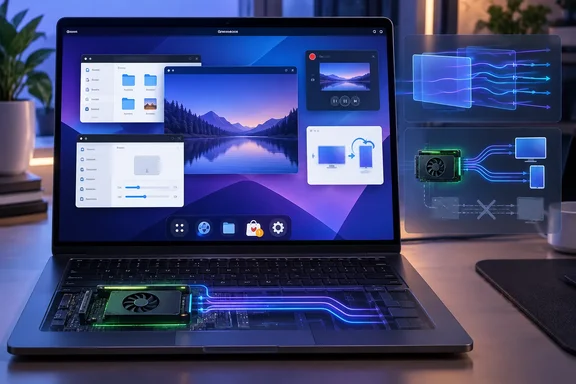
GNOME’s release notes say the project has removed legacy NVIDIA driver interfaces in favor of modern standard graphics interfaces; they do not announce a new GPU control panel. Phoronix separately identified the retired path as EGLStreams and EGLDevice support in Mutter, GNOME’s window manager and Wayland compositor. For Linux desktop users—especially those evaluating a Wayland-first workstation as an alternative or companion to Windows—the distinction is significant: GNOME 51 is simplifying the graphics stack, not adding a rival to NVIDIA Control Panel.
The release also arrived a day before TechPowerUp’s September 17 publication date. That is a minor calendar discrepancy, but it illustrates a more important practical point: GNOME’s version-number release is the upstream starting gun, not an automatic desktop upgrade for everyone. Availability depends on the Linux distribution and its update policy.
Mutter’s frame scheduling is the release’s central change
The largest GNOME 51 change is inside Mutter, which controls window composition, display output, input coordination, and the desktop’s visual cadence under Wayland. GNOME says it reworked scheduling and screen-frame delivery so that animations should stay smoother when the system is busy, while also reducing redundant work and buffer copying during screen recording.
This is the kind of change users notice without necessarily being able to name it. A desktop can have a fast CPU and GPU yet still feel unresponsive if a window animation, a monitor refresh cycle, and an application’s rendering workload are poorly coordinated. Frame scheduling determines when the compositor prepares and presents each frame; improving it can reduce visible hitching when a browser, IDE, video call, or file operation is competing for resources.
GNOME has not published before-and-after benchmarks, hardware coverage, or a list of workloads where the gains are most pronounced. That means readers should treat the “smoother and more responsive” language as an upstream claim rather than a demonstrated universal performance result. Still, the work targets a genuine desktop-engineering concern rather than a cosmetic tweak, and Phoronix’s coverage likewise identifies improved frame scheduling as the release’s headline technical development.
The screen-capture changes could also matter beyond casual recording. Many Linux remote-support, training, streaming, and documentation workflows rely on the same Wayland-era capture stack that GNOME’s built-in Screenshot tool uses. Less buffer copying should lower overhead, though GNOME has not claimed a particular reduction in CPU use, latency, or dropped frames.
NVIDIA support is being narrowed to the modern Wayland path
The most consequential compatibility change is easy to misread. GNOME 51 removes support for legacy NVIDIA graphics interfaces, which GNOME describes as a code simplification enabled by modern standardized interfaces. Phoronix reported in June that Mutter was dropping its EGLStreams and EGLDevice support, NVIDIA’s earlier approach to Wayland integration.
That does not mean GNOME 51 drops NVIDIA GPUs generally. It means the desktop is no longer carrying a compatibility route for older NVIDIA driver stacks that depended on EGLStreams. Current NVIDIA users on the modern GBM, DMA-BUF, and kernel mode-setting path are the intended beneficiaries of a less specialized compositor codebase. The change reduces maintenance burden and aligns NVIDIA handling more closely with the interfaces used elsewhere in the Linux graphics stack.
The risk sits with older proprietary driver deployments, custom images, and long-lived enterprise workstations where “NVIDIA driver” may conceal years of accumulated compatibility assumptions. An administrator upgrading a locked-down GNOME environment should verify the installed driver’s Wayland support before moving to GNOME 51, rather than assuming that a successful NVIDIA setup from a previous release will behave identically.
TechPowerUp’s reference to a single “modern management UI” overstates and mischaracterizes this shift. The GNOME release notes describe removal of old interfaces, not the arrival of a graphical NVIDIA administration tool. There is no indication in the official announcement that GNOME 51 replaces NVIDIA’s own configuration utilities, distribution packaging tools, or enterprise GPU-management workflows.
The first real upgrades will arrive through distributions
GNOME 51 is upstream software, and the project says it will reach major Linux distributions over the coming weeks. Its release announcement specifically points to Fedora 45 and Ubuntu 26.10 as distributions expected to carry the desktop, while offering GNOME OS nightly images and a GNOME 51 Flatpak SDK for earlier testing and development.
Fedora’s published schedule places Fedora Linux 45’s beta on September 15, 2026, just before GNOME 51’s release, with October 20 listed as its current final target. Fedora also reserves October 27 and November 3 as contingency target dates. In other words, Fedora users may encounter GNOME 51 components during the Fedora 45 testing cycle, but a production rollout should not be inferred from GNOME’s announcement alone.
Users on established releases should not expect GNOME 51 to arrive as a normal feature update merely because it is now upstream. Distribution maintainers commonly keep major desktop versions fixed for a release’s lifetime, applying selected bug and security fixes instead. That restraint matters for organizations using Linux desktops alongside Windows fleets: it avoids turning a standard update window into a platform migration without testing extensions, graphics drivers, smart-card tools, remote-access components, and internal applications.
GNOME’s release calendar lists version 51.1 for October 10, 2026. That first point release is likely to be the more sensible baseline for cautious adopters unless their distribution has already incorporated equivalent fixes.
Settings and input changes are aimed at laptops and managed devices
Several GNOME 51 changes address small but persistent workstation annoyances. Displays gains automatic rotation for devices with accelerometers, along with an orientation lock, while monitor arrangement gains center-aligned snapping. The Mouse panel can now automatically disable a laptop touchpad when an external mouse is connected—a useful default for users who accidentally brush the touchpad while typing.
The Users settings panel has a redesigned fingerprint-enrollment flow. This is welcome usability work, but it should not be confused with a change to the underlying biometric security model. GNOME has not announced a new fingerprint-authentication standard, broader hardware support, or an enterprise policy framework; the improvement is to setup and interaction.
Network settings adds DNS search-domain configuration and removes WEP wireless support entirely. The WEP removal is the clearest security-related policy change in the release. WEP has long been obsolete and insecure, so its disappearance should affect few legitimate deployments; however, anyone maintaining old Wi-Fi hardware, isolated lab equipment, or legacy network appliances should identify and replace those dependencies before standardizing on GNOME 51.
Remote Login also gains support for SSH socket servers in addition to the prior service-based configuration. That could be useful for more flexible remote-access setups, but GNOME’s announcement provides no deployment examples or security guidance. Administrators should validate how their distribution exposes the option and ensure that existing SSH access controls, key policies, and logging requirements remain intact.
GNOME Software adds a warning, not a safety gate
GNOME Software will now warn when someone attempts to install an end-of-life application. The feature is a meaningful improvement for ordinary users navigating Flatpak catalogs, because an application’s continued listing is not the same thing as active maintenance.
But it is an advisory, not a block. Users can still proceed, and the warning does not establish that a package is malicious, vulnerable, or incompatible. For managed machines, the practical control remains a curated software source, application allowlisting where appropriate, and an update process that can remove abandoned tools rather than simply alerting after a user selects one.
GNOME Software also exposes a more complete list of Flatpak file permissions before installation and starts faster by reusing cached app data. Those changes make the store more useful as an inspection point, but permission descriptions still require judgment. Access to home-directory files, devices, and host services can be appropriate for one application and excessive for another.
Elsewhere, GNOME says passwords and keys are now stored through a component called oo7. The project characterizes it as enhanced secure key storage, but has not presented a threat model or migration details in the release announcement. Organizations with established secret-storage integrations should confirm behavior in their distribution packages before treating the change as operationally invisible.
The application changes favor responsiveness and usable metadata
GNOME 51’s app work is less flashy but often more immediately useful. Files moves several slow operations off the blocking path, speeds folder reloads for large or slow directories, improves selection behavior after copying, and groups notifications. For users working from network shares or large project folders, these are the changes most likely to register as day-to-day polish.
Calendar has been reworked for faster opening, browsing, and month-view rendering, with reduced background synchronization use. It also gains direct map links for event locations and improved Microsoft Teams meeting-link support in its event editor. The Teams change is particularly relevant in mixed Windows and Linux workplaces: it improves interoperability at the calendar layer, without suggesting that GNOME is offering a native replacement for Microsoft’s collaboration client.
Maps adds offline maps and richer public-transit directions where data is available, including live departures, delays, platform or stop information, and walking-time estimates. Image Viewer now exposes embedded color-profile data, creator and copyright metadata, camera and lens details, and the software used to create or edit an image. Those additions give photographers and designers more inspection capability without requiring a separate metadata utility.
GNOME 51 also adds scalable SVG cursors, expands Reduced Motion support across the shell and core widgets, and allows keyboard-only adjustment of Screenshot selections. These are modest features individually, yet they reinforce the release’s real theme: fewer rough edges in the interaction layer rather than a wholesale redesign.
GNOME’s next major release is planned for March 2027. Until then, GNOME 51’s practical test will occur in Fedora 45, Ubuntu 26.10, rolling distributions, and the managed fleets that decide whether its modernized NVIDIA path and compositor work are ready for their hardware.