

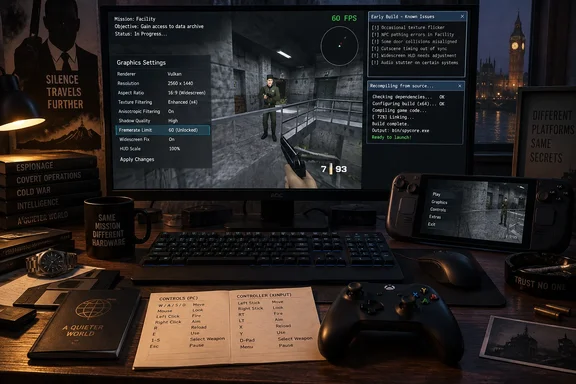
For PC players, this is a more consequential milestone than another emulator configuration. The port runs the original 1997 Nintendo 64 version of GoldenEye 007 from reconstructed source code, adds keyboard-and-mouse support and a modern dual-stick layout, and exposes settings including resolution, frame caps, MSAA, texture filtering, field of view, and draw distance. It is still an early build with visible rendering faults, stretched widescreen, and no multiplayer, but the full single-player campaign is now playable from beginning to end.
The project also clarifies an important distinction often blurred in retro-port coverage: this is the Nintendo 64 game, not the leaked and cancelled Xbox 360 remaster that was separately recompiled for PC earlier in 2026. That difference determines both the look of the game and its feature set. Players seeking HD remaster assets, true widescreen, or online multiplayer will not find them here.
The v0.2.1 story is already outdated
XDA’s report accurately described GoldenEye 007 PC Port v0.2.1 as a pre-1.0 release that could run all 21 solo missions at 60 frames per second, with music and sound effects functioning. But the developer’s GitHub repository now lists v0.2.2 as the current build and records a more detailed test status: the campaign has been played through on Agent difficulty, and each mission has been tested under Windows, Linux, and on real Steam Deck hardware.
That update matters because v0.2.1’s public status page warned of an intermittent Linux and Steam Deck segmentation fault, particularly around destroyable objects and Facility terminals. The v0.2.2 development record says the project traced one crash to a pointer being truncated in a misdeclared field and a second to a race in an audio-thread data structure. Both are listed as fixed.
There is a documentation lag worth noting. The project’s standalone website still presents v0.2.1 as the release and retains the warning that one Steam Deck/Linux crash remains. The GitHub repository, meanwhile, has advanced to v0.2.2 and says those specific failures were fixed after live testing. Windows users should therefore treat the repository release page and its current README as the authoritative build status, rather than relying on the initial announcement.
That does not establish the port as bug-free. It establishes something more useful: the maintainer is publishing known defects, root-cause notes, and build-by-build fixes rather than presenting a few successful screenshots as proof of broad compatibility.
This is a recompilation, not a conventional emulator
The port’s technical design explains both why it can feel more at home on a Windows PC and why it still reproduces some distinctly Nintendo 64-era visual behavior. GoldenEye’s reconstructed R4300 game code is compiled for the host system, while a software implementation handles the Nintendo 64 Reality Signal Processor, or RSP, that originally prepared graphics command lists. The port then translates that work to OpenGL rather than emulating the entire console pipeline in the usual sense.
The developer says the game logic itself remains unmodified decompilation code, while PC-specific work is concentrated in a separate port layer for video, audio, input, timing, and save storage. That architecture resembles the established Perfect Dark PC port, which is relevant because both games use Rare’s related “Indy” engine technology.
In practice, this gives the port several benefits over simply increasing an emulator’s internal resolution. Mouse aiming can use proportional input, controller support follows a contemporary two-stick configuration, and save data is handled through local files. The F10 overlay exposes graphics and input settings without requiring command-line changes or per-emulator plug-in tuning.
The tradeoff is that this is still a compatibility and preservation project, not a remaster. The renderer is described as CPU-bound because it performs RSP work in software. The port targets a reliable 60 fps experience, rather than unlimited frame rates, advanced lighting, ray tracing, or wholesale asset replacement.
The campaign works; the presentation still needs work
The practical headline is strong: the original campaign is functional. The port reaches the front end, mission select, briefings, gameplay, progression, saves, audio, and every one of the game’s 21 solo missions. That is enough to make it a credible option for Windows players who want the N64 release with PC-native controls rather than a proof-of-concept release.
But players should set expectations correctly. The developer’s own issue list describes broken or incomplete visual behavior in several places. Scripted cutscenes can misplace, spin, or suspend Bond’s character model. Surface 1’s billboard trees can render as a solid texture wall instead of individual sprites. Water has a moving seam, particles can cycle through incorrect colors, and some front-end models are inaccurate.
Widescreen is also not finished. Selecting a 16:9 output does not extend the original 4:3 game view; it stretches the picture and HUD. The FOV setting can partially compensate for the cramped view, but it is not a substitute for correct widescreen projection. Large maps including Streets and Egyptian can also cull distant scenery too aggressively at default settings.
Audio is broadly working, but it is not flawless. Sustained automatic fire may have timing anomalies, and some gunfire can fall silent under demanding sound conditions. These are not minor details in a game whose weapon feedback and positional audio are central to its feel, yet the defects are at least documented rather than hidden.
Steam Deck support is real, but it is not the same as a console-ready release
The Linux bundle is intended to run directly on Steam Deck, and the project says SDL2 is included so users do not need to separately install dependencies. The recommended setup is to copy or download the Linux archive, place the required ROM in the appropriate data folder, run it once to create converted assets, and add the executable as a non-Steam game.
SteamOS users need to pay attention to the first launch. According to the README, starting the game in Steam Deck Game Mode seeds a configuration tailored for the handheld: 1280×800 fullscreen, VSync, 4x MSAA, and increased draw distance. If the configuration file is created in Desktop Mode first, those defaults may be skipped because an existing configuration takes precedence.
This is an unusually specific warning, and it points to the difference between “runs on Steam Deck” and a polished Steam release. There is no Steam store package, controller rebinding interface, cloud-save integration, or automatic update channel. The developer has tested the port on real hardware, but users are still sideloading a pre-1.0 fan project and should expect to manage their own files and configuration.
The ROM requirement is a real barrier, not a footnote
The download contains no GoldenEye ROM or original game assets. It supports only the NTSC-U version of the N64 game at present, expects a big-endian .z64 dump with a particular filename, and generates its derived asset folders on first launch. PAL and Japanese releases are listed as future work.
The project frames this separation as necessary for distributing the port layer without distributing Nintendo-owned assets. That does not make the game freely available, and it does not remove the legal questions around acquiring or making ROM dumps in different jurisdictions. For a player who does not already have a compatible dump from a copy they own, the port is not a one-click replacement for a commercial Windows release.
That limitation also separates this project from the separate Xbox 360 recompilation covered by Tom’s Hardware in June. That earlier project targets the unreleased Xbox Live Arcade remaster and advertises features including widescreen, post-processing, and online multiplayer, but it requires access to files from a game that was never publicly released. The new N64-derived port is more straightforward as preservation work because it accepts the retail N64 release, but it lacks the remaster’s visual ambitions.
Multiplayer remains a roadmap item
GoldenEye’s multiplayer is absent from the current port. The project’s roadmap mentions LAN multiplayer across multiple PCs as an idea under consideration, says development has not begun, and gives no timeline. It explicitly does not plan internet multiplayer outside a LAN.
That leaves the release focused on what it demonstrably delivers: a playable single-player version of the original Nintendo 64 game on Windows, Linux, and Steam Deck, with PC input options and configurable display settings. The final technical hurdle is no longer getting GoldenEye’s campaign to boot outside N64 hardware. It is turning a functional recompilation into a dependable PC game without losing the quirks that made the original work.
References
- The GoldenEye 007 PC port we’ve waited decades for is finally here XDA · 2026-09-16T14:48:29+00:00