

What Google actually announced
Google's March 31, 2015 post is cited below only for what it says. In it, Google said ASUS would launch "a new type of Chrome device" that summer. The Chromebit was described as smaller than a candy bar, a full computer, and available for less than $100. The pitch was that plugging it into any display would turn that display into a computer.
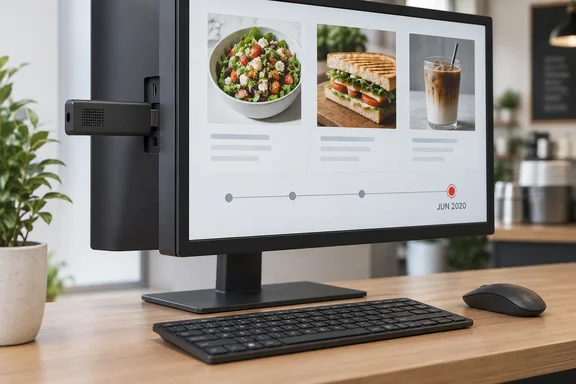
The announcement date is not the retail date. In a later post, dated November 2, 2015, Google's Hiroshi Lockheimer said the ASUS Chromebit would be available "in the next couple weeks" as an $85 device. That post pitched it two ways. It could replace an old desktop, or a business could turn a billboard into a smart digital sign. So signage was part of the original pitch. It was not a later repurposing.
That November post was mainly about something else. Google was reassuring people that Chrome OS was not being folded into Android, and the Chromebit was one item in that message.
Hardware and how it worked
The setup was simple. You plugged the stick into an HDMI display and paired a keyboard and mouse. How-To Geek's retrospective lists the hardware as:
- a Rockchip RK3288 processor
- 2GB of RAM
- 16GB of storage
- Wi-Fi and Bluetooth
- a full-size USB-A port
- a swiveling HDMI end
- three colour options
I could not independently confirm every item here from ASUS documentation, such as the Mali GPU model or the swivel mechanism. Treat those as How-To Geek's reporting.
The Windows stick comparison
How-To Geek contrasts the $85 Chromebit with Intel's $149 Compute Stick running Windows 8.1. That comparison holds up. Intel's April 2015 press release said the Windows 8.1 with Bing version was expected to retail starting at $149. Intel pitched it for productivity apps, streamed content, basic digital signage and thin clients. That is almost the same job list Google gave the Chromebit.
The comparison has caveats:
- The Linux version of the Compute Stick was announced at CES for $89, with 1GB of RAM and 8GB of storage. By April, Intel listed it at $110.
- The Windows model had 2GB of RAM and 32GB of storage. That is twice the Chromebit's storage, so the price gap does not compare identical hardware.
- The Compute Stick also ran Windows, which is why this story matters to a Windows audience. Both sticks aimed at the same idea: an inexpensive computer you attach to a screen you already own.
Why the form factor was limited
A laptop brings its own display, keyboard and pointing device. A stick brings only the computer. It is cheap and pocketable, but it is useless without a screen and input devices, which makes it less convenient than a laptop. That is analysis of the hardware arrangement, and it is also How-To Geek's argument. It is not a documented sales finding.
How-To Geek says buyers mostly picked it up for novelty, and that it found its real home in enterprise and education. It lists menu boards, kiosks, store displays and public internet terminals. Google's launch material supports the signage use. I found no primary source confirming the other deployments, so treat them as the publication's reporting.
The end of updates
This is the most useful fact for IT readers. Google's Chrome Enterprise and Education auto-update policy lists the ASUS Chromebit CS10's automatic updates as running until June 2020. That date is more precise than a vague "support ended in 2020."
Google's policy also explains the consequences of reaching that point:
- After a device's final automatic update, existing and future management policies may not work as intended.
- Google says technical support will not be provided.
- Google says a Chromebook that is no longer updating still has secure mode, which self-checks at startup and typically repairs tampering.
The stick did not stop working in June 2020. It stopped receiving updates, including security updates. For a public-facing sign or kiosk, that is a replacement-planning problem, not a minor footnote.
The same policy now promises 10 years of updates for current Chromebooks. In 2015 Google's November post promised "guaranteed auto-updates for five years." The Chromebit's cutoff sits in a very different era of update policy.
Why there was no sequel
How-To Geek says Google never released another Chrome OS stick, and that the stick PC category largely died out before the 2020s. The Intel side fits that picture: Wikipedia lists the Compute Stick as discontinued in July 2020. Why Google never made a successor is not documented in anything I reviewed. Any explanation is inference.
Takeaways for Windows and IT readers
- The idea keeps coming back. Stick PCs, mini PCs and phone desktop modes all try to make any screen a computer. The Android desktop mode comparison in the original story is a useful analogy. It is not a product lineage, and the Chromebit did not run Android.
- Cheap hardware has an update horizon. A device that is inexpensive on day one still has a replacement date. That matters for kiosks and signage.
- Check the support date before you buy. Google's own policy page tells buyers to look at the date before purchase.
The Chromebit was a clever answer to a narrow question: how cheaply can you put a managed computer behind a screen? It answered that well enough for signage, and not well enough to survive as a mainstream product.
References
- Long before Android desktop mode, Google wanted to turn any TV into a Chromebook How-To Geek · 2026-10-04T15:30:14+00:00
- Auto Update policy - Chrome Enterprise and Education Help support.google.com
- The Intel® Compute Stick: A New Mini-Computing Paradigm, Available Now :: Intel Corporation (INTC) intc.com