

What Google actually announced
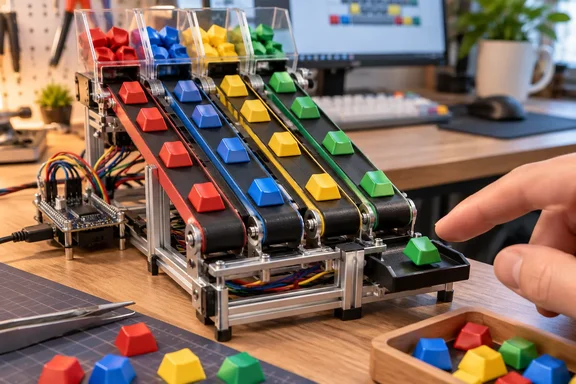
Tom's Hardware reports that Google Japan built the keyboard so the keys flow to your hand rather than the other way round. Google's own Japanese blog post, as inspected for this piece, calls it the 15th entry in its annual keyboard-proposal series. It describes a keyboard with keys on belt conveyors that flow to your hand, and it says you type each character with good timing as it arrives.
The pitch rests on one-handed or one-finger typing. Google argues that conventional keyboards assume two hands, so typing with one hand or one finger means moving your arm and palm a lot. Its answer is to move the keyboard instead.
Key specifications, as stated by Google and reported by Tom's Hardware:
- Four belts, each carrying 29 keys. That is 116 key positions in total, which gagadget also reports as 116 keys.
- Google says both uppercase and lowercase letters can be entered directly.
- The team is considering colour variations, high-speed models and a shorter version for mobile devices. Google's post also mentions a longer version for more character types.
- Google frames the one-handed design as leaving the other hand free, for example for a mouse or a cup of tea. It also jokes that a second unit might raise productivity with two hands.
How it is built
The most useful hardware detail comes from Hackster.io's write-up of the project. It says a gear motor pulls the conveyor around, the key switches are connected by flexible PCBs, and an M5Stack AtomS3-Lite development board monitors the keys and provides a USB interface to a computer. It adds that the team used Kailh Choc low-profile switches and caps. That is attributed to Hackster. I did not inspect the project's own files, so treat the parts list as reported, not verified.
The USB interface matters for readers. It indicates a device that would present itself to a PC as a keyboard, though I haven't confirmed how it behaves on any particular operating system. Nothing I reviewed says it has been tested on Windows, and the project is not a Windows or Gboard software feature.
Build files, and a big caveat
According to Tom's Hardware, the GitHub plans include 3D-printable STL files, KiCad schematics and PCB layouts, and the firmware source code and projects needed to build a working copy. Google's mozc-devices repository lists a mozc-conveyorbelt directory, which matches. The repository says it holds circuit diagrams and firmware for Gboard DIY keyboards, and it describes them as previously known as Google Japanese Input / Gboard April Fools. The repository also carries an Apache-2.0 license, and it says plainly that this is not an officially supported Google product.
Google's FAQ says there are no plans to sell the keyboard, but the design is published as open source so people can make a similar device. Gagadget notes the documentation is in English and Japanese-language project pages, so expect to work out some details yourself.
Before you reach for a 3D printer:
- Expect a maker project, not a kit. I did not review the project README, so I can't confirm a full parts list, assembly steps or required tools.
- Expect to source parts and be comfortable with PCBs and firmware. The design needs a motor, flexible PCBs and a microcontroller board, as Hackster describes.
- Expect no support. Google disclaims it.
Does it work? Nobody has measured
Google's claims about ease and productivity are its own pitch. The blog offers no typing-speed data, ergonomic study or accessibility evaluation. The tradeoff is built in: you swap finger and arm travel for waiting and timing. Mikeshouts notes the downside is that you have to wait for the desired key to appear at the front. Dexerto's description of the demo video says users must wait for their chosen key to arrive and press it before it disappears from view.
The series is also played for laughs. Gagadget calls it a harmless way to test mechanical ideas when nobody expects a product. PC Gamer's headline takes a wry view of Google's humour. Tom's Hardware, for its part, says the models won't make its best-keyboard lists but are fun to display.
A series with a calendar
Google's FAQ says October 1 was picked as a nod to the 101-key keyboard. The mozc-devices index lists April 1 releases through 2019, starting with the Drum set version in 2010. After that the series moved to October 1 from 2021:
- 2021: Yunomi version
- 2022: Bar version
- 2023: CAPS version
- 2024: Double-sided version
- 2025: Dial version
- 2026: Conveyor Belt version
The index also shows that some older entries were never open source, while this one has its own source directory. The project's 2.9k stars and 179 forks on the repository page show there is a steady crowd of hobbyists following the series.
Bottom line
Don't expect to buy this at a retailer, and don't expect it to replace your daily keyboard. For PC hobbyists, though, it is a published, documented example of a custom USB HID device with moving parts. If you like open hardware, it is a quirky weekend project. Everyone else can enjoy the video.
References
- Google Japan shows off wild conveyor-belt keyboard with keys that move to your fingers Tom's Hardware · 2026-10-04T11:40:00+00:00
- GitHub - google/mozc-devices: Circuit diagrams and firmware source code for Gboard DIY keyboards · GitHub github.com
- Google Japan built a keyboard with four moving conveyor belts gagadget.com