

Chromebooks Are Not Gone
BGR's piece says Chromebooks are gone and Googlebooks have replaced them. The evidence points the other way.
- Google has said Chromebooks and Chromebook Plus aren't going anywhere. Both continue to receive up to 10 years of updates, and schools and businesses can keep managing them through the same admin console.
- Axios reported that Googlebook isn't meant as a Chromebook replacement. It quoted Android executive Sameer Samat saying ChromeOS is widely used in education and business, where devices are often shared. He described Google as "very committed" to it.
- Google's own description is of a new category that is built on the Android technology stack and paired with desktop foundations from ChromeOS.
Cheap leftover Chromebooks, some reportedly under $50 according to BGR, are best read as ordinary retail clearance. There is no evidence in the material I reviewed that this is a company-wide wind-down.
The Price Gap
| Tier | Reported starting price |
|---|---|
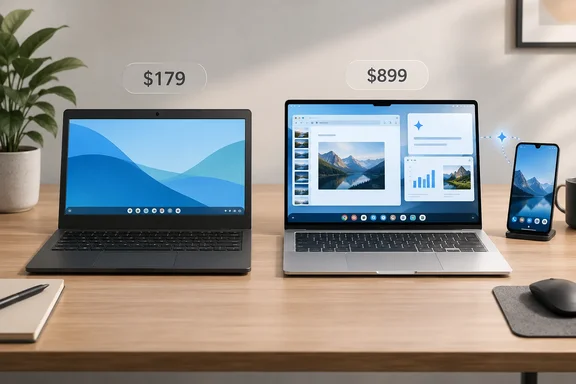
| Entry Chromebook | $179 (Acer Chromebook 315 in Google's store) |
| Chromebook Plus | from $369, with premium Chromebook configurations topping out at $799 |
| Googlebook | $899 to $1,299 across the first five models |
Google's blog says Googlebooks start at $899. The $899 to $1,299 range comes from Axios and other reporting, not from Google's post.
BGR's $200 to $300 Chromebook price range is a fair characterization of the budget end. Google's current store pricing sits near it. BGR's figures of 4GB of RAM and 128GB of storage are not verified here as typical specs.
Chromebook Plus is the fairer comparison. TechRepublic made that point: Chromebook Plus is the more useful comparison than a basic Chromebook.
What the Extra Money Buys
Everything below is Google's own description. I haven't tested any of it.
Hardware. Google says every Googlebook uses premium materials: aluminum, magnesium alloy and carbon fiber. It lists touchscreens up to 2.8K OLED, haptic glass trackpads and backlit keyboards. It also lists Intel or Qualcomm processors with NPUs above 45 TOPS, and up to 14 hours of battery life. "Up to" is a ceiling, not a typical runtime.
Processors. BGR names a last-gen Snapdragon X Elite and a third-gen Intel Core Ultra 5. Google's post names only Intel and Qualcomm. One roundup of the launch lineup lists Intel Core Ultra 5 or 7 chips in the $899 Acer model. Check the exact chip and RAM for the specific model you're considering.
Android phone integration.
- Phone settings, saved passwords, Wi-Fi networks and messages carry over at setup, with end-to-end encryption.
- "Continue On" resumes phone tasks from the taskbar.
- The Files app browses phone files and photos.
- "Cast My Apps" streams phone apps into a desktop window.
Compatibility matters here. Gadget Hacks reported that buyers with an Android 17 phone gain Cast My Apps and Quick Access. It also said Magic Pointer and Create Your Widget arrive once they finish rolling out. Google's announcement doesn't spell out phone or region requirements, so confirm yours before buying.
Gemini features.
- Magic Pointer brings Gemini suggestions to whatever is under the cursor. Google says it acts only when asked and can be switched off.
- Rambler turns speech into structured notes.
- Create My Widget builds desktop widgets from plain-language prompts.
Apps and development.
- Google lists desktop Chrome with extensions and Android apps from Google Play.
- It also lists Adobe Photoshop, Lightroom and CapCut.
- Developers get Antigravity and a full terminal environment.
- The terminal runs in an isolated Linux environment under a pKVM hypervisor that Google describes as Level 5 security-certified.
Security and updates. Google says Googlebook shares ChromeOS's security architecture, including a Titan hardware root of trust and on-device malware detection. It promises updates for up to 10 years.
The Bundles Are Not Discounts
Google says every Googlebook includes 12 months of Google AI Pro, which comes with 5TB of cloud storage and higher Gemini limits. It also includes three months each of YouTube Premium, Adobe Photoshop and more, plus a year of GeForce NOW.
BGR puts dollar values on these bundles: $240 for the AI Pro plan and $350 for the other trials. I couldn't confirm either figure in Google's announcement. These are time-limited subscriptions, and they do not lower the sticker price. They are worth something only if you would pay for them anyway. After the trial periods end, you may be paying for them or dropping them.
Where the Price Premium Comes From
BGR's history section is useful context. Google has always kept a flagship Chromebook around, from the 2013 Chromebook Pixel through the Pixelbook Go. BGR also notes the 2023 Chromebook Plus push, which raised the baseline to 8GB of RAM and 1080p screens. Google's own Chromebook Plus announcement at the time put the minimum at Intel Core i3 or Ryzen 7000-series, 8GB of RAM and 128GB of storage.
On that view, Googlebook is the next step up that ladder, not a surprise. It also has a new software layer on top, which is part of what you pay for.
Who Should Care
- Budget buyers, students and browser-first users. A Chromebook or Chromebook Plus remains the better value. This is my inference from the spec and price gap, not a benchmark result. Android Police's author argued the same, writing that Chromebook Plus laptops around $500 offer some of the best value on the market.
- Android phone owners who want tight phone-to-laptop integration. These buyers are the target. Samat told Axios the first version is built for "the Android community."
- Developers who want a local terminal, Linux tools and AI coding agents. They may get the most out of the premium tier.
- IT administrators. Chromebook management and education use continue as before, per Google's statements reported by Gizmochina. How Googlebook fits into fleet management is not covered in the material I reviewed.
The Bottom Line
Chromebooks cost less because they sit in a different, broader market. Googlebooks are priced as a premium category: premium materials, faster chips, Android integration, built-in AI and bundled services. BGR's closing question is the right one: will people pay more than they're used to? Devices reach U.S. shelves on October 4, and independent reviews will show whether the premium is justified.
Update: Google flags Android app performance differences on Intel Googlebooks (October 5, 2026)
Some complex Android apps and games may not perform as well on Intel Googlebooks as on Qualcomm models, according to Tom’s Hardware’s October 5 report, citing a Google statement to Android Authority. Google reportedly says most Android apps run smoothly on both platforms, but a small subset originally designed for Arm processors needs developer tuning to deliver its best performance on Intel hardware.
According to Tom’s Hardware, the Intel models are the Asus Googlebook 14, Lenovo Googlebook 15 and Acer Googlebook 14; the Dell XPS Googlebook and HP Googlebook 14 use Qualcomm’s Snapdragon X Elite. The report says Google has not identified the affected apps. Google’s statement describes ongoing work with developers, Intel and Qualcomm to improve performance and compatibility, rather than a completed fix.
This adds an important qualification to the Android-app support described above: access to the same app ecosystem does not necessarily mean identical performance across Googlebook models. For Windows users considering a switch, or IT teams evaluating these laptops, the practical next step is to test essential Android apps on the exact model before committing. The disclosure does not establish that Intel Googlebooks are broadly incompatible, or that Qualcomm models will run every app flawlessly.
Update: More phone-link features reportedly require Android 17 (October 5, 2026)
Googlebook’s Android 17 requirement reportedly extends beyond the phone-app streaming and Quick Access features noted above. According to How-To Geek’s October 5 report, citing a Googlebook reviewer’s guide via Android Authority, task continuity, shared file access and synced notifications also require a compatible smartphone running Android 17. That broadens the compatibility caveat: buyers should not assume those connections will work simply because they own an Android phone.
There is another restriction even with a compatible handset. According to the same report, DRM-protected video services and sensitive apps, such as banking apps, cannot be streamed to the laptop; users instead see a privacy screen. Phone-app streaming therefore does not guarantee access to every phone app from the Googlebook desktop.
For Windows users weighing a switch, these reported requirements make the existing phone part of the purchasing decision. Before paying for Googlebook’s cross-device features, confirm both handset compatibility and Android 17 availability, then check whether essential apps permit streaming. IT teams evaluating the platform should likewise test their intended phone-and-laptop combinations rather than treating Android integration as universally available.
Update: WeChat testing reveals a Googlebook account-session limitation (October 7, 2026)
WeChat runs on an ASUS Googlebook 14 but reportedly signs the user out of their phone account when they log in on the laptop, according to The Gadgeteer’s October 7 compatibility guide. Reviewer Vincent Nguyen recorded the behavior on October 6 using a Galaxy Z Fold8 and phone-number sign-in. This is a firsthand observation from one device pairing, not evidence that every Googlebook has the same limitation.
The finding adds a workflow caveat distinct from the Intel app-performance issue reported earlier: an app can run successfully without supporting simultaneous phone-and-laptop use. The Gadgeteer notes that app and operating-system versions still need to be recorded for a reproducible comparison. It does not attribute the logout behavior to the laptop’s processor.
The same guide also qualifies the GeForce NOW bundle described above. According to The Gadgeteer’s review of the offer terms, the included year is a Fast Pass promotion capped at 50 hours per month, excludes Install-to-Play, and prevents upgrading to Performance or Ultimate until the promotional period ends. The outlet had not verified Googlebook-specific service availability as of October 6; that uncertainty is not confirmation that the service is unavailable.
For Windows users considering a switch, these findings make simultaneous account access and the precise subscription entitlement additional purchasing checks—not just whether an app appears in the advertised lineup.
References
- Why Are Chromebooks So Much Cheaper Than Googlebooks? bgr.com · 2026-10-03T13:47:00+00:00
- Intel's Googlebooks might not run some Android apps as well as Qualcomm's Tom's Hardware · 2026-10-05T15:53:44+00:00
- Googlebook's Android integration has two limitations that you won't see coming How-To Geek · 2026-10-05T19:29:16+00:00