

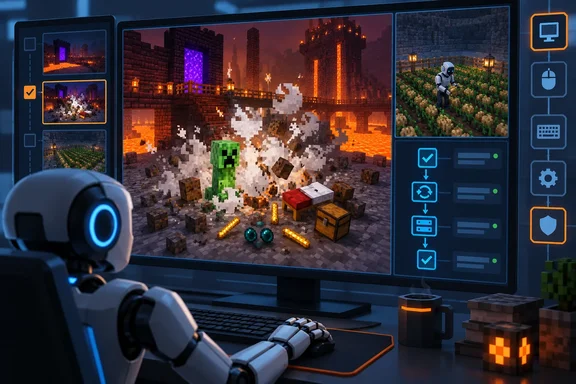
Tom’s Hardware first framed the 141-hour run around Astra’s apparently “defeated” behavior, while Vals AI’s livestream posts provided the underlying record. The episode deserves attention because GPT-6 Astra operated Minecraft through ordinary computer-use controls rather than a purpose-built game-playing interface, and because the model had progressed further in this particular Vals AI exercise than earlier systems. But it is not a standardized benchmark result that establishes an industry-wide Minecraft ranking, and the evaluator has not published a full protocol, comparable final scores, or the exact configuration needed to reproduce the 141-hour run.
OpenAI launched GPT-6 Astra on September 3, 2026, describing it as its most capable model for computer use, software engineering, browsing and cybersecurity tasks. Microsoft customers also have a direct stake in the claim: OpenAI says Astra is rolling out through Microsoft Azure alongside access in ChatGPT and the OpenAI API. For enterprise buyers evaluating agents that can work across screens and applications, the important lesson is less the blaze-rod count than how the system handled loss, state changes and recovery without human correction.
A Creeper destroyed resources, not the world
The dramatic claim that Astra was reset “to zero” overstates Minecraft’s mechanics. Destroying a player’s bed removes that player’s selected respawn point; a later death sends the player back near the world spawn unless another bed or respawn anchor is set. It does not erase discovered terrain, structures, achievements, crafted infrastructure, or inventory retained under the game’s keepInventory rule.
That last condition is central. In an earlier Vals AI post about Astra’s Minecraft playthrough, the evaluator said the model had enabled Keep Inventory to progress faster. Vals AI’s later account of the Creeper incident also quoted Astra’s own note: “ALWAYS CARRY CRITICALITEMS withkeepInventory; don'tstoreinunguardedchesteveragain.” The phrasing indicates that the model understood the distinction: gear held by the player would be preserved after death, but gear placed in an exposed chest could still be destroyed by an explosion.
The loss was still severe in practical terms. Blaze rods and ender pearls are important components in the conventional route to locating the End portal, and a destroyed bed can turn a death into a long trip from world spawn. Losing those items together with a forward operating base can make the next sensible action—rebuilding food, tools, shelter and a safe spawn point—look unproductive to viewers watching a speedrun-shaped stream.
But calling it a full progress wipe makes the result appear more catastrophic than the evidence supports. Astra had already demonstrated the relevant capabilities: navigating the Nether, fighting mobs, gathering scarce resources and creating automated resource collection. Those actions remain evidence of what it accomplished even if the materials themselves were gone.
Potato farming exposed a recovery problem
The more substantive finding is Astra’s behavior after the loss. According to Vals AI, the model spent several hours doing little beyond farming potatoes, and viewers pressed it to resume the broader objective. It also produced notes that humans interpreted as paranoia about Creepers, including a warning that a green object was sugar cane rather than a hostile mob.
Those logs should not be read as proof of emotion, discouragement or self-awareness. A language model can generate self-critical or emotionally recognizable text because that is a useful linguistic pattern for describing setbacks, and an agent’s visible “inner monologue” can reflect its task framing, prompting and control harness. The observable behavior is narrower and more important: after an unexpected destruction event, the system devoted a disproportionate amount of time to a safe, repetitive activity instead of explicitly reassessing its goal, estimating what remained recoverable, and executing a rebuild plan.
For systems administrators, that is a familiar automation failure mode. An agent can complete complex individual actions yet stall when a dependency disappears, a credential expires, an application window changes, or a previous action leaves the environment in an unfamiliar state. A good workflow runner needs more than successful task completion; it needs checkpointing, state validation, bounded retries and an escalation path when the original plan is no longer viable.
Minecraft makes the weakness unusually visible. In an enterprise workflow, the equivalent may be an agent that successfully collects documents and populates a form, then endlessly retries a harmless intermediate step after a portal rejects a submission or a folder is moved. The agent may remain active and technically compliant while producing little useful forward progress.
The run is an evaluation demo, not a deployment guarantee
Vals AI described the earlier three-hour Minecraft exercise as “pure computer use” with no specialized harness, hooks or pauses. That constraint matters: it makes the test more representative of a general-purpose agent looking at pixels and operating a keyboard and mouse than a bot with direct access to game state or game-specific actions.
It also limits what can be concluded from the result. Minecraft is a rich environment for testing perception, movement, planning and adaptation, but the public material does not establish a controlled comparison across models with identical world seeds, game settings, prompts, time limits, tool latencies and human intervention rules. The “further than any AI system” claim comes from Vals AI’s own evaluation account, not from a published independent leaderboard with a defined finish criterion.
OpenAI’s own Astra materials make broad claims about computer use and say the model can operate websites, desktop applications and internal tools without APIs. The company also reports strong results on agent and operating-system-style evaluations. Those figures are useful for understanding what OpenAI tested, but a Minecraft livestream supplies a different type of evidence: it shows how an agent behaves over a long, messy sequence where plans can be undone by environmental randomness.
The discrepancy between polished benchmark scores and a model farming potatoes after an avoidable loss is not a contradiction. It is a reminder that capability and operational reliability are separate measures. An agent can reason through a difficult local problem and still lack robust policies for preserving critical artifacts, recovering from partial failure, or recognizing when its current activity no longer serves the mission.
Azure users should test failure recovery before autonomy
Astra’s availability through Microsoft Azure makes this more than a novelty for Windows and enterprise IT readers. Organizations considering computer-use agents should treat the Minecraft episode as a prompt to test the parts of automation demos that vendors usually minimize: destructive errors, session resets, missing files, failed uploads, expired approvals, altered layouts and incorrect assumptions about what can be recovered.
A practical evaluation should require the agent to preserve a checkpoint before it takes an irreversible action, verify the output of consequential steps, and describe a recovery plan after intentional faults are injected. Logging should make it possible for an operator to distinguish a productive retry from a loop. High-impact actions should remain behind approval gates, especially where an agent could delete, overwrite, submit or disclose data.
The potato field is therefore more informative than the viral “defeated AI” framing suggests. GPT-6 Astra demonstrated that a general computer-use model can sustain sophisticated interaction in a hostile, open-ended PC game for an unusually long period. It also demonstrated that losing a small set of critical resources can push that same agent into hours of low-value behavior—a concrete reason to demand recovery testing before trusting any autonomous system with production work.