

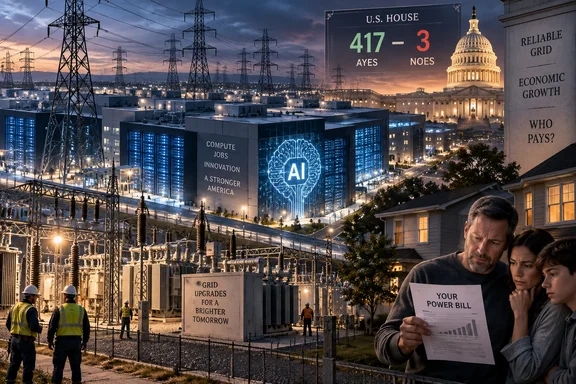
That distinction is central. TechRadar described the measure as one that could make AI data center operators pay for generation and grid upgrades, and the broad outline is correct. But the House-passed bill does not itself set a nationwide data-center tariff or directly compel every operator to pay. It amends the Public Utility Regulatory Policies Act, or PURPA, to create a federal must-consider standard for state commissions and qualifying nonregulated utilities.
The Associated Press likewise characterized the bill as a federal recommendation that leaves electricity-market regulation with the states. The Congressional Budget Office’s analysis is even plainer: H.R. 9340 requires consideration of rates intended to recover upgrade costs from qualifying customers; it does not impose a private-sector mandate. That is a narrower instrument than the headline political message, but still a consequential one for the economics of large-scale cloud and AI capacity.
What H.R. 9340 would require regulators to consider
The bill targets a “large-load customer”: a nonresidential electricity customer operating a data center with peak demand of at least 100 megawatts at a single facility. One hundred megawatts is an industrial-scale threshold. It is far above a conventional corporate server room or regional enterprise data center, and it squarely reaches the campuses being built for hyperscale cloud, GPU clusters, and frontier-model training.
For those facilities, the proposed PURPA standard asks utilities to create rates that recover the full incremental cost of generation, transmission, and distribution upgrades required to serve the new load. “Incremental” is the important word. The bill is aimed at work that would not have been necessary absent the large customer: additional generating capacity, new substations, larger transformers, upgraded lines, and other grid reinforcements.
The legislation also calls for a financial contribution or assurance before utilities make upgrades. That provision matters when a data-center project changes course. A utility that has committed money to a substation or power-plant expansion can be left with stranded costs if the proposed customer delays, downsizes, cancels its build, or stops taking service. The bill’s theory is that the developer, rather than existing residential and small-business customers, should bear that project-specific exposure.
This is more than a debate over who pays the first construction bill. It is an attempt to change who carries the risk of a failed or deferred AI infrastructure project.
The bill does not apply only to AI companies
The public debate has centered on AI data centers, but the statutory trigger is a data center’s demand and does not limit coverage to a particular workload, model provider, or company. A 100-megawatt cloud campus hosting Azure services, Microsoft 365 infrastructure, enterprise virtual machines, conventional storage, streaming, web services, or high-performance computing could be within scope if it meets the definition.
That makes the bill relevant to the larger data-center supply chain, including developers, power procurement teams, utilities, colocation operators, and major enterprise tenants. A corporate IT department running a few racks or leasing conventional colocation space will not suddenly become a regulated 100-megawatt customer. But organizations negotiating long-duration capacity with a hyperscaler could eventually face indirect effects through site selection, construction schedules, contract structures, and the price of power-intensive AI capacity.
Microsoft was among Amazon, Google, Meta, OpenAI, Oracle, and xAI in signing the White House’s Ratepayer Protection Pledge in March 2026. The pledge says signatories will “build, bring, or buy” the energy needed for new facilities, fund related delivery infrastructure, and pay whether or not they ultimately use the power. Unlike H.R. 9340, that White House arrangement is voluntary.
The House bill would not turn the pledge into a straightforward national mandate. Its practical purpose is to push equivalent cost-allocation decisions into state proceedings, where utilities establish rates and regulators determine whether particular investments are prudent and recoverable.
Why the state-level mechanism changes the result
Electricity is local in a way cloud computing is not. A hyperscaler can sell a service nationwide, but a new 230-kilovolt line, gas turbine, transmission upgrade, or substation is built in a particular utility territory under a particular state’s rate rules. Congress is working through PURPA because the statute already uses a model in which states must consider federal standards while retaining authority to adopt, modify, or reject them.
That leaves substantial room for different outcomes. One state commission could adopt a rigorous take-or-pay structure requiring a large-load customer to guarantee payments for new power and wires even if utilization falls short. Another may decide its existing large-load tariff already addresses the issue. A third may build in exceptions for shared upgrades that improve reliability or create capacity for other customers.
The American Public Power Association has already flagged the complication. It supports protecting existing customers from the costs of serving large data centers, but opposes a new PURPA mandate on the grounds that many public-power utilities have already adopted, or are developing, their own large-load policies. The association says roughly 200 public-power utilities would have to comply with any new PURPA must-consider requirement.
That objection does not mean public-power systems reject cost recovery from data centers. It means the House vote has not settled what “full incremental cost” will mean in every location. Whether a transformer expansion benefits only one campus, whether new generation is attributable to a single customer, and how long a payment guarantee must last are precisely the disputes that commissions and utilities would still have to resolve.
The political vote was overwhelming; the legal change is still incomplete
The 417–3 House vote is a significant political signal. It puts members of both parties on record supporting the proposition that rapid data-center expansion should not raise electricity bills for customers who receive no direct benefit from the new load. AP reported that lawmakers described the measure as a modest first step, rather than a complete answer to local concerns about AI campuses.
But the Act is not law. The House vote on September 16, 2026, is only one step in the federal process. The Senate must pass the measure in identical form, and the president must sign it, before state commissions face the new PURPA consideration requirement.
Even enactment would not produce an immediate rate change. The CBO says the bill would require state regulatory commissions to consider adopting the standard, and its cost estimate concludes that the direct administrative costs to states would be small. That assessment says nothing about the potentially much larger commercial consequences once a utility applies the standard to a real 100-megawatt project.
For data-center developers, the likely pressure point is upfront financing. If regulators adopt strong assurance requirements, developers could need to post collateral, pay contribution-in-aid-of-construction charges, sign longer service commitments, or directly procure dedicated generation before a utility begins work. Those costs could favor the deepest-pocketed hyperscalers and developers over smaller AI infrastructure firms that cannot readily guarantee multi-year power obligations.
What the Act leaves untouched
The bill is narrow by design. It does not create a nationwide process for public disclosure of data-center power contracts. It does not set rules on water consumption, diesel backup generators, land use, air emissions, local tax incentives, workforce promises, or community agreements. It also does not guarantee that utility bills will fall; it seeks to prevent project-specific expansion costs from being shifted to other customers.
Public Citizen Energy Program Director Tyson Slocum made that point in comments reported by Reuters, saying the measure leaves many consumer and community impacts unaddressed. The criticism is well-founded on the bill’s text. H.R. 9340 is fundamentally a ratemaking and financial-risk measure, not a comprehensive data-center permitting law.
There is another omission with direct relevance to enterprise buyers: no provision tells cloud customers whether a provider may pass higher infrastructure costs on through service pricing. The legislation addresses the relationship between the utility and the large-load customer. It does not regulate Azure, AWS, Google Cloud, Oracle Cloud, colocation leases, GPU rental agreements, or enterprise AI subscriptions.
Enterprises should therefore resist treating the House vote as evidence of a coming change to cloud pricing. It may raise the capital cost and complexity of certain new campuses, particularly in constrained power markets, but the bill contains no customer-price controls and no requirement for providers to disclose how electricity commitments influence their commercial rates.
The real test will be utility contracts, not the House roll call
For IT leaders whose AI plans depend on hyperscale capacity, the immediate operational takeaway is modest: there is no new federal compliance obligation for ordinary enterprise data centers, and no federal rule has taken effect. The more durable effect is that power availability is becoming a contract and deployment risk alongside chips, networking, cooling, and real estate.
If H.R. 9340 becomes law, the projects most exposed will be new campuses at or above 100 megawatts that require dedicated grid investment. Their developers may have to carry more of the cost—and more of the cancellation risk—before servers are installed. That could slow marginal projects in grid-constrained regions, while making sites with existing generation, available transmission capacity, or well-developed large-load tariffs more attractive.
The House has established the political principle. The next concrete consequence depends on whether the Senate advances H.R. 9340 and, if it does, how state utility commissions translate “full incremental cost” into enforceable rates and financial guarantees.
Update: States would have up to two years to consider the proposed large-load standard (September 18, 2026)
Tom’s Hardware reports that H.R. 9340 sets a two-year window for state regulatory authorities and nonregulated electric utilities to consider adopting the new PURPA standard, if the bill is enacted.
That timing further limits the bill’s near-term effect. Even after Senate passage and presidential signature, no automatic data-center charge would take effect nationwide. State commissions could spend as long as two years evaluating whether their current large-load tariffs already recover project-specific generation, transmission, and distribution costs, or whether new rules are needed.
For hyperscalers, colocation providers, and developers planning 100-megawatt-and-larger campuses, the practical consequence is continued uncertainty rather than an immediate federal payment requirement. Project teams may encounter different contract, collateral, and cost-recovery expectations depending on where a facility is proposed—and when the relevant state regulator completes its review.