

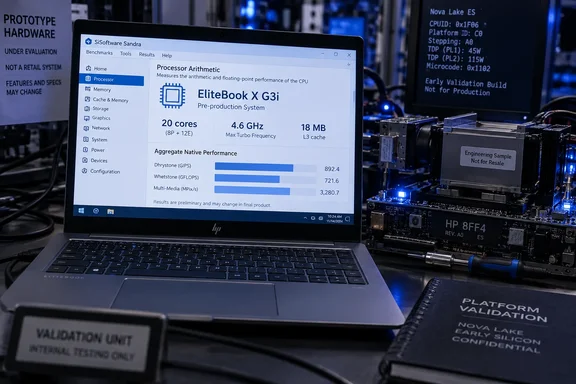
Wccftech first highlighted the result, and Teliko separately reported the same SiSoftware record, which labels the motherboard “HP 8FF4” and the processor simply “Genuine Intel(R) 0000.” That generic CPU string is common for pre-production Intel hardware whose final CPUID branding has not been enabled. The useful part is the combination of an apparently next-generation EliteBook name, an HP board identifier, and a core count that does not match HP’s current Panther Lake EliteBook X configurations.
HP and Intel have not announced an EliteBook X G3i as of September 17, 2026. More importantly, Intel’s own publicly available Nova Lake-BGA documentation still calls the platform a beta release, which makes the suggestion that the EliteBook appearance signals a launch just around the corner an overreach.
What the SiSoftware entry actually confirms
The SiSoftware record supports a narrow but meaningful conclusion: HP has hardware in testing that identifies itself as an EliteBook X G3i, using an unreleased Intel processor with 20 cores. That is considerably stronger than an anonymous benchmark database entry because the platform name and board vendor are visible.
It does not, however, identify the commercial CPU SKU. “Genuine Intel(R) 0000” tells Windows utilities and benchmark software that the chip is an Intel engineering sample, not whether it will become a Core Ultra 5, Ultra 7, Ultra X7, or a business-only vPro part. There is also no confirmed breakdown between performance cores, efficiency cores, and low-power efficiency cores.
That absence matters. Intel’s current mobile designs use more than a simple P-core-plus-E-core formula. Panther Lake-H parts in HP’s present EliteBook X G2i line use a 4P+8E+4LP-E arrangement in several 16-core configurations. A reported total of 20 cores could represent several different Nova Lake designs with sharply different sustained performance, power limits, graphics capability, and scheduling behavior under Windows 11.
The entry’s reported 3.0 GHz to 4.6 GHz clock range should likewise be treated as laboratory telemetry, not a specification. Engineering samples commonly operate with provisional firmware, restricted turbo behavior, unfinished power tables, or debug settings. A maximum clock value from one benchmark scan says little about the performance HP will permit in a thin 14-inch commercial notebook.
The cache report is less certain than the core count
Wccftech’s analysis argues that four 4 MB L2-cache blocks point to Nova Lake’s rumored Coyote Cove performance cores. But Teliko’s account of the same SiSoftware result describes 4 MB of L2 cache split across four blocks, rather than four blocks of 4 MB each. Those are radically different claims: one implies 16 MB total L2 cache; the other, 4 MB total.
Neither outlet links the raw SiSoftware result in a form that resolves the discrepancy. Until the underlying cache readout can be inspected, it should not be used to infer a final core topology, the amount of cache per core, or a specific Coyote Cove design. The 20-core total and 18 MB L3 figure are the more defensible observations because both reports agree on them.
There is still a reasonable basis for associating the machine with Nova Lake. Intel has publicly documented Nova Lake in its Software Development Emulator since January 2026, and its architectural programming reference identifies Nova Lake with Coyote Cove P-cores and Arctic Wolf E-cores. Intel has also published a driver package explicitly intended for “Nova Lake-BGA Beta” platforms, including Windows 11 guest support for virtualized display environments.
Those records confirm that Nova Lake development is real and includes BGA, or soldered-package, platforms appropriate for notebooks. They do not tie Intel’s official Nova Lake work to HP’s 8FF4 board, and they do not validate every cache or clock detail exposed by SiSoftware.
The EliteBook X G2i baseline makes the G3i name plausible
HP’s current 14-inch EliteBook X G2i is a useful comparison because it already sits near the upper end of the company’s mainstream business-laptop line. HP lists configurations built around Intel Core Ultra 7 356H and Core Ultra 7 366H processors, while other published G2i specifications include the Core Ultra X7 358H. Those chips are 16-core Panther Lake designs with 18 MB of Intel Smart Cache.
The apparent G3i sample preserves that 18 MB L3-cache figure while increasing the reported CPU total to 20 cores. That does not automatically make it faster in practical office workloads. For enterprise buyers, responsiveness on battery, heat under video conferencing, graphics-driver maturity, NPU capability, memory capacity, docking behavior, and firmware stability often matter more than four additional CPU cores.
Still, core count is relevant in the EliteBook market. A 20-core part could help locally virtualized test environments, compilation work, simultaneous Teams calls and browser workloads, data processing, and heavier endpoint-management activity. Whether that potential reaches users will depend on HP’s configured long-term power limit and cooling design, neither of which is present in the benchmark result.
The G3i naming also suggests this may be an annual platform transition rather than an experimental one-off. HP’s G2i machines are commercial systems with Windows 11 Pro configurations, enterprise management features, optional cellular connectivity, and Intel vPro options. Yet a model name in validation software is not a promise that every current G2i option will carry forward. The record says nothing about vPro, Intel Stable IT Platform Program support, 5G, removable or soldered memory, storage slots, displays, ports, or dock compatibility.
“First” should mean first public sighting, not first system
The claim that this is the first Nova Lake notebook needs narrower wording. It may be the first publicly surfaced notebook benchmark result associated with Nova Lake, but SiSoftware is not an inventory of every platform Intel and its OEM partners are testing. Intel reference systems, private OEM qualification machines, and systems operating under nonfinal identifiers can all exist without appearing in public results.
Intel’s beta-driver documentation already shows that Nova Lake-BGA platform work is beyond purely theoretical architecture planning. That makes it entirely plausible that HP and other laptop makers have active validation hardware. It does not establish HP as the first OEM with a Nova Lake notebook, nor does it establish the EliteBook X G3i as the first Nova Lake product headed for sale.
The timing claim also deserves restraint. Wccftech framed the engineering-sample appearance as a sign that Nova Lake’s official launch is near. Intel’s public documents offer a different signal: the Nova Lake-BGA package is still described as beta, and Intel has not published a consumer or commercial launch date, final mobile SKU list, or supported platform matrix for Nova Lake.
For IT departments, that distinction is practical. A benchmark entry is useful for roadmap awareness and for asking HP account representatives about future qualification plans. It is not a reason to defer an active EliteBook X G2i purchase, freeze a Windows 11 refresh, or assume a G3i system will arrive within a particular procurement cycle.
What Windows and enterprise buyers should watch for next
The next evidence worth trusting will be an HP quick-spec sheet, service guide, regulatory filing, or product configurator that identifies the processor family and supported hardware options. On Intel’s side, a product brief or ARK listing should clarify the final CPU topology, graphics architecture, NPU performance, memory support, and business-management capabilities.
A meaningful Nova Lake EliteBook announcement should also answer questions SiSoftware cannot:
- HP needs to state whether the G3i remains available with Intel vPro and its commercial fleet-management features.
- Intel needs to identify the exact core layout and clarify how Windows 11’s scheduler should treat the platform’s different core types.
- HP needs to disclose memory configuration, especially whether the model continues with soldered LPDDR5X or introduces serviceable DDR5-based options.
- Both companies need to specify the firmware and driver support timeline for corporate Windows 11 images, docks, wireless adapters, and device-management tools.
For now, the HP EliteBook X G3i result is a credible early clue that Nova Lake has reached OEM notebook validation. Its 20-core reading is intriguing; its unbranded engineering CPU, disputed L2-cache interpretation, and beta-stage platform context are the reasons to treat it as a roadmap signal rather than a product announcement.