

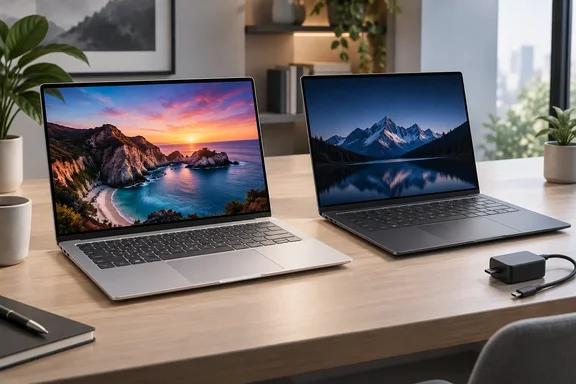
The OmniBook 5: OLED at a $699.99 starting price
HP calls the OmniBook 5 a premium consumer Windows laptop aimed at students, young professionals and people who juggle a lot of tasks at once. HP's newsroom release says the OmniBook 5 is powered by up to an Intel Core 7 processor with integrated NPU capabilities.
HP's release doesn't name the exact chips, but VideoCardz does. It reports that the laptop is based on Intel's Wildcat Lake processors and starts at $699.99 in the US with a Core 5 315 processor, 8GB of memory and a 256GB SSD. According to the same report, higher configurations will offer up to an Intel Core 7 350 processor, 16GB of RAM and a 1TB SSD. VideoCardz also says HP's US store is already listing Wildcat Lake configurations with 8GB of memory and 256GB or 512GB storage, although availability can vary by configuration and color.
So the $699.99 model has 8GB of RAM. That's enough for browsing, Office and video calls. It will feel tight if you keep lots of Edge tabs open alongside Teams and a photo editor. Some machines in this class solder their memory to the board, so check whether that applies here before assuming you can upgrade later. HP's release doesn't say either way.
HP's other OmniBook 5 headline specs:
- Up to 42 hours of local video playback. HP measured this with continuous 1080p playback from local storage at 200 nits, with Wi-Fi switched on but not connected. That's a best-case lab test. Streaming over Wi-Fi at higher brightness while Teams runs will drain the battery much faster.
- Thin and light build: an ultra-thin 11.77 mm profile, lightweight 1.16 kg design, flexible 180° hinge, dual full-function USB-C ports and HP's compact 65W USB Mini GaN charger.
- Display: up to a 2.5K OLED touchscreen with 100% DCI-P3 color coverage, up to 620 nits, HP Eye Ease and up to a 90% screen-to-body ratio.
- Video calls: an FHD infrared camera that works with Windows Hello face sign-in, dual microphones, Poly Studio-tuned audio and DTS:X Ultra.
- Design: aluminum chassis in Smoke Silver, Starlit Blue, Peony Pink and Soft Honeydew.
The display footnote to read first
HP's footnote says the 2K OLED panel, rated up to 300 nits, is the one available at launch. The 2.5K panel rated up to 620 nits is planned for March 2027. So the "up to 620 nits" figure doesn't apply to any OmniBook 5 you can buy this fall.
On the positive side, VideoCardz reports that HP also uses an OLED panel across the entire range rather than reserving it for higher-priced configurations. At this price you'd normally expect a basic IPS screen. Even at 300 nits, OLED gives you real blacks and wide color.
There's one conflict in the coverage. VideoCardz describes the later panel as 3K, while HP's own release and footnotes say 2.5K. Go with HP's figure until spec sheets confirm otherwise.
Processor and NPU fine print
HP's footnotes add three more caveats:
- Core 7 models are planned for mid-October 2026, so the cheapest configurations may arrive first.
- AI features aren't guaranteed. Features that use the NPU may require a software purchase, a subscription or enablement by the software or platform provider. "AI-ready" means the hardware is there. It doesn't promise any particular Copilot or local AI feature.
- USB-C speeds and charger compatibility vary. HP notes that actual USB-C throughput may vary and charger performance depends on the device.
Section summary: The OmniBook 5 puts OLED, an aluminum body and Windows Hello in a $699.99 laptop. The launch model has a 300-nit 2K screen, and the entry configuration has 8GB of RAM.
The ProBook 4 G2iS: HP's thinnest business notebook, by HP's own measure
The second product is aimed at a different buyer. HP says the ProBook 4 is purpose-built for SMBs and mobile professionals. The model announced is the ProBook 4 G2iS 14 AI PC.
HP's listed specs:
- Up to an Intel Core 7 processor with up to 17 TOPS NPU AI acceleration, up to 32 GB of memory and up to 1TB of storage
- A 14-inch 2.8K OLED display with 100% DCI-P3 color and a 120Hz refresh rate
- An aluminum chassis about 12 mm thin, starting at 2.6 lb (weight varies by configuration)
- Finishes in Eclipse Gray, Atmospheric Blue and Mist Silver
- A 70Whr battery with HP Fast Charge, along with MIL-STD durability
Notebookcheck adds detail HP left out. It reports that the G2iS is powered by Intel Wildcat Lake processors and uses LPDDR5x memory. VideoCardz says it starts with 8GB of memory and a 256GB SSD. Notebookcheck calls the screen "3K" where HP says 2.8K. HP's figure is the official one.
The charger detail IT buyers should check
HP's Fast Charge footnote promises up to 50% charge in 45 minutes with the system off or in standby. It also says batteries larger than 56Wh and smaller than 83Wh need a power adapter of at least 100 watts for that result. The ProBook's 70Wh battery falls in that range.
Notebookcheck, however, reports that the ProBook 4 G2iS gets a 70 Wh battery and comes with a 65 W USB-C charger. If that's the standard bundle, the 45-minute figure may not apply out of the box. This comes from comparing HP's footnote with third-party reporting, not from HP confirming it. IT admins should still check which adapter is in the box, or plan for a 100W USB-C charger if fast charging matters to their staff.
What "thinnest" and "MIL-STD" actually mean
- "Thinnest business notebook": HP compared the ProBook only against its own commercial notebooks that have a defined set of features, including preinstalled security tools, MIL-STD testing, USB-C docking, HDMI and specific processor classes. The claim uses each device's lowest maximum published thickness. It's an internal HP comparison, not a ranking against every business laptop on the market.
- MIL-STD 810: HP's footnote says the testing doesn't show fitness for U.S. Department of Defense contracts or military use, and doesn't guarantee future performance. Accidental damage needs an optional HP Accidental Damage Protection Care Pack. It shows the laptop survived some tests. It isn't a warranty.
Section summary: The ProBook 4 G2iS offers an OLED screen, 120Hz and a 70Wh battery in a thin business chassis. Buyers should check the bundled charger and treat the "thinnest" and MIL-STD claims as HP's own measurements.
Pricing and availability differ by region
US and UK schedules differ, and the coverage reflects that:
| Model | United States (HP release) | United Kingdom (Technology Reseller) |
|---|---|---|
| OmniBook 5 14 AI PC | HP.com and Best Buy, October 2026, from $699.99 | HP.com and select retailers, January 2027, from £679 |
| ProBook 4 G2iS 14 AI PC | HP.com, November 2026, price TBA | HP.com, December, price TBA |
VideoCardz also reports the ProBook's availability planned for December. That matches the UK date but not HP's US release, which says November. HP says pricing and availability can change without notice, so treat all of these dates as expected, not confirmed.
UK buyers face a three-month wait for the OmniBook 5. Some may not mind, since the brighter 2.5K panel is due only two months after that.
Who should consider these laptops
HP is chasing the budget end of the market, which got more competitive after Apple's cheaper MacBook arrived. VideoCardz says HP is clearly targeting the same entry-level segment as Apple's MacBook Neo. HP is also squeezing costs in other ways: earlier this year Notebookcheck reported that some affordable PCs get a new importance in the times of RAM shortages and exploding prices, after HP put cheaper soldered storage into some ProBook G2 configurations.
My take, from general industry experience rather than hands-on testing (no independent reviews were available when this was written):
- Students and home users: The OmniBook 5 is worth a look if OLED, Windows Hello and two USB-C ports matter to you. Pay extra for 16GB of RAM if your budget allows.
- Buyers who want the best screen: Wait until March 2027 for the 620-nit 2.5K panel. A 300-nit OLED will struggle by a sunny window.
- SMB IT admins: Pilot the ProBook 4 G2iS before ordering in bulk. Confirm which charger ships with it, test docking with your existing USB-C docks, and check how it enrolls in Intune or your management tool before rolling it out.
- AI buyers: Expect hardware that's ready for local AI. Don't count on any specific AI feature unless the software vendor confirms support for these chips.
Bottom line
These are useful mid-range launches with genuinely appealing displays. Most of the important limits are in the footnotes: the launch screen is dimmer than the headline figure, the battery-life number comes from a best-case test, and fast charging may need a charger that doesn't come in the box. Read those before you buy.
References
- HP OmniBook 5 14 launches at $699 with Intel Wildcat Lake and OLED display - VideoCardz.com videocardz.com
- HP Brings Premium PC Experiences to more consumers - TECHNOLOGY RESELLER TECHNOLOGY RESELLER · Thu, 01 Oct 2026 18:19:12 GMT
- HP launches ultra-thin Wildcat Lake laptop with 3K OLED display and 70 Wh battery - Notebookcheck News notebookcheck.net