

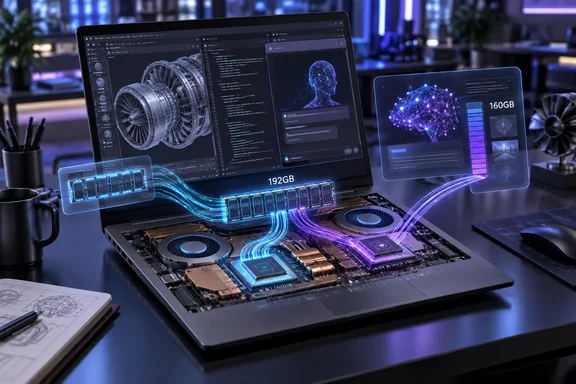
HP detailed the system on September 15, while GfxSpeak and Notebookcheck separately reported the 16-inch design, its Ryzen AI Max PRO 400-series platform, and its unusually high memory ceiling. The practical change is more consequential than the marketing around “agentic AI”: a Windows workstation buyer can configure one pool of LPDDR5X memory for both CPU work and GPU-accessible AI workloads, rather than being capped by the fixed 8GB, 12GB, or 16GB of VRAM typically attached to a mobile discrete GPU.
The catch is equally important. HP’s 300-billion-parameter local-model claim does not name a model, quantization level, context length, inference framework, or tokens-per-second result. Those variables decide whether a model merely loads, produces usable interactive output, or becomes an impractically slow demonstration.
The 192GB figure changes the local-AI ceiling
The ZBook Ultra G3a’s headline configuration pairs AMD’s 16-core, 32-thread Ryzen AI Max+ PRO 495 with a Radeon 8065S integrated GPU and an XDNA 2 NPU rated at up to 55 TOPS. AMD lists the chip as supporting up to 192GB of 256-bit LPDDR5X-8533 memory, with a 55W default TDP and a configurable range up to 120W. HP says its chassis can sustain up to 100W.
This is a shared-memory system. The 192GB is not conventional system RAM plus a separate 160GB of graphics memory; it is a single memory pool. HP allows up to 160GB of that pool to be assigned to graphics through the BIOS or a graphical interface, leaving at least 32GB for Windows, applications, file cache, and background services at the maximum GPU-memory setting.
For local LLM work, that arrangement directly addresses a central laptop limitation: model capacity is constrained by GPU-addressable memory more often than by CPU capability. A conventional Windows mobile workstation with a powerful discrete professional GPU may deliver better rendering throughput or CUDA application compatibility, but it cannot turn its system memory into a 160GB VRAM reserve. HP’s design can, at least on selected configurations.
That makes the ZBook potentially useful for developers evaluating large quantized models, data scientists handling memory-heavy datasets, and organizations that cannot send sensitive prompts or documents to an external inference provider. It is less automatically compelling for users whose applications depend on Nvidia CUDA, high-end GPU rendering plug-ins, or established discrete-GPU certification requirements. Shared memory creates capacity; it does not make an integrated Radeon GPU equivalent to a high-end RTX professional card in every workload.
HP’s flagship claim needs a performance number
HP says the ZBook can run models with up to 300 billion parameters locally and calls it the first thin performance mobile workstation capable of doing so. That claim should be read as a capacity statement, not a completed performance verdict.
A 300-billion-parameter model is far too large to fit in raw form on a 192GB machine. In practice, such a model would require aggressive quantization and careful control of context size, with the model, runtime overhead, operating system, and any other active applications competing for the same physical memory. Longer prompts and larger context windows add memory pressure beyond the model weights themselves.
HP acknowledges a version of this limitation in its product disclosures, saying local-AI results vary by model, configuration, software, and workload. Yet the launch announcement provides no benchmark for prompt processing, token generation, model-loading time, or sustained performance. It also does not identify the runtime stack used to substantiate the 300B claim.
That omission is significant for enterprise procurement. A workstation that can technically load a model but produces only a few tokens per second may be valuable for batch work, testing, or offline analysis; it is a poor substitute for an interactive assistant used throughout a workday. IT teams should require vendor-tested configurations for their intended framework—whether that means llama.cpp, Ollama, LM Studio, PyTorch, ROCm, or another deployment path—before treating the machine as a local inference standard.
The more defensible immediate conclusion is that HP has moved the memory-capacity boundary for a portable Windows workstation. Independent testing still has to establish whether its thermal design, memory bandwidth, drivers, and software support turn that capacity into consistently useful local inference.
The processor reporting contains one correctable error
The submitted reports correctly identify the Ryzen AI Max+ PRO 495 as a Zen 5-based 16-core part, but GfxSpeak identifies its graphics as Radeon 8060S. AMD’s own specifications list the PRO 495 with Radeon 8065S Graphics, a 40-compute-unit integrated GPU running at up to 3GHz. Notebookcheck and MobiDevices also identify the newer 8065S part.
The 8060S and 8065S distinction is easy to miss because both are 40-CU RDNA 3.5 integrated designs. But it matters in a generational refresh where the processor’s modest clock uplift and the move to 192GB memory are the central hardware changes. HP’s product page simply says “AMD Radeon Graphics,” avoiding the conflict, while its press material names only the processor.
AMD also lists Windows 11 64-bit, Red Hat Enterprise Linux, and Ubuntu as supported operating systems for the processor. HP’s ZBook product page specifies Windows 11 Pro and Ubuntu 26.04 LTS for the workstation. That dual-OS positioning is a practical plus for technical teams, though prospective Linux buyers should wait for actual machine-specific driver and certification documentation rather than assuming CPU-level support guarantees every feature works identically.
The unit’s platform is otherwise geared toward mobile workstation use: two Thunderbolt 4 ports, one 10Gbps USB-C port, HDMI 2.1, USB-A, microSD, a Nano SIM slot, optional 5G, and storage configurations up to 8TB. Display choices include an FHD low-blue-light option, a 2.8K OLED configuration, and a 4K HP DreamColor panel with a 120Hz refresh rate.
A larger chassis is doing much of the work
The G3a is a 16-inch system, starting at 4.2 pounds and 17.9mm thick, rather than a simple revision of the 14-inch ZBook Ultra G1a. HP says the new thermal assembly raises maximum TDP from 55W on the G1a to 100W on the G3a, which is the basis for its claim of up to 81.8 percent higher TDP.
TDP is not a performance benchmark, and it should not be treated as one. It does, however, explain why HP moved this design into a larger frame: a 16-core APU with a 40-CU GPU can only deliver sustained workstation performance if the system can remove heat and supply power over time. HP points to dual mid-mounted fans, a larger vapor chamber, and firmware-level power distribution as the mechanism.
The result may matter more to CAD, rendering, engineering visualization, compilation, and local AI users than the NPU specification. The NPU can handle supported low-power AI tasks, but the large-model pitch rests on the CPU, integrated GPU, memory pool, and cooling system working together.
HP says the machine carries ISV certifications and specifically calls out Autodesk Revit 2027, 3ds Max, and Chaos Enscape. Organizations should still validate the exact certification against the selected display, memory, operating system, driver release, and application version. “ISV-certified” is meaningful only when the certification covers the deployed configuration and the feature set the organization relies on.
Perplexity is bundled, but it is not the local-model stack
HP has wrapped the hardware launch in a partnership with Perplexity, promoting preloaded Perplexity Computer software and an MCP Connector integration for Autodesk Revit. HP says the aim is to let users execute defined tasks through prebuilt workflow tools rather than assemble models, prompts, integrations, and automation components from scratch.
The bundle should not be confused with a complete offline AI deployment. HP’s own product notes say local LLMs are not preinstalled and must be downloaded and installed independently. The Perplexity offer is a 30-day trial for selected products, followed by a subscription requirement; HP also says feature availability, connectors, integrations, and regional access can vary.
For Windows administrators, that separates two decisions that HP’s launch presentation blends together. One is whether the workstation’s hardware justifies deployment for local inference. The other is whether Perplexity’s cloud-connected product, connectors, permissions model, data handling, subscription, and Autodesk integration fit company policy.
Those decisions need different reviews. A locally stored model can keep inference data on the machine when configured correctly, but an application that can hand work to a cloud model introduces separate identity, network, logging, retention, and procurement considerations. HP says users can choose when to bring in cloud intelligence, but that choice needs an organization-level control plane before the laptop is deployed with proprietary project data.
The procurement question is price—and HP has not answered it
HP has not provided even a starting price, which is the largest missing detail in the announcement. The top-memory configuration will require 192GB of soldered LPDDR5X memory selected at purchase, and HP says memory capacity cannot be upgraded later. That makes it essential to size the machine for its eventual workload rather than buy a lower-memory system with plans to expand it.
The 16-inch G3a also makes a clearer argument than its predecessor for longer fleet life: HP says the keyboard is IT-replaceable, with language swaps supported for global deployments. But the non-upgradeable memory remains the component that defines the product’s value—and its long-term constraint.
When the ZBook Ultra G3a arrives in October, buyers should judge it on the configuration HP actually sells, the local models they can run at acceptable speed, driver stability under Windows 11 Pro or Ubuntu 26.04 LTS, and the final price of 128GB and 192GB systems. Until then, HP has announced a potentially important high-memory mobile workstation, not demonstrated a proven 300B-model laptop workflow.
References
- HP released the ZBook Ultra G3a with AMD Zen 5 processor and 192 GB unified memory mobidevices.com · 2026-09-16T11:01:59+00:00
- HP presents the ZBook Ultra G3a 16″ - gfxspeak.com gfxspeak.com · 2026-09-15T13:59:27+00:00