

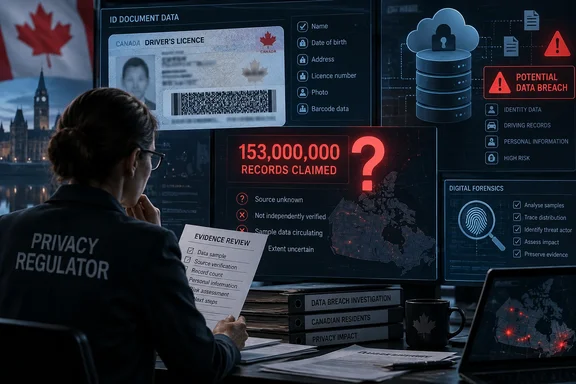
IDScan.net has publicly acknowledged an unauthorized party may have accessed or copied customer information held in cloud accounts. Its September 4 notice, also filed with Massachusetts regulators, says affected data may include full names and driver’s-licence or other government-ID numbers. The company has not publicly identified the intrusion method, the affected customers, the time period of exposure, or the number of Canadians whose documents were involved.
For Canadians and the businesses that scan IDs, the immediate takeaway is more specific than the breathless “largest breach” framing: this appears to involve reusable identity documents, not credentials that can simply be reset. A leaked password can be changed. A driver’s licence image, number, address, date of birth and photograph can support impersonation attempts for years, even after the original dark-web service disappears.
The confirmed breach is narrower than the claimed scale
The existence of an IDScan.net security incident is no longer merely an allegation. In its notice, the New Orleans identity-verification provider said that it learned around September 1 that data may have been accessed without authorization, secured its systems and brought in third-party specialists to investigate. It also said it would contact potentially affected people directly and offer credit monitoring and identity-protection services.
What has not been confirmed is the scale and complete contents of the alleged collection. KrebsOnSecurity first reported that a criminal service called Nexus was offering searches across what it claimed were more than 153 million U.S. and Canadian driver’s-licence records, alongside other identity documents. Krebs said he validated samples with affected people and found indicators pointing toward IDScan.net, while Reuters, TechRadar and Tom’s Hardware subsequently reported the FBI was examining the incident.
Those reports are meaningful evidence, particularly because IDScan.net has since acknowledged possible unauthorized copying from its cloud environment. But the alleged total still should not be treated as a verified count of unique people, valid documents, or even records actually taken from one system. Criminal-marketplace catalogues can contain duplicate scans, expired IDs, data from multiple sources, invented counts, or records added after the original intrusion.
Global News reported that filtering the alleged database for Canadian driver’s licences returned roughly 1.1 million results. That figure is also unconfirmed by Canadian authorities, IDScan.net and the privacy commissioner. It is an estimate derived from the alleged criminal service’s search results, not a tally produced from breach forensics.
The privacy commissioner is testing whether notification rules apply
The Office of the Privacy Commissioner’s engagement is not itself a finding that IDScan.net violated Canadian privacy law. It means the regulator is collecting enough information to determine obligations and next steps under the Personal Information Protection and Electronic Documents Act, or PIPEDA.
PIPEDA requires an organization under its scope to report a breach to the commissioner when there is a real risk of significant harm. The same threshold requires direct notification to affected individuals as soon as feasible after the organization determines the breach occurred. The law specifically lists identity theft, financial loss and harm to a credit record among the possible forms of significant harm.
Driver’s-licence images make that threshold difficult to dismiss if the reported scope is borne out. A scan can contain data frequently used by financial institutions, telecom providers, vehicle-rental companies and age-verification services to assess identity. The danger is not confined to a fraudulent credit-card application; criminals can use convincing document images in socially engineered support calls, account-recovery attempts and synthetic-identity schemes.
The major unknown is whose information IDScan.net held and in what form. The company’s notice refers to information “stored within their accounts on the IDScan.net cloud,” wording that suggests the incident may involve data uploaded or retained by the company’s customers rather than one monolithic government motor-vehicle database. That distinction does not reduce the potential harm to individuals, but it makes the notification chain more complicated: IDScan.net, its business customers and their customers may each hold different pieces of the information needed to identify affected people.
Canadians should not wait for the victim count
People who receive a direct IDScan.net notification should treat it as a reason to act, while recognizing that a notice may arrive well after criminals have had access to usable information. Those who have no notice should not assume their documents were exposed; at present, there is no authoritative public lookup tool or confirmed affected-person list.
The practical response in Canada differs from the U.S.-centric advice often repeated after a breach. Canada’s Financial Consumer Agency says consumers should obtain and review their credit reports, contact both Equifax Canada and TransUnion Canada to place fraud alerts when fraud or identity theft is suspected, and report confirmed fraud through the National Fraud Reporting System. A fraud alert tells prospective lenders to take additional steps to confirm identity before extending credit.
A security freeze, sometimes called a credit lock, can offer stronger protection because it blocks creditors from pulling a report for new credit. Availability is provincial and bureau-specific, however. Canadians should confirm whether they qualify and request protections from both Equifax and TransUnion; TransUnion says a freeze or alert on one bureau’s file does not automatically update the other.
The first signs of identity misuse are often more mundane than a large bank transfer. Watch for credit inquiries you did not authorize, mail or email about new accounts, changes to mobile-phone service, unfamiliar benefit claims and requests to “verify” information from callers who already know personal details. An unexpected caller with a correct licence number or address should be treated as more suspicious, not more trustworthy.
People should also be wary of breach-themed phishing. IDScan.net says it will notify potentially affected individuals and provide credit-monitoring and identity-protection services, but criminals regularly exploit publicity around breaches with counterfeit notification emails, fake enrollment portals and urgent demands for a one-time passcode. Do not use links or phone numbers supplied in an unexpected message; independently locate the organization’s contact details before discussing any account or document.
ID-scanning customers need to examine their own retention practices
For IT administrators, venue operators and businesses using IDScan.net or comparable document-capture systems, the urgent question is not limited to whether the vendor sends a notice. It is whether staff have been collecting and retaining scans they never needed to keep.
A bar checking age, a hotel checking in a guest, a parcel counter releasing a shipment and a company screening visitors may have a valid reason to inspect an ID. That does not automatically justify preserving front-and-back images, barcode data and transaction metadata indefinitely in a cloud account. The IDScan.net notice is a reminder that a stored document image becomes a long-lived, high-value credential whenever it is retained.
Organizations using document-verification platforms should immediately inventory active and former cloud tenants, identify which data fields and images are retained, and verify which employees and third parties can export them. They should preserve logs and avoid deleting evidence that may be needed for legal or regulatory review, but they should also suspend unnecessary bulk exports, shared credentials and overly broad account access while the vendor’s investigation continues.
They should then check whether internal retention settings match their stated privacy notices and contractual commitments. If a business has been retaining full ID scans merely because a product default made it easy, this incident creates a defensibility problem before any regulator contacts it. “We did not know the cloud account kept copies” will be a weak explanation where an organization chose the workflow and controlled the customer relationship.
The unanswered technical questions now matter most
Neither IDScan.net nor law enforcement has disclosed the entry point, whether the suspected access is ongoing, whether attackers accessed the service’s production environment or customer accounts, or whether encryption and access controls limited what could be copied. Those omissions matter more than a dramatic claimed record count because they determine whether businesses can contain the risk or should assume copied data is already broadly distributed.
The Nexus site reportedly went offline after the initial reporting. That is not evidence the documents are gone. Once identity images have been exported, sold or mirrored, taking down one storefront may only remove the most visible way to search them.
Canada’s privacy commissioner is now positioned to force clearer answers about Canadian exposure and notification duties. Until IDScan.net publishes verified scope, affected organizations identify themselves, and investigators establish how the data was obtained, the responsible assumption is limited but serious: the breach is confirmed; the advertised scale is not; and a driver’s-licence image is valuable enough to justify immediate fraud monitoring and tighter data retention.