

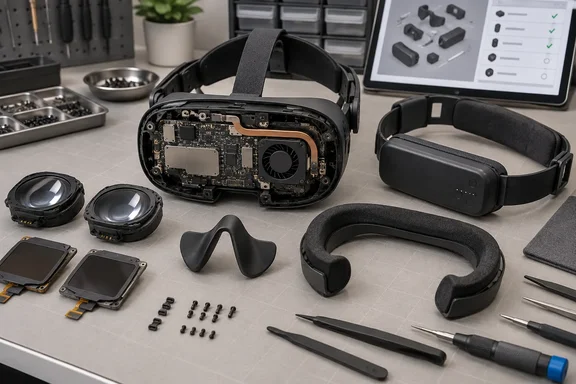
Steam Frame Teardown: Where PC Gamer Stopped and iFixit Kept Going
Ridley's account is openly a story of lost nerve. His disassembly exposed the metal plate, complete with copper heatpipe, atop of the mainboard. While trying to lift that plate, he pulled some of the cameras around the board's edge out early. When the mainboard still wouldn't come free, he stopped and put the screws back into PC Gamer's only review sample. He broke nothing, but he expected he would if he kept going.
iFixit's lead teardown technician, Shahram Mokhtari, got stuck at the same point. In iFixit's teardown video, Mokhtari says he got "a bit confused here". While hunting for whatever was holding the plate, he removed the two forward-facing tracking cameras that also handle passthrough, then realized the last fasteners were three screws on the copper heatpipe. TechPowerUp's summary describes the rest of the compute module the same way: it comes apart pretty uneventfully, aside from some confusion with the cooling assembly and an abundance of cables running over the motherboard.
Two different people getting stuck at the same plate tells owners something useful. That step is where the Frame stops being friendly, and neither account is a safe repair procedure for it. Mokhtari's verdict on the deep layers is that very few repairs should ever need them. TechPowerUp paraphrases iFixit's position as saying the design holds up because most repairs would not need that level of disassembly, so burying that complexity there is the correct decision.
Before the findings, the relationship: iFixit sells Valve parts. Its article states that iFixit partners with Valve to provide parts, tools, and repair guides for Valve hardware, including Steam Frame. Valve had no input on our editorial process and did not review this teardown before publication. Several outlets independently reported the same findings from iFixit's article and video, including TechPowerUp, HotHardware, and PC Guide. The underlying teardown is still a single piece of work by one lab.
Valve's Strap-and-Core Split Puts the Steam Frame Battery Within Reach
The Frame has two halves. The optical and compute side of things detaches from the headband, which includes the battery, speakers, and consumable foams. Ridley describes three switches under the magnetic face mask that release the core module from the strap, then six Torx screws holding the plastic cover. HotHardware likewise describes a simple three-latch mechanism to pop off the entire head strap and outer plastic chassis in seconds.
This layout matters most for the cheapest and most frequent repairs. The Frame's face and headrest foams come off for replacement. iFixit adds that the nose bridge is a separate modular part that can be replaced on its own, which it says goes further than other headsets it has seen. Because the battery lives in the strap, replacing it doesn't involve the displays at all.
The battery is where iFixit's first complaint comes in. It found no stretch-release tabs, peelable adhesive wraps, or electrically debondable glue. It got the pack out with a little isopropyl alcohol and gentle prying, and said it would rather see a deliberate release mechanism. The pack is a curved two-cell lithium-polymer battery rated at 20.9 Wh. It connects through a small board with two solder points, which plugs into the headband with a press connector. Citing other reviewers, iFixit puts real-world runtime at one to two hours. It argues that short runtime makes normal battery wear show up sooner, and that owners should expect to want a new battery within a couple of years.
Ridley's write-up sounds more upbeat about third-party batteries than iFixit's does. Ridley says iFixit expects aftermarket packs to be fairly easy to add. iFixit's own article does predict that the community will build third-party packs, but it warns that the reverse-engineering "may not be an easy" job. The reason is that power, audio, microSD data, and services from the rear USB-C port all pass through one small strap connector. That same detail gives owners a first thing to check. If power, audio, the microSD slot, or the rear USB-C port stops working, iFixit suggests looking at that shared connector for dirt or damage before opening anything. PC Gamer also says Valve is already developing its own strap with swappable batteries. No other outlet in this coverage has reported that.
Magnetic Lens Stacks Make Steam Frame Display Repair Approachable, Not Tool-Free
The lenses and displays slide along a rail to set interpupillary distance (IPD), the spacing between the optics that should match the distance between your pupils. iFixit found that sliding them to the widest setting exposes the access screws. Inside, the lens stacks are held to the rail by magnets. HotHardware lists the internal lenses that magnetically attach to the interpupilary distance (IPD) rail among the highlights.
Magnets don't make this a tool-free swap. The display cables are glued to the back of each LCD and need patience to peel away. Ridley left them alone because he was afraid of damaging the review unit; iFixit pried them off. Once the cables are free, iFixit says, the assembly lifts out cleanly, and it calls this one of the most approachable optical-module replacements it has seen. Ridley reports iFixit saying only the Bigscreen Beyond has an easier lens-stack removal. Mokhtari's video notes add that the magnetic lens stack makes panel or eye-tracking replacement surprisingly approachable for a DIYer. That fits with iFixit's finding that the two inward-facing IR cameras used for eye tracking sit on the inside edge of the lenses.
The panels are LCDs, not the micro-OLED some enthusiasts hoped for. iFixit explains the trade-off. OLED pixels produce their own light and can show deeper blacks, while an LCD relies on a backlight that leaks through dark pixels. iFixit expects the LCD choice to make replacement displays cheaper, but it can't give a price yet because it won't sell displays at first. (TechPowerUp calls the panels IPS, which is a type of LCD. iFixit's article only says LCD.)
The owner-relevant point is limited but real. A cracked or sun-damaged display can come out without dismantling the rest of the headset. iFixit points to Valve Index owners who reported scratched lenses and LCDs burned by sunlight focused through the lenses, so this is a failure that actually happens.
The Steam Frame Fan Is Buried Under the Snapdragon 8 Gen 3 Mainboard
Below the optics, the Frame looks like other densely packed standalone headsets. A copper thermal structure runs across both displays. Thermal compound covers the processor, and cables wrap around the mainboard from every side. iFixit's 256 GB unit has 16 GB of SK hynix LPDDR5X memory stacked on top of a Qualcomm Snapdragon 8 Gen 3, with 256 GB of SK hynix flash storage nearby. PC Gamer reports the same parts. iFixit calls the result "basically a gaming smartphone strapped to your face."
The fan sits on the back of the board under a second heatpipe, and it is iFixit's biggest complaint. "The thermal hardware and fan appear to be separate parts, which is welcome. Getting to them, though, is the problem. Removing the fan takes us past the optics and through the dense internal assembly, disturbing far more hardware than we'd like for a replacement. The fan is the Frame's clearest missed opportunity," iFixit says. Fans collect dust and wear out, and iFixit notes that the fanless Index ran hot enough that many owners installed third-party fans in its front compartment.
The coverage disagrees on one detail. TechPowerUp says the internal fan and heatsink module are not individually serviceable. iFixit's own wording is that they appear to be separate parts that are simply hard to reach. The primary source says separate but buried, and that is the version to rely on until iFixit's repair guides show the actual procedure.
The IR emitter count also differs. iFixit counted twelve infrared emitters around the board's edges, six on each side, and says they track play-space boundaries even in low light. PC Gamer's account says six, three per side. iFixit's number comes from its own infrared camera imaging, so it is the more reliable figure. The controller shells also carry plenty of emitters around the top, underside, and stem.
Soldered TMR Sticks and AA Batteries Define Steam Frame Controller Repairs
iFixit took the controllers only as far as battery removal, because it plans to make its repair guides from that same hardware. It used its Lumafield CT scanner to look at the rest. Power is the good news: the controllers take replaceable AA batteries, which iFixit calls a big improvement over the hard-to-reach rechargeable cell in the Index controllers.
The thumbsticks have the opposite problem. The scan shows a full-size thumbstick soldered to its board. Valve says the Frame uses the same magnetic sticks as Steam Controller, whose sensors use TMR. TMR stands for tunneling magnetoresistance. iFixit explains what it replaces: in a conventional potentiometer, a wiper slides along a resistive track as the stick moves. Wear and contamination can change that electrical reading, leaving the controller reporting movement when the stick is centered. A TMR sensor reads a moving magnet with no sliding contact, which removes that particular cause of drift.
iFixit is careful to add that this doesn't make the joystick immune to drift or other failures. Because the stick is soldered to the board, replacing one means soldering rather than unplugging a module. For most owners, that turns a stick failure from a home repair into a job for a repair shop or someone comfortable with a soldering iron.
Steam Frame Parts and Guides Are Promised, With Batteries and Displays Left Out
For now, the Frame's repairability exists on paper. iFixit says it will use its teardown unit to write repair guides over the coming weeks. PC Guide quotes Mokhtari saying you can expect to see parts available on our store soon. TechPowerUp likewise reports that iFixit also confirms that it will sell Steam Frame spares and publish repair guides, the same way it has with the Steam Deck and now the Steam Machine.
The two parts owners are most likely to need won't be available at first. iFixit writes: "We won't yet be selling Steam Frame batteries when parts go live in our store. We hope that will change. Gamers who drop over $1000 on this headset will rightly expect to be able to use it for more than a couple of years," iFixit says. Displays are also off the launch list, with no price given.
Storage is one area that doesn't depend on parts. The Frame comes in 256 GB and 1 TB versions, and iFixit says the external microSD slot takes cards up to 2 TB. PC Guide reports Valve has recently started shipping the Frame out to those successful in the reservation queue, so the first owners are only now receiving units. That puts the battery question roughly two years out for early buyers.
What this means for Steam Frame owners
If you already own a Frame, you can keep it and use it normally, keep your warranty in mind, and wait for iFixit's official guides before opening anything past the strap or foams. Both teardowns show the risky step is the metal plate over the mainboard. Two people new to that hardware, one of them a professional, got confused there and pulled cameras out early.
- Face foams, headrest foam, and the modular nose bridge are designed to be swapped, and they are the obvious first repairs for a shared or heavily used headset.
- If power, audio, microSD, or the rear USB-C port stops working, iFixit suggests checking the single strap connector that carries all of them for dirt or damage first.
- The battery can be reached from the strap, but it is glued in, and iFixit won't sell replacements at launch. Treat third-party packs as an expectation, not a product you can buy.
- A broken display can come out without full disassembly, but the cables are glued to the panel. Replacement displays aren't on sale yet and have no price.
- The cooling fan is the part most likely to need cleaning and the hardest to reach. Overheating or fan noise will probably mean a deep teardown or a service visit.
- Controller AA batteries are easy to replace, while a failed TMR thumbstick means soldering.
Valve has built a standalone headset where the likely repairs—cushions, battery, displays—can be done without taking apart the mainboard layer. That puts the Frame close to the Steam Deck in repair-friendly design. The fan, the battery glue, and the soldered sticks are real design flaws, but whether owners can fix a Frame in practice now depends mostly on supply: iFixit's guides are due in the coming weeks, and the headset won't be practical to keep running for years until battery and display parts go on sale.
Update: Valve’s listed battery capacity differs from iFixit’s teardown label (September 26, 2026)
VR.org reports that Valve’s Steam Frame product page lists a 21.6 Wh battery, while iFixit’s September 23 teardown identified a 20.9 Wh rating on the curved two-cell pack it removed from its unit.
Neither Valve nor iFixit has explained the 0.7 Wh difference, and the reporting does not establish whether it reflects a specification convention, a production revision, or another distinction. It does mean prospective replacement-battery makers—and owners comparing listings—should not assume that the headline capacity alone identifies a compatible pack.
For now, the practical repair position is unchanged: iFixit is not planning to sell a Steam Frame battery when its initial parts catalog launches. Owners considering a future third-party replacement should verify the pack’s physical fit, connector, and electrical specifications rather than buying based solely on either capacity figure.