

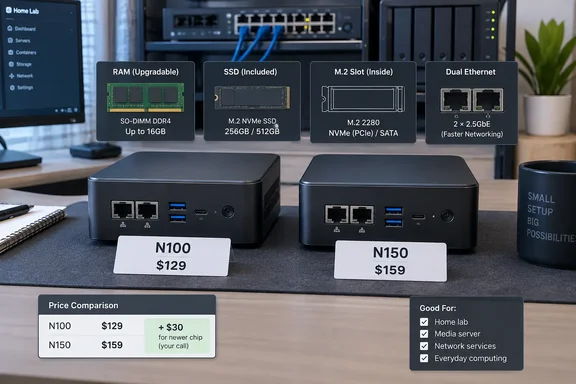
That is the useful distinction behind XDA’s argument that the N100’s automatic recommendation status has expired. Its case combines a modest processor refresh with newer storage and networking layouts. However, one verified retail detail adds an important qualification: Beelink’s $385 EQ14 configuration is explicitly labeled pre-order, not simply ready-to-ship stock.
For home-lab buyers, the question is not whether 150 is a bigger number than 100. It is whether the machine delivers the right capabilities at the right total price.
N100 versus N150: a refresh, not a revolution
Intel’s specifications confirm that these processors have much in common. The N100 launched in the first quarter of 2023; the N150 followed in the first quarter of 2025. Both provide four cores, four threads and 6MB of cache. Their most obvious differences are higher maximum CPU and graphics frequencies on the N150.
| Intel specification | N100 | N150 |
|---|---|---|
| Cores / threads | 4 / 4 | 4 / 4 |
| Maximum turbo frequency | 3.4GHz | 3.6GHz |
| Listed processor power | 6W TDP | 6W processor base power |
| Maximum graphics frequency | 750MHz | 1GHz |
| Graphics execution units | 24 | 24 |
| Quick Sync Video | Supported | Supported |
These are Intel’s published specifications, not measurements of complete mini PCs.
The reasonable interpretation is that the N150 offers additional frequency headroom without transforming the platform. XDA argues that its typical container workloads would feel effectively unchanged. That is a workload judgment, not a controlled benchmark, and should not become a promise that every application performs identically.
There is also no memory-capacity breakthrough in Intel’s specification sheets: both list a 16GB maximum and one memory channel. For buyers planning several virtual machines, the practical lesson is to establish the memory requirement before choosing either processor. A higher model number does not remove that published constraint.
Takeaway: The N150 is a reasonable preference at price parity, not a compelling reason to replace a working N100.
The price argument needs a configuration check
XDA reports that the N100-based Beelink Mini S12 Pro, configured with 16GB of RAM and a 500GB SSD, previously reached roughly $170 and now costs more than twice that on Amazon. That is XDA’s retail observation; it does not establish that every N100 system has lost its price advantage.
The manufacturer evidence does support the other side of its comparison. Beelink’s U.S. EQ14 page lists an N150 configuration with 16GB DDR4, a 500GB SSD and dual 2.5GbE at $385. Crucially, that selected configuration carries a pre-order label.
That changes how buyers should use the comparison. An advertised price is only one part of an actual purchase decision. Before choosing, compare:
- The exact RAM and SSD configuration.
- Ethernet speeds and controller details.
- Whether the unit is in stock or awaiting fulfillment.
- Total checkout cost, including applicable shipping and taxes.
- Return terms, warranty coverage and the seller providing support.
This is a buying checklist, not evidence that either processor family is universally cheaper. The defensible conclusion remains conditional: an N100 loses its bargain appeal when a suitably equipped N150 costs about the same.
Storage and Ethernet matter more than the badge
XDA’s strongest point is that these machines are systems, not processors with decorative cases.
Its examples include the six-M.2-slot Beelink ME mini, the four-NVMe-slot CWWK P6 and HUNSN fanless appliances with four 2.5GbE ports. Those are model-specific configurations described by XDA—not features buyers should assume accompany every N150.
Beelink’s EQ14 documentation provides a particularly useful detail beyond the processor comparison. It specifies two M.2 2280 PCIe 3.0 SSD slots, an internal power supply and dual 2.5GbE networking, but also says the retail unit ships with a SATA III SSD. A listing that advertises PCIe-capable expansion therefore does not establish that its included drive is NVMe.
That is precisely why “500GB SSD” is an incomplete specification. Buyers should distinguish the supplied drive from the capabilities of the expansion slots.
For a proposed Proxmox node, OPNsense appliance or compact all-flash NAS, use the intended role to organize the comparison:
- Virtualization: Verify memory capacity, firmware options and platform compatibility.
- Firewall: Establish the required interface count and confirm operating-system support for the exact controllers.
- Storage server: Confirm drive interfaces, slot sizes and the vendor’s documented storage layout.
- Always-on services: Seek complete-system power measurements rather than relying on the CPU’s advertised wattage.
Both Intel processors list VT-x, VT-d and Extended Page Tables support. Intel nevertheless cautions that feature availability depends on the complete system, including firmware and software. Processor support is the starting point, not a guarantee that every desired virtualization configuration works out of the box.
Similarly, the 6W figures describe processor power classifications, not measured electricity consumption at the wall. They cannot, by themselves, prove an entire mini PC’s operating cost.
Existing N100 owners should resist the upgrade reflex
The purchase recommendation and the upgrade recommendation are different questions.
For an existing owner, the published specification changes alone do not establish a compelling replacement case. If the machine meets its current requirements, replacing it just to acquire the N150 badge is difficult to justify.
A used N100 can also remain attractive, but assess the particular listing rather than assuming “used” means “cheap.” Compare its condition, included components, return protection and total cost with a new alternative.
XDA suggests that home-lab owners tend to retain and repurpose their machines, restricting used supply. That is an observation, not demonstrated market-wide sales data. The practical advice survives without it: buy the actual deal, not a theory about what other enthusiasts keep in their cupboards.
Higher-tier alternatives need their own comparison
XDA also points to Wildcat Lake-based Beelink EQ mini and EQi systems as possible step-up purchases. Beelink’s own announcement confirms a Wildcat Lake product lineup, including the EQ mini.
However, XDA’s specific claims about a $45–$85 premium, added processor capability and 10GbE should not be applied across those models without configuration-level confirmation. A higher-tier alternative deserves consideration when it addresses an identified bottleneck—not merely because it occupies the next shelf.
The recommendation that should replace the old one
Stop recommending the N100 by default, not altogether.
Choose an N150 when the complete configuration, purchase terms and price make it the stronger option. Choose an N100 when a meaningful saving or a better hardware layout makes the older machine more useful. Keep an existing N100 when it continues to do its job.
The processor badge is a useful filter. It is not the purchasing decision—and a home lab has enough moving parts without adding buyer’s remorse.
References
- N100 mini PCs had a great run, but it's finally time to stop recommending them XDA · 2026-10-03T00:00:17+00:00
- Intel® Processor N100 intel.com
- Intel® Processor N150 intel.com