

What Intel actually specifies
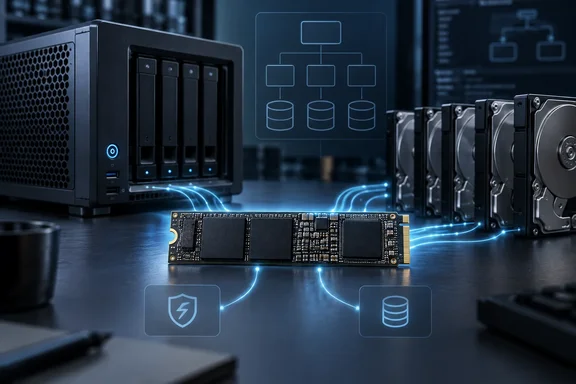
Intel's spec page lists the drive as an M.2 22 x 80mm part with a PCIe 3.0 x4 NVMe interface. It shows a Q2 2021 launch and a marketing status of discontinued. Rated figures are:
- Sequential speeds of up to 1,760 MB/s read and 1,050 MB/s write
- Random 4K performance of up to 410,000 read IOPS and 243,000 write IOPS
- An endurance rating of 1,292 TBW
- A five-year warranty period
- Enhanced Power Loss Data Protection, listed as "Yes"
- An operating range of 0°C to 70°C
Intel's product brief describes the drive as an 80mm M.2 part for data center boot use. It also targets write-heavy jobs such as logging and caching.
These are rated figures, not benchmarks. TBW is a lifetime rating, not a promise about a used unit's remaining life. Check the health of any second-hand drive yourself.
Why latency matters more than throughput
XDA Developers' piece argues that Optane's 3D XPoint media writes in place. That means no erase-before-write cycle and no SLC cache to run out. The article also cites average latencies of about 7 microseconds for reads and 10 for writes. I couldn't confirm those exact numbers on Intel's public spec page. Treat them as XDA's attribution to Intel for now.
The broader point holds. Small, queue-depth-one operations are what many server workloads generate. A drive that handles them well can feel much faster than its sequential numbers suggest. The reverse also holds: a modern Gen 4 drive will copy big files far faster. Not every NAND SSD behaves the same under sustained writes, so the comparison depends on the drive you pit it against.
The SLOG use case, stated precisely
The ZFS Intent Log is where synchronous writes get recorded before the system confirms them. OpenZFS documentation explains that the ZIL exists on every pool and is allocated from the main pool by default. A log vdev moves it to a dedicated device. Several points from OpenZFS are worth keeping straight:
- A SLOG is not a write cache. Asynchronous writes never touch the ZIL. If your workload has no synchronous writes, a SLOG changes nothing.
- It is only read after a crash, to replay writes that hadn't been committed yet.
- It needs low latency and power-loss protection. Consumer SSDs without protection can report data as stable that a power cut then loses.
- Typical beneficiaries are NFS servers, databases and VM hosts with sync-heavy guests.
- Multiple log devices can be mirrored, but raidz isn't supported for the intent log.
- Disabling sync is not a tuning trick. Setting
sync=disabledskips the ZIL and gives up recent-write durability.
A community TrueNAS thread makes the same point. One participant said Optane's power-loss protection, low write latency and high endurance make it a SLOG of choice. They followed that with the question of whether you really need a SLOG at all. If your main use is SMB file sharing, the answer is probably no.
A correction on SLOG sizing
XDA's article says a SLOG only has to hold a few seconds of writes because ZFS commits transaction groups every five seconds. It then puts the figure at a few gigabytes on 2.5GbE. OpenZFS describes the five-second timeout as when a transaction group closes. It also says the group closes sooner if enough dirty data piles up. That interval is not a documented SLOG sizing rule. Plenty of people do run small log devices, and the 118GB model has ample room. But the five-second argument doesn't prove the sizing, so don't treat it as a formula.
Boot, L2ARC and capacity
Intel pitched the drive as a data center boot device, and the endurance case is real for hosts that write constantly. XDA names Proxmox logging, graphs and the cluster database as examples. Some community members call a P1600X boot drive overkill. They would rather spend it on a SLOG or a special vdev.
On L2ARC, XDA says some people partition one drive for both SLOG and L2ARC. A TrueNAS forum veteran said testing showed Optane can handle that split in home use. The same post warned about passing partitions to ZFS rather than whole drives. OpenZFS cautions that L2ARC costs RAM. Each cached block needs a header in ARC, so on a RAM-constrained system an L2ARC can make things slower. Add RAM first.
The wind-down and the money
Intel's support notice says the company plans to cease future development of Optane. It called it impractical to deliver at scale as a single-source supplier. It also said that when it wrote the notice, the five-year warranty terms from date of sale remained unchanged. A secondhand buyer shouldn't assume a fresh warranty starts on resale. The notice lists the P1600X among the discontinued products.
The write-off figure needs care. XDA says Intel wrote off "more than half a billion dollars" in inventory. Intel's Q2 2022 earnings reported a $559 million Optane inventory impairment for the quarter. The full-year 2022 figure was larger, at $723 million. I couldn't open the earnings PDF directly, so that comparison rests on my research notes. Both figures clear half a billion, but they cover different periods.
Price and scarcity: handle with care
XDA puts used prices at $250–$350 and predicts they will only rise. I found no dated, representative sales data to back that range. Other evidence points the opposite way. One 2023 post reported the 118GB drive at $59 as of the latest check. A 2024-era forum thread mentioned new drives on sale at $60. Prices have clearly moved a lot, and today's market could differ by seller and region.
Don't treat the price forecast as fact. Intel did end development and list the model as discontinued. That doesn't prove any particular used unit is scarce or will cost more next month.
Should you hunt for one?
A P1600X makes sense only if all of these apply:
- Your system has an M.2 2280 slot that supports PCIe/NVMe.
- Your workload really produces synchronous writes, or sustained small writes that make a hard-drive pool feel sluggish.
- The used unit's health, price and warranty status check out.
- For a SLOG, you've weighed log-device resilience, since a single device doesn't make your pool redundant.
For ordinary Windows or Linux desktop boot duty, the small capacity and PCIe 3.0 interface count against it. Optane's real value was never speed on a benchmark chart. It is consistent behavior under the kind of writes that make spinning-disk arrays crawl.
References
- Intel stopped making Optane, but its tiny 118GB drive is still the boot drive home lab enthusiasts hunt for XDA · 2026-10-02T20:30:17+00:00
- Intel® Optane™ SSD P1600X Series intel.com
- Intel® Optane™ SSD P1600X Product Brief intel.com