

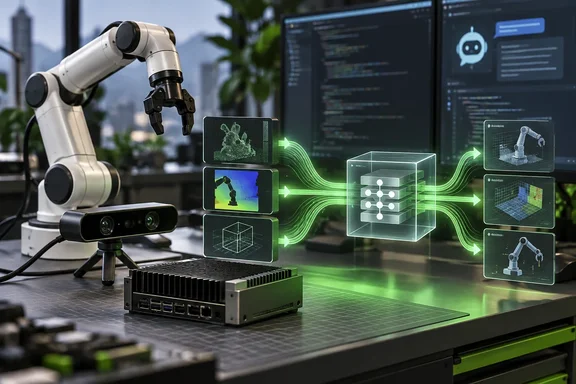
Isaac ROS 5.0 Moves NVIDIA's Robotics Stack to ROS 2 Lyrical and Ubuntu 24.04
ROS, the Robot Operating System, is a set of open-source libraries and tools for building and connecting robot software. In NVIDIA's announcement, Isaac ROS 5.0 is a collection of GPU-accelerated packages built on ROS, released today at the ROSCon conference in Toronto, Canada. The company says Isaac ROS reaches the nearly 1.3 million ROS users. Trade outlets including Robotics 24/7 reported the same launch, though mostly by repeating NVIDIA's own wording.
The platform change is the foundation for everything else. Per NVIDIA's release notes, version 5.0.0 makes ROS 2 Lyrical Luth the supported distribution. It also adds an Isaac ROS Buildfarm apt repository that carries Lyrical packages for Ubuntu 24.04 (Noble). NVIDIA also says it worked with the Open Source Robotics Alliance to contribute a standard data-handling interface to ROS Lyrical that helps robotics software work efficiently across different computing hardware, including GPUs.
The dates differ slightly between sources. The Isaac ROS documentation lists 5.0.0 as September 21, 2026, while NVIDIA's blog says September 22. Progressive Robot found that the GitHub tag for Isaac ROS 5.0.0 is stamped 22 September 2026 at 03:29 UTC, which is the evening of 21 September on the US west coast, so both dates describe the same release. The packages are tagged v5.0.0 on GitHub.
The same outlet flags a possible planning problem. It reports that Lyrical Luth is an LTS release supported until May 2031, and warns that if you had planned to move workstations to Ubuntu 26.04 to match Lyrical's tier 1 platform, you now have two targets to maintain. No other outlet has covered that Ubuntu mismatch. It is still worth checking before you standardize developer machines.
The NITROS-to-rosidl::Buffer Migration Is the Real Upgrade Cost
NITROS is NVIDIA's system for passing data between GPU-accelerated ROS nodes without repeated copies. In 5.0 it has been rebuilt on Lyrical's new rosidl::Buffer interface with a CUDA buffer backend. The release notes say accelerated nodes can now exchange standard ROS messages whose array fields can optionally be backed by GPU memory. In short, GPU acceleration now runs through a mechanism built into ROS itself instead of a set of NVIDIA-specific message types.
That change breaks existing code. The release notes list these packages as removed:
- The
isaac_ros_nitrospackage has been removed. - The
isaac_ros_managed_nitrospackage has been removed. - The
isaac_ros_pynitrospackage has been removed. - The
isaac_ros_nitros_topic_toolspackage has been removed. - The
isaac_ros_nitros_typefamily of packages has been removed.
NVIDIA states that code calling NITROS APIs or types directly needs a source-level migration, and publishes a migration guide titled "From NITROS to rosidl::Buffer." One bridge package, isaac_ros_nitros_bridge_ros2, remains for now. It is deprecated and will be removed in a future Isaac ROS release.
Not every project faces the same amount of work. AiCybr notes that projects using public ROS messages around Isaac ROS packages should see a different migration burden from projects that directly integrated NITROS types. If your nodes only exchange standard ROS messages with Isaac ROS packages, you are in a very different position from a team that wrote custom NITROS-typed nodes.
This did not come out of nowhere. Isaac ROS 4.5.0, released July 6, 2026, had already cut NITROS complexity by retiring the older GXF implementation and adding CUDA streaming support. Version 5.0 finishes the move by swapping NVIDIA's own message types for the ROS-standard buffer.
Two other renames will break builds for people who aren't watching for them:
isaac_ros_visual_slamis nowisaac_ros_cuvslam, named after the cuVSLAM library underneath it. Theisaac_ros_visual_slam_interfacespackage keeps its old name.- In
isaac_ros_teleop, the end-effector pose topic changes type fromgeometry_msgs/PoseArraytoteleop_ros2_interfaces/NamedPoseArray, which labels the left and right entries. Every existing subscriber has to be updated.
Progressive Robot's advice is practical: search for isaac_ros_visual_slam across launch files, package manifests, CI configuration and internal documentation before you start, not after the build fails.
Agent Skills in Isaac ROS 5.0 Target the Developer, Not the Robot
"Agentic" in this release mostly means tooling for AI coding assistants. The release notes say 5.0 adds skills in the open Agent Skills format, which packages instructions an assistant can follow for a specific workflow. The Isaac ROS CLI includes two of them:
isaac-ros-activateactivates the Isaac ROS development environment.migrate-node-to-rosidl-bufferis an early-access skill that helps convert a node from CUDA with NITROS APIs to the new buffer interface.
NVIDIA publishes more Isaac skills in its nvidia/skills catalog under a Physical AI category. It also offers "agent-ready" documentation written so assistants can follow Isaac ROS tools and workflows. The migration skill is the most useful piece for existing teams, because it goes straight at the breaking change above. It is labeled early access, though, so treat its output as a starting point and review it before merging.
Progressive Robot reads the scope the same way. It says the agentic features target the development workflow — helping developers and coding assistants build robot applications. The release notes say nothing about robots making decisions on their own at runtime. Claims that 5.0 turns robots into autonomous agents go well beyond what NVIDIA actually shipped.
Separately, NVIDIA points to partner work that does connect agents to running robots. AgenticROS is described in NVIDIA's blog as an open-source project sponsored by RealSense that links Isaac ROS with NVIDIA's Nemotron open models and NemoClaw blueprints so AI agents can interact with ROS-based robots. That is a separate project with its own maturity and safety questions, not a core Isaac ROS 5.0 feature.
FoundationPose, FoundationStereo and GPU Partitioning Carry Vendor Claims and Hard Limits
A few features go beyond coding help and reach into perception. NVIDIA describes a FoundationStereo fine-tuning skill that lets an AI agent help adapt a stereo depth model to a developer's own cameras, environment and application. FoundationPose, a foundation model that estimates and tracks an object's position and orientation, now has an agent-ready inference library. Pick-and-place, which chains detection, depth estimation and pose output, is also packaged as a standalone skill that can be used outside Isaac ROS.
The biggest performance number is a vendor claim. According to daily.dev's summary of the launch, the FoundationPose library tracks object pose up to 5.5x faster. NVIDIA's announcement gives no benchmark conditions for that figure, and no independent measurements have been published. Treat 5.5x as a best case, not something to plan capacity around.
The new isaac_ros_gpu_partitioning package needs careful reading. It uses NVIDIA CUDA Multi-Process Service (MPS) to give each ROS 2 process a fixed share of the GPU's streaming multiprocessors, and it requires nvidia-cuda-mps-control version 13010 or later. The release notes are explicit that it does not partition GPU memory or isolate workloads. It can stop one perception node from taking all the compute on a shared Jetson. It gives you no memory isolation and no security boundary between processes.
The release also includes fixes and debugging tools:
isaac_ros_segment_anything2no longer leaks a GPU buffer on every frame. Before the fix, live-camera pipelines used more GPU memory for each tracked object until they crashed with a CUDA out-of-memory error.- cuVSLAM's RealSense segmentation-mask workflow no longer aborts on a mono8-to-rgb8 conversion problem.
- The occupancy grid localizer no longer fails to launch because of empty frame IDs under Lyrical.
isaac_ros_deployadds optionalInferenceControllerdebug topics that publish flattened model inputs and the selected output tensor. It also adds troubleshooting guides for the LEAPP runtime, robot description, ROS communication and the safety controller.isaac_ros_teleopadds apose_reset_configlaunch parameter, which startspose_reset_nodewhen set.
Known Issues in Isaac ROS 5.0 That Should Gate a Jetson Upgrade
NVIDIA's list of known limitations is long and specific, and it will decide the timing for many teams. The most likely blockers:
| Component | Affected setup | Documented issue | Workaround |
|---|---|---|---|
| RealSense cameras | Virtual Environment and Bare Metal modes | Supported only in Docker mode | Use Docker mode |
isaac_ros_stereo_image_proc | Jetson AGX Orin, backend:=JETSON, RGB8/BGR8 input | VPI_ERROR_INVALID_OPERATION ends the node before disparity output | Use backend:=CUDA (the default) |
isaac_ros_h264_encoder | Jetson Thor with VPI 4.1.4 | May segfault on shutdown after encoding finishes | Set LD_PRELOAD=/opt/nvidia/vpi4/lib/aarch64-linux-gnu/libnvvpi.so.4 for the encoder launch |
isaac_ros_dnn_image_encoder | Jetson Thor, Jetson AGX Orin, DGX Spark, RTX 5070 | Lower throughput and higher latency than Isaac ROS 4.6 | None listed |
isaac_ros_nvblox | Intel RealSense D455 example | Depth and color frames not integrated, so mesh and map outputs are empty | None listed |
isaac_ros_teleop | Jetson Orin, prebuilt Debian package | Experimental CloudXR runtime missing, so launch can fail | Set ISAAC_TELEOP_CLOUDXR_EXP=0 |
isaac_ros_segment_anything | Virtual Environment or Bare Metal | SAM/MobileSAM conversion fails if PyTorch and torchvision use different CUDA major versions | Install matching builds for the supported CUDA version |
isaac_ros_triton | x86_64, built from source | No PyTorch backend | None listed |
isaac_ros_cumotion_moveit | Examples using upstream robot-vendor packages | May fail to launch because those packages aren't yet certified for Lyrical | None listed |
Some smaller items are also listed. isaac_ros_yolov8 can print spurious component-loading errors at startup even when the pipeline works fine. The occupancy-grid-localizer tutorial may fail to load the Nova Carter scene on DGX Spark with Isaac Sim 6.0.1, because the RTX lidar sensor model can't be created.
The image-encoder regression deserves a close look. Many perception pipelines feed camera frames through that preprocessing step before inference. NVIDIA confirms it is slower than 4.6 on four named platforms, including its flagship Jetson Thor. If your robot runs close to a latency budget, measure your own pipeline on 5.0 before you commit. The cuMotion/MoveIt problem shows a wider dependency: Isaac ROS 5.0 is only as ready as the third-party robot drivers you run on Lyrical.
Jetson Orin Nano to Thor Support Shows Where NVIDIA Wants the Stack to Run
On hardware, NVIDIA says Isaac ROS 5.0 expands deployment across the Jetson platform from Orin Nano to Jetson Thor. The pitch is a single software base from entry-level development boards to high-end robot computers, with ROS, perception, navigation, AI models and application logic all running on the robot instead of in the cloud.
The announcement also lists partners. Mentee Robotics, Universal Robots, ROBOTIS, FieldAI and Noble Machines are described as building Isaac ROS into robots or SDKs. Intrinsic, Seeed Studio, Magna, Flexiv, Ekumen, Ouster, Foxglove and Prefix.dev are named for integrations. One figure comes from NVIDIA: Ekumen reportedly uses isaac_ros_cumotion to plan a collision-free path for a warehouse arm in about 2 to 5 milliseconds. These examples show NVIDIA's claimed adoption. They do not independently confirm performance or production readiness.
Licensing and scope are unchanged. Progressive Robot notes there is no new humanoid locomotion stack, no change to the GR00T model family and no licensing change. Isaac ROS remains free and open source.
What this means for ROS teams
Base your upgrade timing on how deeply your code depends on NITROS and on the known-issues table, not on the agent features. Teams starting new projects on Lyrical and Ubuntu 24.04 can adopt 5.0 now. Teams with running Isaac ROS 4.x robots should first check their dependencies and test performance.
- Search your codebase, launch files, CI and docs for direct NITROS API or type use and for
isaac_ros_visual_slam. Both need changes before a 5.0 build will succeed. - Try the early-access
migrate-node-to-rosidl-bufferskill on NITROS-typed nodes, and review its output like any other code change. - Update every subscriber to the
isaac_ros_teleopend-effector topic for the newNamedPoseArraytype. - If your robot uses RealSense cameras outside Docker, D455-based nvblox mapping, or cuMotion with MoveIt, stay on 4.6 until those limitations are fixed.
- Benchmark
isaac_ros_dnn_image_encoderpreprocessing on your own Jetson or RTX hardware, since NVIDIA confirms it is slower than 4.6. - Treat
isaac_ros_gpu_partitioningas a way to share compute between processes, not as memory or security isolation.
Isaac ROS 5.0 finishes NVIDIA's move from its own NITROS message types to GPU acceleration built into ROS 2 Lyrical itself. For the long term, that is a bigger change than the AI-agent features. The deprecated isaac_ros_nitros_bridge_ros2 package works as a countdown: it will be removed in a future release, and any team still depending on NITROS at that point will be forced to migrate. Teams that plan the rosidl::Buffer migration now can do it on their own schedule, ideally once the Lyrical-certified vendor drivers and the image-encoder fix arrive.
References
- Isaac ROS 5.0 Drops NITROS for rosidl::Buffer Source Migration blogs.nvidia.com
- Release Notes — Isaac ROS nvidia-isaac-ros.github.io