

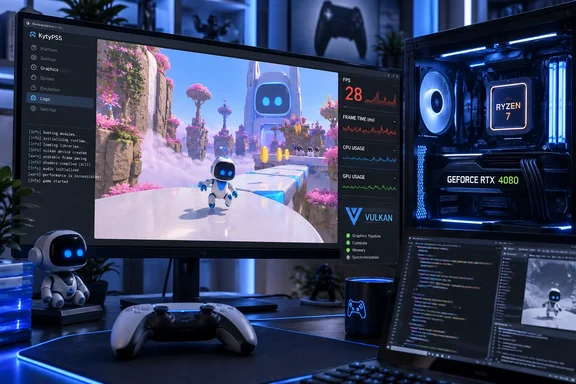
That distinction is more important than the headline’s “playable roster” wording suggests. A title that loads, renders 3D scenes, accepts input and survives a brief test has cleared meaningful emulator hurdles. It has not necessarily reached the point where a user can finish the game reliably, maintain consistent performance, or reproduce the result outside one tester’s hardware and software configuration.
KytyPS5’s own GitHub repository puts the project in similarly cautious terms. The open-source emulator says it remains in an early development stage, warns users to expect crashes, graphical defects, limited compatibility and poor performance, and says its current work is centered on compatibility and boot reliability. In other words, the project’s official status matches the video evidence: Astro’s Playroom appears to be an encouraging in-game result, not a compatibility guarantee.
Astro’s Playroom is a useful but limited milestone
Astro’s Playroom is a revealing test case for a PS5 emulator because it is a native PS5 title designed to demonstrate the console’s hardware features, rather than a lightweight 2D game or a release built around a mature multiplatform engine. It is pre-installed on retail PS5 consoles, but that does not mean it comes bundled with KytyPS5, nor does it make obtaining a usable game dump automatic for PC owners.
The emulator’s documentation explicitly says KytyPS5 does not distribute games or copyrighted PlayStation system software, and tells users to use legally obtained game files. On Windows, its launcher scans user-selected folders for game directories containing an eboot.bin executable. That is a developer-oriented workflow, not the console-like “install and download” experience some readers may infer from a game compatibility headline.
There is another naming point worth clearing up. Astro’s Playroom is the 2020 PS5 pack-in title; Astro Bot is the later standalone game. Notebookcheck’s report says KytyPS5 had already been seen running games including Demon’s Souls and Astro Bot, then describes the new Astro’s Playroom footage as another addition. These are separate software releases, so the newer demo should not be dismissed as merely the same game being retested under a shorter name.
The footage also gives no basis for comparing KytyPS5 with native PC ports or with PS5 hardware. There is no published benchmark methodology attached to the reported test: no stated resolution, internal renderer settings, driver version, frame-time data, shader-cache state, save-file progression, or extended stress test. “No crashes in a short video” is a useful observation, but it cannot establish stability across level transitions, suspend-and-resume behavior, controller functions, audio, or a full playthrough.
High-end hardware did not turn this into a smooth experience
The reported test rig is significant precisely because it is not a modest machine. A Ryzen 7 9800X3D paired with an RTX 4080 is high-end gaming hardware, yet Notebookcheck says the emulator often dipped under 30 fps in Astro’s Playroom. That result suggests the immediate bottleneck is not simply graphics horsepower; emulator correctness, CPU-side translation work, synchronization and shader handling remain likely constraints.
KytyPS5’s technical documentation supports that reading. Its renderer uses Vulkan 1.3 and includes code paths for PS5 graphics command processing, shader decoding and recompilation, resource management, and SPIR-V generation. Console emulation has to reproduce behavior expected by PS5 software while translating that work into APIs and drivers available on the host PC. A modern GPU can help, but raw specifications do not eliminate the cost of reproducing timing, memory behavior and graphics pipeline assumptions made by console software.
The project lists Windows 10 version 1803 or later, a 64-bit x86 processor, and a Vulkan 1.3-capable GPU with current drivers as baseline requirements. Those are build and launch requirements, not a statement that PS5 games will perform acceptably on every compatible Windows PC. The GitHub documentation also identifies Windows as KytyPS5’s primary and most-tested platform, which makes it the clearest target for enthusiasts willing to compile software and provide bug reports—but it should not be mistaken for a polished consumer release.
Tom’s Hardware recently reported stronger results in a handful of less demanding or better-behaved titles, including a hands-on test of PAC-MAN WORLD Re-PAC at 60 fps on a Ryzen 7 7700X and Radeon RX 6700 XT. That finding is useful context, but it does not contradict the rough Astro’s Playroom showing. Emulator compatibility is title-specific in the early stages: one game reaching a stable frame rate can reflect a code path the emulator handles well, while another exposes unimplemented functions or costly rendering behavior.
The practical meaning of “runs” has to stay narrow
For testers, the Astro’s Playroom demo is valuable because it expands the set of PS5 software that can reach visible gameplay in KytyPS5. Each successful test can produce logs, regressions and repeatable cases that help developers isolate what works and what still fails. KytyPS5’s maintainers specifically ask contributors to submit detailed game bug reports with complete log files, indicating that community testing is part of the project’s development model.
For ordinary Windows gamers, the responsible takeaway is much less dramatic. Do not buy a Ryzen 7 9800X3D, an RTX 4080, or any other component on the assumption that it will deliver a working PS5 library through KytyPS5. The demonstration shows that even a premium desktop cannot yet guarantee a console-like result in this particular game, and the official project documentation directly warns that behavior may change substantially between builds.
Users who choose to experiment should also avoid treating unofficial builds, compatibility spreadsheets and short social-media clips as interchangeable with the official project. KytyPS5 is GPL-2.0 licensed and publicly developed, but forks and locally modified builds can differ materially from the main repository. A claimed result therefore needs the exact emulator revision, host operating system, GPU driver, title version and test conditions before it can be called reproducible.
The next useful result is repeatability, not another boot screen
KytyPS5’s progress is real enough to watch: its repository has been actively updated, it supports Windows, and the project now documents a practical Vulkan-based Windows build path using Visual Studio 2022 tools, Qt 6, CMake, Ninja and clang-cl. But the new Astro’s Playroom footage does not change the emulator’s early-stage status.
The immediate consequence is straightforward. Astro’s Playroom belongs in the “boots and can reach gameplay under experimental conditions” category until independent testers can show sustained, repeatable performance and complete-session stability across more than one configuration. For KytyPS5 developers, the footage is another data point; for Windows users, it is not yet a reason to plan a PS5 replacement PC.
References
- KytyPS5 PS5 emulator reportedly adds another PS5 game to its playable roster Notebookcheck · 2026-09-16T08:25:00+00:00