

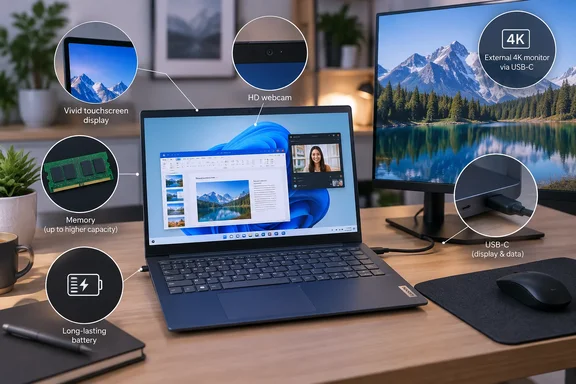
The screen is the attraction—but check the variant
Techaeris identifies its Cosmic Blue review unit as 83RR0000US, with a Core 7 350, 16GB of RAM, a 512GB SSD and Windows 11 Home. Its display is a 15.3-inch, 1920 × 1200 touchscreen rated at 120Hz, 400 nits and 100% sRGB.
Lenovo’s official Product Specifications Reference confirms that panel option, but also lists a 60Hz non-touch IPS display and a 165Hz OLED alternative. The family name therefore does not guarantee the reviewed screen.
That distinction matters more than a cosmetic color choice. A recommendation built around smooth scrolling and touch input cannot automatically transfer to a cheaper configuration without those features. Treat the display specification as a purchasing requirement, not a footnote.
Everyday performance, with an upgrade caveat
Techaeris reports responsive browsing, office work and video calls, but discourages demanding gaming. Its account does not provide enough reproducible benchmark detail to establish a precise performance ranking.
Lenovo specifies six CPU cores and an NPU rated up to 17 TOPS. Its “AI PC” designation should not be read as proof of particular local Copilot capabilities.
More practically, Lenovo lists one DDR5 SO-DIMM slot, with tested offerings up to 32GB, and one M.2 2242 SSD slot.
The memory implication is straightforward: expanding a 16GB configuration means replacing its module, not adding another alongside it. Budget for the replacement and verify compatibility before ordering. Upgradeable is useful; it is not synonymous with unlimited expansion.
For a 4K monitor, choose the right port
Lenovo explicitly specifies 4K at 30Hz over HDMI and 4K at 60Hz over USB-C, alongside 45–65W USB-C Power Delivery charging.
For a desk setup, that makes USB-C the sensible starting point for a 4K/60Hz display connection, using compatible equipment. Also, do not assume any phone charger will replace the supplied adapter: match the documented charging requirements. The connector’s shape is not its résumé.
Battery and webcam claims need caution
Techaeris reports six to eight hours of mixed-use battery life, but its specification table says 50Wh while its battery discussion says 60Wh. The camera description similarly switches between 720p and 1080p with infrared facial recognition. Those contradictions prevent a confident specification-level conclusion about the review unit.
Lenovo lists both battery capacities and multiple webcam options; infrared Windows Hello support is optional.
Before purchasing, obtain confirmation of the exact battery and webcam. That is particularly important if facial sign-in or long unplugged sessions are deciding factors.
Bottom line
Techaeris lists $849.99 as reviewed, not a guaranteed current price. Its favorable verdict rests on getting a useful everyday Windows laptop rather than a gaming machine or mobile workstation.
The strongest buying approach is to preserve that configuration discipline: confirm the touchscreen, camera, battery and upgrade path, then judge the actual asking price. This IdeaPad’s appeal is credible—but the model number deserves as much attention as the review score.
References
- Lenovo IdeaPad Slim 3i 15 (Gen 11) Review - Techaeris Techaeris · 2026-10-01T20:07:33+00:00
- Document psref.lenovo.com