

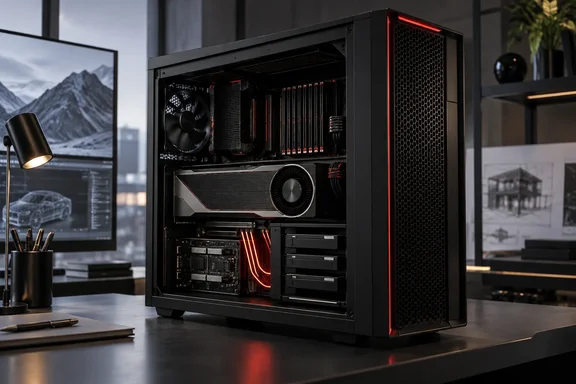
For Windows workstation buyers, the most important detail is tucked beneath those impressive numbers: Lenovo’s maximum-capacity memory configuration does not run at 6400MT/s. Its product reference specifies a substantially lower operating speed when all four 64GB modules are installed.
A wider rollout, not a brand-new workstation
Lenovo announced the ThinkStation P4 on May 13, 2026, with availability planned in selected markets from June. The October development is therefore an expansion of availability and orderable configurations, rather than the debut of a new chassis.
The platform uses AMD’s PRO 675 chipset and Ryzen PRO 9000 processors, topping out at the Ryzen 9 PRO 9965X3D with 16 cores and a maximum boost frequency of 5.5GHz. Lenovo lists Windows 11 Pro and Linux options, alongside optional liquid cooling for its highest-performance processor configurations.
What the 72GB graphics option actually adds
NVIDIA’s specifications confirm two RTX PRO 5000 Blackwell memory variants: 48GB and 72GB. The larger model provides 50% more VRAM, using GDDR7 memory with error correction. NVIDIA lists a 300W maximum power consumption, four DisplayPort 2.1 outputs and a dual-slot design.
That memory expansion is principally about accommodating larger workloads. NVIDIA identifies local AI development, inference and complex 3D projects as intended uses; its explanation highlights how model size, context windows and multimodal pipelines increase GPU-memory requirements. More capacity should not be read as a promise of proportionally faster application performance.
There is also a useful timing distinction: NVIDIA announced general availability of the 72GB card on December 18, 2025. What is new here is its reported availability within Lenovo’s P4 configuration—not the invention of a new GPU.
Lenovo’s platform reference additionally lists 96GB RTX PRO 6000 options, but carries an orderability caveat. A supported component in a specification sheet is not proof that every regional storefront offers it.
The 256GB RAM caveat buyers should not miss
Lenovo’s detailed memory specifications establish three important boundaries:
- 256GB requires four 64GB non-ECC CUDIMMs.
- Those modules carry a DDR5-6400 rating, but the four-module configuration runs at 3200MT/s.
- One or two 64GB CUDIMMs run at 5600MT/s; ECC system memory is a separate offering using smaller modules.
The practical conclusion is straightforward: the maximum-memory build prioritizes capacity, not the highest advertised memory rate. Buyers should ask for the installed configuration’s operating speed and ECC status, rather than relying on the module label.
The GPU’s ECC-equipped VRAM does not make the 256GB system-memory configuration ECC-equipped. Lenovo and NVIDIA document those as separate memory specifications.
How Lenovo reaches 48TB
Lenovo’s launch specifications break the storage ceiling into three 4TB M.2 SSDs and three 12TB SATA hard drives: 12TB of SSD capacity plus 36TB of HDD capacity. This is a mixed-storage total, not 48TB of all-flash storage.
The product reference adds two upgrade considerations: only two onboard M.2 slots support PCIe 5.0, while the third supports PCIe 4.0; some aftermarket storage additions require upgrade kits.
Starting prices tell only part of the story
Notebookcheck’s October 6 report lists starting prices of $1,849 before US sales tax, £2,114 including UK tax, and €1,793–€2,530 including tax across the cited Eurozone markets. It describes a starting memory-and-storage combination of 16GB DDR5-5600 and 512GB, with integrated graphics. The reported 72GB GPU surcharge alone is approximately €11,000 or £12,000, depending on market. These are reported regional prices, not a universal component price or guaranteed checkout quote.
The sensible purchasing approach is to compare complete configurations. Specify the exact GPU memory variant, installed RAM capacity and operating speed, SSD/HDD split, operating system and support package.
The P4’s expanded availability is meaningful for buyers who need substantial local GPU memory. But the strongest takeaway is less glamorous than the headline: 72GB VRAM, 256GB RAM and 48TB storage describe different resources, with different configuration trade-offs. A workstation quote should explain all three—not merely put the biggest numbers in bold.
References
- Lenovo releases new ThinkStation desktop globally with 72 GB VRAM and up to 256 GB RAM Notebookcheck · 2026-10-06T16:22:00+00:00
- Lenovo releases new ThinkStation desktop internationally with up to 256 GB RAM and 48 GB VRAM - Notebookcheck News notebookcheck.net
- RTX PRO 5000 Blackwell | NVIDIA nvidia.com