

What the patches enable
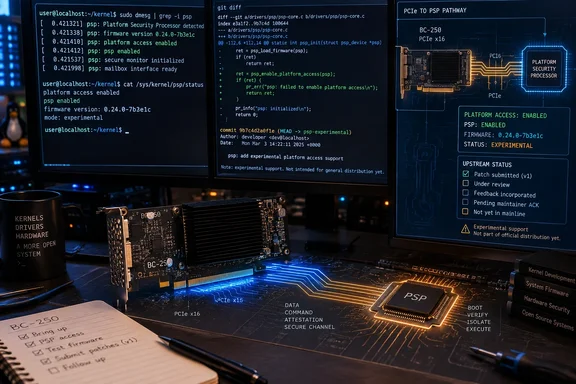
The central problem is device recognition. According to the kernel patch submission, the BC-250’s AMD Secure Processor appears with PCI identifier 1022:143e, but no entry in the driver’s sp_pci_table[] matches it. Consequently, the device remains unbound—without an attached driver—and its memory windows stay disabled.
Those memory windows provide the addressable interface through which software can interact with the device. Adding support therefore addresses a prerequisite for communication with the PSP, rather than merely changing how Linux names the hardware.
The submission reports that, with the changes, the AMD Crypto Co-Processor driver produces these messages:
ccp 0000:01:00.2: platform access enabled
ccp 0000:01:00.2: psp enabled
The patch author also reports reading 00.1c.01.02 from the device’s bootloader_version attribute in sysfs, Linux’s interface for exposing device information. Together, these observations document initialization and a firmware-version response on the tested BC-250. They are the contributor’s results, not WindowsForum testing.
A related initialization fault
The series also includes a fix for a NULL dereference in psp_firmware_is_visible(). In the mailing-list discussion, the contributor explains that the fault concerns PSP configuration data without associated TEE data—the data used for trusted-execution-environment support. The reply identifies the pspv1 and pspv2 configurations as relevant, while explicitly saying the fault had only been observed on the BC-250.
A NULL dereference occurs when software attempts to access an object through a pointer that does not reference one. Here, the discussion exposes another obstacle in the driver’s handling of the newly supported device. It does not establish that every system using those PSP configurations has experienced the fault.
The contributor had not added a stable-backport tag and invited maintainers to decide whether one was appropriate. Owners should therefore avoid assuming the fix will automatically appear in an older distribution kernel.
What BC-250 owners should take from this
Phoronix describes the BC-250 as a cut-down PlayStation 5-derived APU board with six Zen 2 CPU cores, a 24-compute-unit RDNA 2 GPU and 16GB of GDDR6 memory. Its report places the PSP work alongside earlier Linux graphics-driver and sensor-support improvements, illustrating how support for this unusual hardware is being assembled incrementally.
The demonstrated result remains narrower than complete security-processor functionality. Although Phoronix characterizes the work as enabling the processor for encryption tasks, the primary submission’s reported checks establish PSP initialization and responsiveness, not encryption throughput, application compatibility or working video decode. Those capabilities cannot be inferred from an “enabled” log message alone.
For owners tracking experimental kernels, the useful checks are whether their kernel includes the BC-250 support series and whether the PSP initializes successfully. The PCI address shown above belongs to the reported test system; it should not be treated as a universal device location. The concrete advance is that Linux can recognize and communicate with a previously unbound BC-250 component, giving further platform-support work a functioning starting point.