

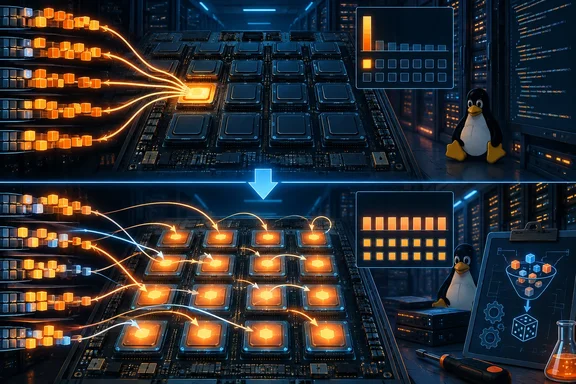
Phoronix first reported the patch series on September 16, 2026. The important qualification is that this is a proposal, not a shipped kernel feature: the reporting identifies neither a merged commit nor a Linux release target, and the patch’s claimed performance result is described only as a modest gain on systems with many CPU cores. Administrators should not expect a distribution update or tune a fleet around it yet.
The scheduler race is about simultaneous decisions
Linux often tries to wake a task on an idle CPU rather than queue it behind work already running elsewhere. That decision carries several competing priorities: a CPU in a shallower idle state may return to useful work more quickly, while a recently idle CPU can look attractive because it may preserve warmer cache contents.
Loehle’s patch focuses on cases where several candidate CPUs have the same advertised idle-exit latency. Existing selection can prefer the first eligible candidate encountered during a scan, which creates an ordering bias. More importantly, two or more CPUs making placement decisions at roughly the same time can each observe the same target as idle, choose it, and only then enqueue their tasks.
The result is not a correctness failure. Linux will still run the work, and ordinary load balancing can later distribute it. The loss is in the first placement decision: one logical CPU can receive several newly runnable tasks while equivalent idle CPUs remain unused long enough to affect latency or throughput during short bursts.
That pattern becomes more plausible as the number of concurrently waking tasks and available CPUs rises. A lightly loaded four- or eight-core PC has fewer equally viable targets and less parallel scheduler activity than a machine with dozens or hundreds of logical CPUs. On a dense compile server, CI runner, database host, or virtualization node, small placement inefficiencies can recur frequently enough to register in benchmarks.
Reservoir sampling removes scan-order favoritism
The proposed mechanism is reservoir sampling, a one-pass technique for selecting fairly among candidates without first storing them all or performing another scan. When Linux finds a CPU with a better idle-exit-latency class, it discards prior candidates and begins a new pool. When it finds another CPU in the same best class, it randomly decides whether that CPU replaces the current choice.
The patch uses the scheduler’s per-CPU pseudorandom-number generator and reciprocal_scale() rather than division. That implementation detail matters because idle-CPU selection is performance-sensitive code: a fairness fix that adds a second full scan or expensive arithmetic could erase the benefit it seeks to create.
The proposed randomization is intentionally narrow. It does not make task placement generally random, discard CPU-affinity constraints, or abandon the scheduler’s preference for lower advertised exit latency. It changes only the tie-breaking behavior among candidates that the existing policy already considers equivalent on that latency measure.
That is also why the expected gain is modest. The patch cannot help when only one CPU is eligible, when one candidate has clearly better advertised latency, when a task’s affinity mask rules out alternatives, or when the work is long-lived enough that periodic balancing corrects the initial placement. Its target is a specific transient collision during the slow-path picker.
“Recently idle” is an imperfect signal
Loehle’s explanation also calls out a subtle limitation in the existing preference for the most recently idle CPU. The scheduler’s idle_stamp is used as a proxy for cache warmth and availability, but it does not track whether a CPU is currently entering a CPUIdle state.
A CPU that looks newly idle in scheduler accounting may already be committed to entering an idle state. If that transition cannot be aborted, waking work there can require the processor to finish entering idle and then leave it again. Another CPU that has been idle longer may already be resident in its idle state and need only the exit transition, even if both report the same worst-case exit latency to the scheduler.
The patch does not claim to solve the broader mismatch between scheduler-visible idle timing and real-time CPUIdle entry. Instead, it stops using a deterministic ordering among ties, reducing the chance that many concurrent selectors make the same optimistic choice based on the same stale snapshot.
This distinction limits the story’s practical scope. The reported change is not evidence that Linux’s scheduler is broadly mishandling idle states or that desktop responsiveness is about to change. It is an optimization for a well-defined contention case, and the available reporting does not provide the machine configuration, workload details, benchmark figures, variance, power data, or latency percentiles needed to judge how portable the gain may be.
High-core-count systems are the plausible beneficiaries
The strongest case for the patch is hardware with abundant runnable work and a large set of equivalent idle CPUs: Arm server systems, x86 servers with high logical-core counts, and virtual hosts that schedule many guest vCPUs. Those are environments where several tasks may wake in parallel and where leaving capacity idle after a placement collision is more likely to be observable.
For a Windows administrator who also manages Linux infrastructure, this is a kernel-side behavior change rather than an application deployment requirement. Container platforms, KVM hosts, CI systems, and compilation farms would inherit it only after their distribution kernels pick up a merged upstream version. It should require no changes to cgroups, CPU pinning, IRQ affinity, or application thread counts.
There is one operational wrinkle: randomness can make individual scheduling decisions less reproducible. That is the point in production, where the aim is to avoid a fixed scan bias, but it can complicate narrowly controlled microbenchmarks or investigations that assume the same thread wakeups will always land on the same CPUs. The implementation’s use of a scheduler-local generator suggests the patch is designed to keep that overhead and disruption contained.
No rollout path has been established
Phoronix’s report establishes that Loehle sent the series, but no independently reported kernel-maintainer response, revision history, merge status, or release destination was available in the material reviewed for this article. That absence matters more than the patch’s small size: Linux scheduler changes can be revised, split, replaced by a broader idle-selection rework, or simply remain unmerged if benchmark coverage does not persuade reviewers.
The immediate consequence is straightforward. There is nothing for end users or sysadmins to install today. The item is worth watching for operators whose Linux hosts regularly run workloads across large pools of CPUs, but its value will depend on public benchmark evidence and whether the scheduler maintainers accept the trade-off between less deterministic selection and better distribution under concurrent wakeups.