

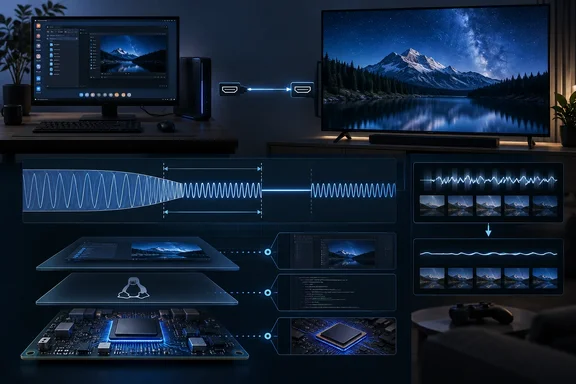
Linux’s VRR target limiter would make display preferences explicit
Variable refresh rate, or VRR, lets display refresh timing vary instead of keeping presentation tied to one fixed cadence. Frattaroli’s proposal addresses a practical complication: some refresh rates can produce visible brightness flicker. Its stated goal is to preserve judder-free or low-latency presentation within an expected operating range while avoiding rates that cause that problem.
The proposed userspace API—the interface through which software outside the kernel communicates its requirements—would express two related preferences. Software could request a constrained range for VRR operation, or it could request a single fixed target. Those are different choices about how the display should behave, even though both narrow the freedom given to the VRR mechanism.
A range leaves room for variation between its boundaries. A fixed target expresses a preference for one rate. The practical implication is that software could communicate more than a general willingness to use VRR: it could tell the display system which timing behavior suits the content.
The Linux kernel’s Kernel Mode Setting documentation already lists a VRR enable property, prop_vrr_enabled, among its display configuration properties. The proposed target controls would add a more specific vocabulary for rate selection. That distinction also explains why “limiter” should not be read as a promise to increase game performance: the described interface concerns VRR targets, and the report supplies no rendering-performance measurements.
There is a documented precedent for this direction. A separate September 12, 2025 RFC by Chuanyu Tseng proposed allowing Linux display clients to restrict the VRR range within the panel’s supported range on a per-commit basis. That earlier proposal establishes that range control was already under discussion; it is not confirmation that Frattaroli’s new interface has been accepted or that the two proposals have identical semantics.
Quick Media Switching gives televisions notice of a rate change
The Quick Media Switching, or QMS, component addresses a different part of display timing: communicating an upcoming change before it happens. Frattaroli’s description identifies a new connector property for this purpose. A connector represents the output endpoint in Linux’s display model, making this part of the proposal about signaling toward the display.
The motivation is particularly relevant to media playback. According to Frattaroli’s explanation quoted by Phoronix, advance notice of a rate change could allow advanced processing algorithms in televisions to remain enabled. Without that notice, processing may need to be disabled so the television can accommodate a sudden change and present at the required rate immediately.
This gives the proposal two complementary jobs. The range and fixed-target controls describe desired operating behavior; QMS communicates an anticipated transition. Grouping them together makes sense because selecting a suitable rate and moving to it are separate requirements.
For a Linux media system connected to a television, that is a potentially useful distinction. The intended benefit extends beyond choosing a refresh target to preserving processing during a planned change. The available report provides the design rationale, however, rather than measurements from particular televisions or a compatibility list. Buyers should not treat the proposal as a guarantee about a display’s processing behavior.
Rockchip RK3588 and Weston define the initial implementation scope
Phoronix reports that the patches implement “Game Mode” VRR in the HDMI state helpers and in the Rockchip RK3588 driver. It also identifies a vrr-limiter branch for Weston, the reference Wayland compositor. These are concrete implementation targets, giving the discussion both a kernel-side component and corresponding userspace work.
The division matters because a new kernel interface does not by itself produce a desktop setting. A compositor—the component responsible for assembling and presenting a desktop’s surfaces—needs a way to use the interface. The Weston branch provides a place for that work, but it does not establish availability in other desktops.
Linux’s Kernel Mode Setting documentation helps explain the hardware boundary. Its display model connects framebuffers and planes to a display controller, then routes output toward connectors. Drivers validate proposed configuration changes against hardware constraints before committing them. A common interface therefore provides a way to request behavior; it does not make every output device capable of that behavior.
The reported RK3588 implementation should consequently remain the named hardware scope. It would be premature to extend this announcement to Intel, AMD, or NVIDIA PC graphics drivers, or to assume that an existing VRR-capable monitor is sufficient. Likewise, the report identifies HDMI work without establishing equivalent implementation coverage for other display connections.
Several details remain important for eventual deployment: the accepted interface, support in the relevant driver, and adoption by the compositor a user actually runs. The available evidence does not identify a shipping kernel version or a mainstream desktop release containing the feature. That is the consequential availability limit, not a reason to dismiss an RFC whose purpose is to settle the design.
Linux users should track adoption before changing their setup
Keep current display configurations in place and treat this announcement as a development milestone, not an upgrade instruction. There is no established end-user procedure here for enabling the proposed controls, choosing safe range boundaries, or recovering from an unsupported configuration. Inventing a universal setting would erase exactly the driver and compositor boundaries that determine whether this work can help.
For developers, the substantive opportunity is to evaluate the proposed contract between userspace and the display driver. For PC enthusiasts considering Linux gaming or television-connected playback, the useful takeaway is narrower: the work targets an identifiable presentation problem, but purchasing or migration decisions still need shipping support.
- The proposed VRR interface covers both a constrained operating range and a fixed target, allowing software to express different timing preferences.
- Brightness-flicker avoidance is a stated motivation, not a measured result across a documented collection of displays.
- The QMS connector property is intended to announce upcoming rate changes so television processing can accommodate them.
- The reported implementation includes HDMI helpers, Rockchip RK3588, and a Weston branch; it does not establish support across mainstream PC graphics drivers or desktops.
- Wait for an accepted interface and explicit driver and compositor availability before treating the proposal as a feature you can deploy.
Frattaroli’s proposal would give Linux display software a clearer way to express which refresh behavior it wants and when that behavior will change. Its value lies in making those preferences explicit across the userspace–kernel boundary. Review and subsequent implementation will determine the usable interface; adoption by the relevant driver and compositor will determine when that control reaches a desktop or media system.