

Before anyone clears space on an SSD: this isn't a finished remaster. It's an early-testing technical project, and you have to bring your own copy of the game.
What changed in version 0.7
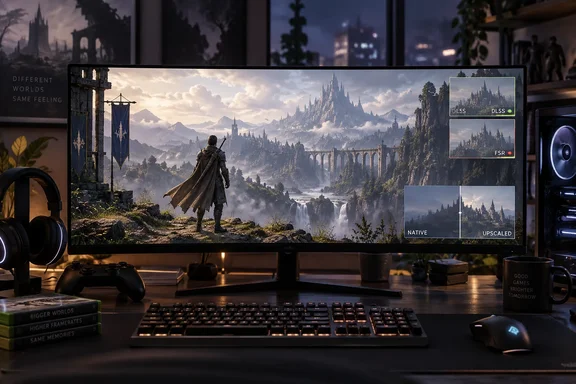
ixbt.games reported that version 0.7 of LostOdysseyRecomp added NVIDIA DLSS Super Resolution and AMD FSR under both Direct3D 12 and Vulkan. According to the same report:
- AMD FSR 3.1.4 is available, including a Native AA mode.
- The game now works in 21:9 ultrawide and other screen formats.
- freefrank is still fixing technical problems and graphical bugs.
- Builds are available for Windows x64 and Linux x64.
The project's own README is more cautious, and it's the better source. It says Windows gets experimental DLSS/FSR upscaling on Direct3D 12 and Vulkan, while Linux gets only the Vulkan path. It also says broader scene coverage, mixed-DPI and fullscreen behavior, and player acceptance are still open questions. The settings list in the repository includes "16:9 / 21:9 resolution presets with Widescreen toggle, Off/FXAA/SMAA/experimental TAA, upscaler options (Off/DLSS with Quality/Balanced/Performance/DLAA), Standard/High filtering, 30/60 FPS and output/display controls; fullscreen and mixed DPI need more testing".
So "fully works in 21:9" is true in the sense that the option exists and the developer has tested it. It doesn't mean every monitor, GPU and scene has been checked.
Version note: 0.7 is already old. When checked, the GitHub README pointed to a v0.7.3 Windows package (LostOdysseyRecomp-windows-x64-v0.7.3.zip). It said v0.7.3 builds on the v0.7.2 DLAA sizing and D3D12 work, and adds Direct3D 12 root-signature and descriptor-table de-duplication plus opt-in render-timing diagnostics. The project moves fast, so check the releases page for the current build.
Summary: DLSS, DLAA, FSR 3.1 and ultrawide presets are all in the port now, and the developer labels all of them experimental.
Why "recompilation" matters
Most people who've played Xbox 360 games on a PC used an emulator like Xenia, which translates the console's PowerPC code while the game runs. Static recompilation translates the game's PowerPC code into native PC code ahead of time. The game then runs as an ordinary Windows or Linux executable, with a thin layer that stands in for the console hardware.
The best-known example of this approach is the Sonic Unleashed recompilation. That's general industry context, not something the Lost Odyssey project claims. The practical benefit is that native code is easier to extend with features the original never had, like modern upscalers, high-resolution UI and PC-style settings menus. The downside is that every game needs its own dedicated project, and bugs have to be fixed one at a time.
The upscaling work has been on the community's wish list for a while. A GitHub issue opened on September 8, 2026 asked for FSR support. The requester wrote that "Since the upscaling now works, this would be a perfect fit to improve the visual experience." The project's release notes also record test work on the DLSS pipeline, including "hardware synthetic Vulkan execution on an RTX 5080 without NGX". That's a synthetic test, not proof that the full game has been played start to finish with DLSS on.
Summary: Recompilation turns the Xbox 360 code into a native PC program, which is what makes features like DLSS and FSR possible. Every new feature still needs testing inside this one game.
How to try it on Windows
Based on the project's published instructions:
- Check requirements. You need an AVX-capable CPU and a GPU driver that supports Direct3D 12 or Vulkan.
- Download and extract the current Windows release ZIP into a folder you can write to. Avoid protected locations like Program Files.
- Run LostOdysseyRecomp.exe and import your game files when prompted. The importer accepts an extracted folder, a
default.xexfile, an XDVDFS ISO or a GOD container. On first launch, the installation guide says you "choose Files to select one or more files, or Folder to scan a directory." - Import the extra discs and DLC too. The importer "recognizes supported game discs and Lost Odyssey DLC from their headers and structure; you do not need to choose a disc or DLC mode." Then restart LostOdysseyRecomp.exe after importing.
- Pick your language and graphics settings. The first launch prepares shaders, and later launches reuse the shader cache.
What success looks like: the game continues past setup and shader preparation into the opening areas, which the developer says have been tested.
For Linux, the project offers AppImage and standalone Flatpak packages built on the Freedesktop 26.08 platform. An AppImage just needs to be made executable with chmod +x and run directly.
Common snags
- Your rip won't import. The README lists specific audited USA/Europe and Europe/Asia editions. Other regional builds, title updates and modified XEX files aren't validated. One user reported on GitHub that a four-folder rip with a single
default.xexwasn't accepted, saying "Your intaller does not accept my rip." If that happens to you, check the installation guide for the list of accepted disc versions. - Updating. The project advises you to keep your save and profile folders when updating. The built-in updater checks GitHub's latest release, and download integrity checks, safe extraction and rollback remain enabled.
- Later discs. Lost Odyssey spans four discs. The developer warns that later-disc progression is not fully verified, so a finished playthrough isn't guaranteed.
- Fullscreen or odd scaling. Mixed-DPI setups and fullscreen mode are listed as needing more testing. If you have a laptop with a 150% display and an external monitor at 100%, expect some trial and error.
Summary: Installation is simple if your disc image matches an audited edition. Most problems come from unsupported rips and the game's later stages, which haven't been tested yet.
Coming in v0.8.0, and what's still missing
ixbt.games says DLSS Frame Generation and experimental Android support are expected in version 0.8.0. The project roadmap agrees, and its planned list is longer. It includes DLSS frame generation on Vulkan and D3D12, dynamic multi-frame generation, separate FSR frame generation, a native 120 FPS evaluation, Linux and macOS on ARM (including Apple Silicon), and Android. The roadmap also says frame generation is currently build-gated, off by default, and not an enabled feature in shipping builds. There's no release date, so treat these as plans, not promises.
The more important caveat is the developer's own. Opening areas and selected scenes have been tested, but a complete playthrough hasn't, and rendering and stability issues remain. Is this the definitive way to play Lost Odyssey today? Not yet. Plenty of players will still find the officially backward-compatible Xbox version the safer route to the ending. That's general knowledge about Xbox backward compatibility, not a claim from the project.
The bigger picture
This project doesn't pirate the game, and it isn't a Microsoft port. It depends on players owning the game data. Legally, that puts it in the same territory as emulation and other recompilation projects, though it's not a legal clearance. The project says the game and its assets belong to their owners and that users should supply data from their own discs.
For Windows gamers, the takeaway is that community recompilation keeps turning console-only classics into native PC programs with modern features. Official ports of a lot of these games never arrived. Lost Odyssey, a four-disc JRPG from Hironobu Sakaguchi's Mistwalker, is getting DLSS and ultrawide support from one developer's GitHub repository instead. It's still rough, but it's worth watching.
References
- After 19 years, Lost Odyssey ported to PC and Xbox 360 exclusive gets modern tech - ixbt.games ixbt.games · 2026-09-27T18:36:12+00:00
- GitHub - freefrank/LostOdysseyRecomp: Experimental native PC port of Lost Odyssey using static recompilation. No game assets included. · GitHub github.com
- (Feature) FSR Support · Issue #10 · freefrank/LostOdysseyRecomp github.com