

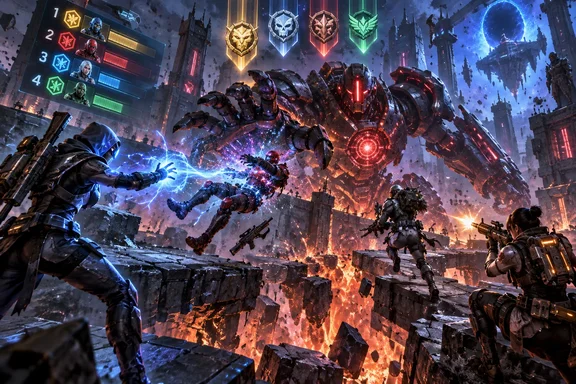
The game premiered during the PC Gaming Show Tokyo Direct on September 20. PC Gamer highlighted its central co-op-versus-competition premise, while Gematsu reported that it is planned for PC through Steam and the Epic Games Store. Bladework’s Steam page lists a 2027 release window, so this is an early announcement rather than a playable launch or open test.
A shared mission with an individual scoreboard
The basic loop described on Steam is deliberately conflicted. Four “Operators” enter missions in the fractured world of Galus, fighting hostile enemies and bosses while gathering medals that feed an individual leaderboard. A squad cannot simply ignore the PvE objective: surviving encounters and clearing the mission appear to be prerequisites for anyone to claim a win.
But the final result is not a team score. Steam’s description says only one Operator can win, creating an arrangement in which helping a teammate at the right moment may be sensible, while allowing that same teammate to dominate the scoreboard is not.
This is closer to a competitive co-op format than a conventional four-player dungeon crawler. Players share space, threats, and progression through a run, while their incentives diverge whenever points, challenges, or a high-value combat opportunity appear.
Combat, challenges, and sabotage
Bladework says missions will combine enemy encounters, bosses, arena games, mental challenges, and traversal time trials. The announcement trailer shows squads fighting large robotic enemies, moving through broad combat spaces, and dealing with environmental hazards, but it does not yet establish how frequently the game shifts between collaborative and head-to-head activities.
The most important competitive tool appears to be a class of abilities called Disruptors. According to the Steam listing, these can be used on enemies or aimed at rival Operators to deal damage, interfere with their position, and potentially steal points. Players may also redirect some boss abilities toward competitors.
That mechanic gives the premise more structure than a post-mission scoreboard alone. If Disruptors are as consequential as Bladework describes, a player who is behind in damage output may still have a way to change the result through timing, positioning, and well-chosen interference. It also raises a practical group-play question: teams will need to decide how much sabotage is acceptable before it starts costing everyone the mission.
Builds are designed around a single run
Marked For Mayhem is also presenting itself as a run-based action game. Players select a weapon at the beginning of a mission, acquire abilities and modifiers during the run, and assemble combinations around the equipment and upgrades they find. Steam describes post-match drone modifications as another layer that can augment abilities for later play.
The available details do not confirm the full progression model, including whether those drone upgrades involve only gameplay unlocks, how matchmaking will work, or how the game will prevent long-term upgrades from overwhelming new players. Those details will matter in a game where individual competition sits beside cooperative objectives.
For now, the published design suggests that the immediate build is intended to be adaptable rather than fixed. A player may need to change plans based on weapons, modifiers, enemies, and the competitive state of the match instead of arriving with one optimized role.
What PC players can confirm today
The Steam page provides a few concrete facts beyond the trailer:
- Marked For Mayhem is being developed and published by Bladework Games.
- It is planned for Steam in 2027, with an Epic Games Store version also announced by Gematsu.
- Steam lists online PvP, Steam Achievements, and Family Sharing support.
- The listing names Windows 10 as the minimum operating system and Windows 11 as recommended, with DirectX 12 and a broadband connection required.
- The posted minimum specification calls for 16GB of RAM and graphics in the GeForce GTX 1060 6GB or Radeon RX 580 6GB class; the recommendation moves to a GeForce RTX 2060 or Radeon RX 5700.
Those requirements are preliminary because the game is still far from release, but they indicate that Bladework is targeting modern 64-bit Windows PCs rather than older hardware.
Gematsu says sign-ups for a limited beta are available. Since Steam’s public page currently provides a 2027 release window but does not give beta timing, prospective players should treat any test access as limited and await details from Bladework rather than assuming a broad public demo is imminent.
For players with a regular four-person group, the appeal is straightforward: Marked For Mayhem is betting that a dungeon run becomes more tense when every rescue, boss kill, and side challenge can improve one teammate’s odds at everyone else’s expense. The trailer establishes that premise; the unanswered question is whether its scoring and sabotage systems can keep a match competitive without turning cooperative play into a reason to quit halfway through.