

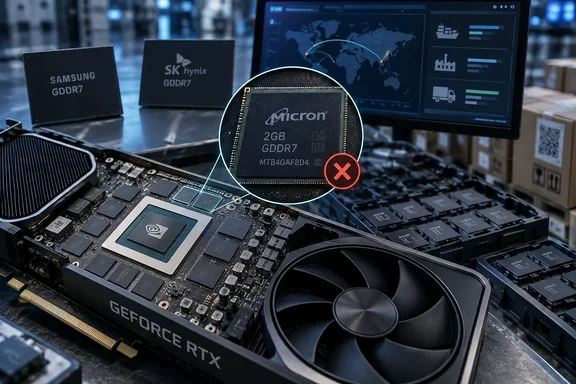
The useful takeaway for PC buyers is narrower than the headline suggests. A reported end-of-life listing raises questions about future memory supply, but it does not establish an immediate shipment cutoff, a graphics-card shortage, or a reason to replace a working GPU.
Micron’s reported GDDR7 retirement comes with a manufacturer correction
Wccftech reports that Micron’s 16Gb GDDR7 devices rated at 28Gb/s and 32Gb/s are listed as end of life on the company’s website. It attributes the discovery to Uniko’s Hardware and identifies MT68A512M32DF-28:A as the 28Gb/s part used in some RTX 50-series production.
The distinction between “16Gb” and “2GB” is simply bits versus bytes: eight bits make one byte. These are descriptions of the capacity of an individual graphics-memory chip, not the total memory capacity of a graphics card. Likewise, 28Gb/s and 32Gb/s describe data rates rather than storage capacity.
Both the headline and a subheading in Wccftech’s report name SK hynix, contradicting the body’s repeated references to Micron. The defensible reading is therefore that Wccftech is reporting a Micron 2GB GDDR7 lifecycle change. Its text supplies no corresponding evidence of an SK hynix end-of-life announcement.
There is also an important limit to the claim. The EOL finding remains a single-outlet report, and no independently confirmed last-order or last-shipment date is established. A catalog status alone cannot tell buyers how much inventory remains available to graphics-card manufacturers or when any sourcing change will reach finished cards.
RTX 50 supplier diversity was real, but Micron’s share is unknown
There is evidence that Micron memory reached actual RTX 50-series hardware. VideoCardz reported photographs shared on QuasarZone showing Micron-branded GDDR7 packages on a GALAX GeForce RTX 5060. It identified the markings as consistent with Micron’s MT68A512M32DF family and described the cataloged 28Gb/s part as a 16Gb, or 2GB, device.
That observation establishes a useful boundary: Micron’s involvement extended beyond an announcement or an expectation of future supply. It does not establish how many cards used its memory, which other models received it, or whether deployment extended across regions and board revisions.
Samsung and SK hynix were already associated with the RTX 50 supply chain before that sighting. In April 2025, Tom’s Hardware reported that Nvidia had begun sourcing SK hynix GDDR7 alongside Samsung, attributing the development to the account MEGAsizeGPU. That earlier reporting provides supplier-history context, rather than independent confirmation of today’s reported Micron retirement.
The before-and-after picture is consequently incomplete. Public reporting identified three suppliers, and one supplier’s initial 2GB products are now reportedly marked EOL. That supports concern about reduced sourcing diversity, but “fully dependent on Samsung and SK hynix” overstates what is known about remaining Micron inventory and delivery commitments.
Wccftech discusses a hypothetical scenario in which Micron supplied 10% of the total volume. That is not a measured market share. Without an actual supply figure, neither a negligible impact nor a substantial production shortfall can be calculated from this report.
Higher-density GDDR7 does not promise an automatic RTX 50 upgrade
Wccftech also describes Micron as continuing with 3GB GDDR7 products. A move toward higher-density chips could be relevant to future graphics-card designs, but the existence of a larger-capacity component does not establish a shipping RTX 50 configuration.
The arithmetic is straightforward: a 3GB chip holds half again as much data as a 2GB chip. The product conclusion is not. No Nvidia announcement cited in this reporting establishes that existing RTX 50 models will adopt those devices, retain their current specifications with different memory arrangements, or receive higher-capacity replacements.
Capacity and transfer speed must also remain separate. Micron’s public GDDR7 documentation describes speeds up to 32Gb/s and explains that total memory bandwidth depends on the memory interface. Its advertised system bandwidth above 1.5TB/s specifically assumes a 384-bit bus. That figure cannot be applied to every card merely because it uses GDDR7.
For buyers, the practical consequence is to evaluate a finished card’s documented VRAM capacity and performance, rather than infer an upgrade from a memory manufacturer’s product direction. Wccftech’s further references to possible 4GB and 6GB chips in 2027–2028 do not constitute a confirmed Nvidia RTX 60 launch schedule or memory specification.
RTX 50 buyers should act on card availability, not an EOL headline
Keep a planned purchase tied to the card’s actual price, capacity and availability; this report alone does not justify accelerating it. For an existing owner, the reported change concerns component sourcing rather than a newly disclosed fault in installed memory.
The same distinction applies to business purchasing. A future sourcing change may warrant questions about availability for a planned order, but it does not establish that a particular workstation configuration is already affected. The missing commercial detail is the shipment timetable, not a Windows setting or driver workaround.
- Treat Micron as the manufacturer identified by the reported EOL finding; the SK hynix wording conflicts with Wccftech’s own account.
- Do not interpret component end of life as a graphics-card recall or an announced end to driver support.
- Do not assume Micron supplied 10% of RTX 50 memory; the reporting provides no measured share.
- Compare finished graphics cards by their documented specifications and actual prices, rather than assume a memory supplier’s name determines performance.
- Do not postpone a needed purchase solely in anticipation of 3GB-chip RTX 50 upgrades, because this reporting establishes no such release.
The reported retirement deserves attention as a potential reduction in sourcing options for new RTX 50 production. Its immediate consumer significance remains limited by the absence of a confirmed delivery cutoff or quantified supply impact. A manufacturer lifecycle notice or a documented change in board availability would make the consequences clearer; until then, the evidence supports watching procurement conditions, not treating a contradictory headline as proof of an impending GPU shortage.
Update: Additional details (September 23, 2026)
VideoCardz reports that a GALAX GeForce RTX 5060 previously found with Micron GDDR7 used four 2GB D8FHL packages, supplying the card’s standard 8GB total memory capacity.
It also says Micron’s 3GB GDDR7 chips are already used in RTX PRO Blackwell products and the GeForce RTX 5090 Laptop GPU. That confirms higher-density Micron parts are shipping in other Nvidia designs, but not in desktop RTX 50 consumer cards.
Update: Tom’s Hardware independently verifies Micron’s 2GB GDDR7 listings are gone (September 24, 2026)
Tom’s Hardware reports that Micron’s product pages for its 16Gb, or 2GB, GDDR7 devices now return “No results found,” independently corroborating the catalog change previously identified by UNIKO’s Hardware. The outlet says the affected 28Gb/s and 32Gb/s parts are marked end of life, though Micron has not publicly supplied last-order or final-shipment dates.
According to Tom’s Hardware, Micron’s 2GB GDDR7 appeared only in limited RTX 50 retail production, including some GeForce RTX 5060 cards, while Samsung and SK hynix supply most standard-capacity GDDR7 used across the lineup. That assessment strengthens the case that an immediate retail shortage is unlikely.
The report also characterizes the move as a shift toward higher-margin 3GB GDDR7 for AI-oriented hardware. It does not, however, establish a new desktop GeForce configuration or change the earlier conclusion: buyers should judge actual card availability and specifications rather than assume an imminent RTX 50 supply disruption.
References
- SK Hynix 2 GB GDDR7 Memory Chips Reach End Of Life, Leaving RTX 50 Series Fully Dependent On Samsung And SK Hynix Wccftech · 2026-09-22T11:49:01+00:00
- Micron discontinues 2GB GDDR7 chips for gaming GPUs as it pivots toward higher-density memory for AI Tom's Hardware · 2026-09-24T12:30:00+00:00