

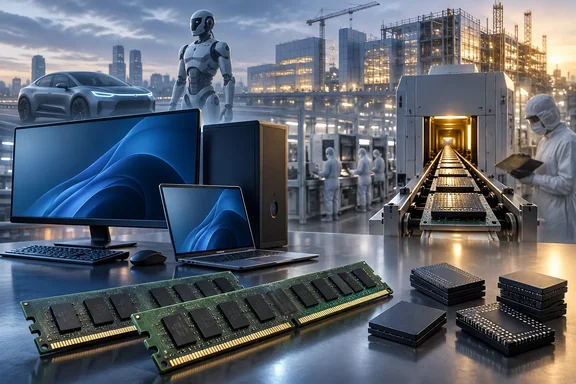
If you've been putting off a RAM upgrade or a new laptop until prices calm down, this is bad news. Below is what Micron actually said, what it didn't say, and what it means for Windows users.
What Micron said
Micron released its fiscal Q4 and full-year 2026 results on September 30, 2026. Its fiscal year ended on September 3. On the earnings call, CEO Sanjay Mehrotra said "Industry demand has strengthened since our last earnings call, and we expect memory and storage supply demand conditions to be much tighter in fiscal 2027 and 2028 than they were in 2026."
The wording on dates shifts. In the opening remarks of the published transcript, Mehrotra says "fiscal" 2027 and 2028. In the market-outlook section, he repeats the forecast using "calendar" 2027 and 2028. Either way, Micron expects the next two years to be tighter than this one. The fiscal/calendar difference only moves the window by a few months.
His tone has hardened since the last call. Yahoo Finance noted that in June, he told analysts the memory crunch would last past 2027 but struck a softer tone than he did on Wednesday.
The forecast in Micron's prepared outlook:
| Metric (Micron's industry forecast) | Calendar 2026 | Calendar 2027 | Calendar 2028 |
|---|---|---|---|
| DRAM bit shipment growth | Mid-20s % | ~Low-20s % | ~Low-20s % |
| NAND bit shipment growth | Low-20s % | ~Mid-20s % | ~Mid-20s % |
| Supply-constrained? | Yes | Yes | Yes |
DRAM supply growth is forecast to slow, not stop, while demand keeps rising. Micron also expects high-bandwidth memory (HBM), the stacked DRAM used next to AI accelerators, to grow faster than ordinary DRAM through calendar 2028. That matters to PC buyers because HBM and desktop DDR5 come out of the same limited wafer capacity.
Micron's own line on supply: "Even with additional industry DRAM clean room space plans with robust demand trends, including new upside requests from customers, we do not have line of sight to when supply and demand will return to balance."
Section summary: Micron forecasts tighter DRAM and NAND markets in 2027 and 2028. DRAM supply growth slows to around the low 20s percent a year, and the company won't put a date on when shortages end.
The numbers behind the forecast
The financial results show how much money there is in selling memory during a shortage. According to Micron's SEC-filed release, fiscal Q4 revenue was $54.23 billion, up from $11.32 billion a year earlier. Full-year revenue was $133.19 billion, against $37.38 billion in fiscal 2025.
Pricing drove most of that. In the quarter, DRAM revenue totaled $39.8 billion, representing 73% of total revenue, with bit shipments increasing in the mid-single digit percentage range quarter-over-quarter and average selling prices rising in the high-teens percentage range. NAND was more extreme: bit shipments up approximately 10% sequentially and ASPs climbing roughly 30%.
Micron shipped only a little more DRAM than the quarter before, but got much more money for each bit. That pattern is typical of a supply-constrained market. Gross margin was about 87%, a figure that would be remarkable even for a software company.
A lot of future supply is already spoken for. Moor Insights & Strategy CEO Patrick Moorhead called the results "Not a slowdown," he wrote in an X post, highlighting that more than 75% of Micron's 2027 output is already committed. Micron has signed 26 multi-year take-or-pay "strategic customer agreements," which it estimates will make up more than 35% of its revenue through 2030. Some now run into 2031.
Why new fabs won't fix this soon
Micron is building a lot of new capacity. The timelines from the call:
- ID1 (Idaho): wafer output starting mid-calendar 2027
- Tongluo (Taiwan): meaningful product shipments from mid-calendar 2027
- HBM advanced packaging (Singapore): initial output in early calendar 2027
- ID2 (Idaho): wafer output starting late calendar 2028
- DRAM fab expansion (Japan): initial output in late calendar 2028
- New NAND facility (Singapore): output in the second half of calendar 2028
- First New York fab: initial wafer output in calendar 2030
Micron itself says that first output is not the same as full capacity. New fabs "take time to ramp and gradually becomes more meaningful, starting a few quarters after initial output." The company plans to raise fiscal 2027 capital spending above earlier plans. Most of the increase is construction spending aimed at adding cleanroom space in late calendar 2028 and beyond.
Mehrotra listed several other reasons supply is slow to grow:
- Each new HBM generation uses more wafer area per bit than standard DRAM.
- Future process-node shrinks deliver less productivity gain per wafer.
- Cleanrooms take years to build and then ramp up gradually.
A useful way to picture it: the industry is adding lanes to a motorway, but the lanes open one at a time, years apart, while traffic keeps growing.
Section summary: Micron has new fabs coming, but most of the extra capacity arrives late in 2028 or later and ramps up gradually. That's why the company expects 2027 and 2028 to be tighter than 2026.
The robots are coming (eventually)
This is the second part of the story. Micron argues that physical AI could become a new source of memory demand even if spending on AI data centers cools down.
The headline figure needs to be read carefully. Micron said memory in Level 4-and-higher autonomous vehicles typically exceeds 200 GB, and storage reaches multiple terabytes. It said each figure is more than an order of magnitude above today's Level 2-plus and Level 3 semi-autonomous cars. It then said humanoid robots are expected to need comparable amounts of memory and storage.
So the 200 GB-plus figure was stated for self-driving cars. Robots were described as expected to be similar. Micron didn't say every robot ships with 200 GB of DRAM today, and it gave no measured industry average.
On timing, Micron said physical AI "can become a significant driver of memory and storage demand by the end of this decade." It added that "several physical AI customers are sampling our next generation products." The SEC-filed release says Micron has started sampling 1-gamma-based LPDDR6 to "multiple physical AI markets."
Sampling means customers are evaluating parts. It doesn't mean they're shipping robots in volume. To matter at the scale of the PC market, humanoid robots would have to sell in very large numbers, and nobody on the call gave unit forecasts.
Is Micron talking up its own business?
It's a reasonable question. Micron is a public company with good reasons to tell investors that demand will last. Its earnings release includes the usual forward-looking-statement warning that results could "differ materially" and that it "cannot guarantee future results."
Not everyone expects the boom to run indefinitely. Yahoo Finance reported that Morningstar sees the current memory boom extending into 2028 before a major supply-driven downturn emerges. Investors weren't fully convinced either. Micron's shares closed the regular session at $1,066.10, up 0.1% from the previous close, before slipping 0.78% in after-hours trading to $1,056.75. On the call, an analyst said memory-stock valuations suggest the market thinks 2027 could be the peak.
Memory has always been a boom-and-bust industry. The bust usually comes when all the new fabs open at about the same time. Micron's case is that the fabs are years away and demand will still be there when they open. Morningstar's view implies the downturn has been postponed, not avoided.
Still, the near-term outlook doesn't rest only on Micron's word. Yahoo Finance noted that SanDisk is also seeing demand outpace supply, with customer allocation expected to continue beyond 2027.
What this means for Windows PC buyers
Micron gave no forecast for retail RAM or SSD prices, so nobody can honestly promise exact prices for 2027. Micron did say a few things that matter to PC buyers:
- PC and mobile revenue is still growing, but unit sales may fall. Micron said PC and mobile industry revenue should still grow in calendar 2026 thanks to premium devices, despite possible double-digit drops in units in both markets. Fewer machines, at higher prices, with more memory in each.
- AI PCs need more memory. Micron said OEMs adding AI features to flagship PCs and phones are driving demand for devices with more DRAM and NAND. Copilot+ PCs and on-device AI tools need memory, and that memory comes from the same constrained supply.
- Consumer parts are low on the priority list. When 75% of next year's output is already committed, much of it under long-term contracts with big customers, the retail DIY market isn't first in line.
General buying advice (not Micron guidance):
- If you need more RAM now, don't wait for 2027 prices. Micron's outlook gives no reason to expect relief within the next year.
- Buy the RAM you'll need for the machine's whole life. For a soldered-memory laptop, pick the configuration you'll need in three years. You can't add more later.
- Check what you actually use first. Task Manager's Performance tab shows memory in use, committed memory and hardware-reserved memory. If you rarely go above about 70%, an upgrade may not help much.
- Look after your existing hardware. Reusing DDR4 in a platform that still supports it, or moving a good SSD into a new build, saves money while prices are high.
- Watch the business side too. IT teams planning 2027–2028 PC refreshes should budget for memory as a volatile, rising cost, not a stable one.
The bottom line
Micron's message is clear: 2026 was tight, and the company expects 2027 and 2028 to be tighter. New fabs arrive mostly in late 2028 and later, and they ramp up slowly. The robot argument is real but is a longer-term bet, based on customers sampling parts rather than robots shipping in volume. Morningstar's expectation of a downturn after 2028 shows that analysts disagree about how long this lasts.
For now, nothing in Micron's outlook points to cheaper RAM any time soon.
References
- RAM crisis to get worse in 2027 and 2028 — and then the robots are coming TechRadar · 2026-10-01T11:37:06+00:00
- Micron's Blowout Q4 Pushes Memory Peak Further Out finance.yahoo.com
- Micron projects tightening RAM shortages through 2028 as it generates record profit Tom's Hardware · 2026-10-01T12:50:00+00:00