

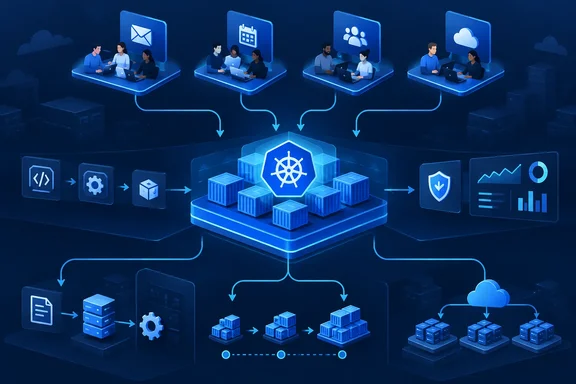
The useful lesson is the division of responsibility. Microsoft’s Customer Stories account describes an internal platform designed to remove repeated infrastructure work without transferring application ownership away from product engineers. It offers a concrete operating model, although it does not provide measurements demonstrating how much engineering time, money, or downtime that model has saved.
Microsoft 365’s COSMIC makes shared operations the platform team’s job
COSMIC stands for Containers on Substrate-Managed Intelligent Clusters. Microsoft describes it as an internal platform built on Azure Kubernetes Service, or AKS, through which Microsoft 365 engineers inherit deployment workflows, security and compliance controls, observability, runtime operations, and infrastructure management. Its scope therefore extends beyond providing Kubernetes infrastructure: it includes the common ways teams deploy and operate their applications.
Microsoft says the underlying problem emerged as Microsoft 365 expanded across hundreds of engineering teams. Although those teams served different customer needs, many independently addressed the same operational challenges: provisioning environments, deploying safely, satisfying security requirements, observing services, and maintaining resilience. Suma SaganeGowda, Partner Group Product Manager for Microsoft 365 Core Platform, describes developers becoming “part-time infrastructure engineers.” That is Microsoft’s characterization of duplicated work, rather than a measured staffing finding.
The documented before-and-after is straightforward. Previously, individual engineering teams built and maintained common operational capabilities independently. Under the COSMIC model, a dedicated platform organization owns shared capabilities that participating application teams can use. The account does not establish that every Microsoft 365 workload has migrated to COSMIC, or that all teams use identical configurations.
The ownership boundary is particularly important:
| Responsibility | Ownership described by Microsoft |
|---|---|
| Applications and application architecture | Product engineering teams retain ownership. |
| Application quality, reliability, and customer experience | Product engineering teams retain ownership. |
| Shared deployment workflows and operational capabilities | The COSMIC platform team owns the common foundations. |
| Shared security, compliance, observability, and infrastructure capabilities | The COSMIC platform team provides capabilities that application teams inherit. |
This division comes directly from Microsoft’s description of COSMIC. It does not amount to a complete incident-response responsibility matrix, but it makes clear that consuming a platform does not absolve product engineers of responsibility for their applications.
The practical implication is that centralization needs a defined boundary. An application team can stop maintaining a common deployment mechanism while remaining accountable for the application it deploys. Enterprises evaluating this model should preserve that distinction: assigning infrastructure work to a platform team and assigning application reliability to that team are different decisions.
COSMIC turns operational improvements into reusable capabilities
Microsoft’s strongest explanation of COSMIC concerns how improvements spread. SaganeGowda says that when a team develops a better deployment pattern, stronger security control, or more effective practice, the goal is for other engineering teams to inherit it through the platform instead of implementing it independently. That is the mechanism behind the claim that COSMIC scales expertise.
There is a useful difference between documenting a recommended practice and incorporating it into a shared workflow. Documentation still leaves each consuming team with implementation work. A platform capability can move some of that work into the common service. Applied to Microsoft’s account, the intended benefit is fewer separate implementations of the same operational foundation—not simply a larger collection of hosted applications.
That benefit remains an intended outcome in the available evidence. The September account gives no deployment-frequency comparison, incident-reduction figure, cost baseline, or engineering-hours measurement. No independent corroboration of those outcomes is present in the available reporting; the account and the supporting product descriptions are Microsoft’s own. The evidence supports explaining the operating model, not declaring a quantified productivity breakthrough.
Microsoft also describes an organizational mechanism for keeping the platform useful. COSMIC operates as a product organization, with Microsoft 365 engineers as its customers. Developer experience is considered alongside reliability, security, and performance; capabilities are prioritized from engineering needs, refined through feedback, and evaluated according to whether they remove meaningful work.
That gives enterprise readers a more useful evaluation criterion than the number of services a platform exposes. A shared capability earns its place when it takes recurring work away from application teams. A centralized interface that leaves those teams doing the same underlying tasks would not satisfy the standard Microsoft describes.
SaganeGowda explicitly says the team wanted to avoid becoming a bottleneck and that its responsibility was not to own applications. Microsoft does not disclose COSMIC’s exception process or internal service commitments, so the story cannot serve as a complete organizational blueprint. It does, however, establish the intended direction: the platform team serves application teams rather than absorbing them.
AKS Automatic shows where Azure supplies part of the foundation
Microsoft says operating COSMIC has helped inform AKS Automatic, Azure Kubernetes Fleet Manager, and investments in observability and governance. Sean McKenna, Director of Product for Azure Cloud Native, describes this as a “Customer Zero” feedback loop: Microsoft uses its own services at scale and applies that operating experience to Azure’s development. The account does not identify a feature-by-feature lineage from COSMIC to those products.
AKS Automatic is nevertheless a useful public comparison because its documentation specifies which operational decisions Azure makes on the customer’s behalf. Microsoft Learn describes Automatic as handling cluster setup, node management, scaling, security, and recommended configurations. Those are public AKS Automatic capabilities, not a disclosed inventory of COSMIC’s internal implementation. Microsoft Learn
The most consequential distinction in that documentation is between preconfigured, default, and optional features. Preconfigured features are always enabled and cannot have their settings changed or be disabled. Default features arrive configured but can be changed. Optional features require the customer to enable or configure them. This vocabulary defines how much control an organization retains when it accepts an operational standard. Microsoft Learn
For example, Automatic preconfigures node autoprovisioning and managed system node pools. It also preconfigures automatic Kubernetes upgrades through the stable channel and node operating-system image updates through the NodeImage channel. The documented AKS Standard comparison leaves more of those choices to the operator, with manual upgrades as the default and automatic upgrade channels available as options. The trade-off is less setup and recurring management work in exchange for accepting more service-defined behavior. Microsoft Learn
Security follows the same pattern. Automatic preconfigures Azure role-based access control for Kubernetes authorization, Microsoft Entra Workload ID, an OpenID Connect issuer, and deployment safeguards with baseline Pod Security Standards enforced through Azure Policy. These are specific platform controls. Their presence should not be interpreted as a guarantee that an application is secure or that an organization has satisfied every compliance obligation. Microsoft Learn
For Windows-focused teams, the operating-system boundary deserves attention before any architectural comparison. Microsoft’s Automatic comparison lists Azure Linux for managed system nodes and Azure Linux or Ubuntu for user nodes. Windows Server appears as an option under AKS Standard, not Automatic. Organizations planning around Windows containers should therefore not treat Automatic as interchangeable with the Windows-capable AKS Standard option. Microsoft Learn
There are also precise limits to the service guarantees. Microsoft documents an Automatic SLA under which 99.9% of qualifying pod-readiness operations complete within five minutes, covering scheduling and node provisioning when needed. Separately, it documents a 99.95% Kubernetes API-server uptime SLA. Neither figure is a Microsoft 365 application-availability measurement or evidence of COSMIC’s performance. Microsoft Learn
These details illustrate why adopting a managed service and building an internal engineering platform remain separate decisions. Automatic supplies documented cluster capabilities and defaults. COSMIC adds Microsoft 365-specific workflows and an internal product organization around its platform. Buying the former does not, by itself, create the latter.
Azure Kubernetes Fleet Manager extends standardization across clusters
Fleet Manager addresses another part of the operating model: applying coordinated management across multiple Kubernetes clusters. Microsoft’s product page describes joining AKS clusters across regions and subscriptions, then managing activities such as upgrades and resource placement centrally. That is relevant when repeated operational work exists between clusters as well as between application teams. Microsoft Azure
Its upgrade controls make the comparison concrete. Fleet Manager supports update runs for Kubernetes versions and node images, reusable strategies governing order and timing, and optional approvals for update groups and stages. Auto-upgrade profiles can trigger upgrades when new versions appear. These capabilities provide a public example of turning an operational practice into a reusable management mechanism. Microsoft Azure
Staging and approvals are important to the decision because central management does not require every cluster to change simultaneously. Fleet Manager’s documented controls allow organizations to define progression across groups. That is a more specific proposition than simply “automating upgrades”: the operator can establish how a shared change advances through the fleet. Microsoft Azure
Availability still needs to be assessed capability by capability. The product page labels Managed Fleet Namespaces and Automated Deployments from Git as previews. It also contains conflicting statements about Azure Arc-enabled Kubernetes: the main description advertises preview support, while the FAQ says support is unavailable. That contradiction prevents treating cross-cloud and on-premises Arc integration as an unqualified capability on this evidence. Microsoft Azure
The pricing boundary is narrower than “free fleet management.” Microsoft says the Fleet Manager resource itself has no charge, while charges apply to the AKS cluster created on the customer’s behalf and its associated virtual machines, storage, and networking. The COSMIC account supplies no cost comparison from which enterprises could estimate their own savings. Microsoft Azure
For readers considering an internal platform, these public services are building blocks to evaluate against actual requirements. Neither the COSMIC account nor the product descriptions establish that every organization needs both services, or that Microsoft 365’s internal arrangement is the appropriate design for a smaller environment.
Use the COSMIC model to decide what work to centralize
Platform leaders should begin with recurring operational work and ownership boundaries, rather than treating COSMIC as a product-selection mandate. Microsoft’s account supports examining where teams repeatedly build the same foundations and whether a shared capability could remove that effort. It does not justify an immediate migration or provide a supported deployment recipe.
The most practical distinction is between application-specific decisions and common operational mechanisms. Microsoft leaves application architecture, quality, reliability, and customer experience with product engineers. An enterprise adopting the same principle would need to make that separation explicit before deciding which deployment, security, monitoring, or infrastructure functions belong in its platform.
For Microsoft 365 tenant administrators, there is no customer-facing COSMIC configuration procedure in this announcement. It describes Microsoft’s internal engineering operations, not a new tenant feature or an administrative action customers must perform. The actionable audience is principally the organization designing or operating its own software platform.
- Keep application ownership explicit when transferring common operational work to a platform team; Microsoft’s model retains product-team responsibility for application reliability and customer experience.
- Evaluate shared capabilities by the recurring work they remove, matching COSMIC’s stated emphasis on developer feedback and useful outcomes.
- Compare AKS Automatic’s fixed configurations with your requirements before adopting it, especially where operating-system support or upgrade control affects workload compatibility.
- Evaluate Fleet Manager’s staged updates and approval controls when the problem spans multiple AKS clusters, while keeping preview capabilities separate from established requirements.
- Build your own baseline for effort, reliability, and cost rather than borrowing an assumed return from COSMIC; Microsoft has not published those outcome measurements in this account.
Microsoft’s COSMIC story provides a clear model for distributing operational expertise through shared capabilities while leaving application accountability with the engineers building the product. For enterprises, the next decision is which repeated task deserves that treatment—and which documented Azure capabilities can support it without imposing an unsuitable operating model. The value comes from making useful expertise reusable, with a boundary that both the platform team and its application teams understand.
References
- Microsoft 365 scales engineering expertise with Azure Kubernetes Service (AKS) - Microsoft Microsoft · Tue, 22 Sep 2026 01:18:08 GMT
- Azure Kubernetes Fleet Manager | Microsoft Azure azure.microsoft.com
- Introduction to Azure Kubernetes Service (AKS) Automatic - Azure Kubernetes Service | Microsoft Learn learn.microsoft.com