

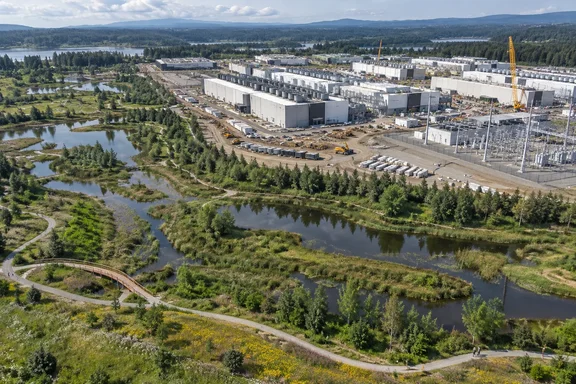
That distinction matters for readers assessing the company’s response to community pressure. Neowin’s report accurately points to real projects, including wetlands, restored streams and native plantings. Yet Microsoft has spent years presenting those projects as evidence of a broader approach, while continuing to add capacity at the same locations. The company’s environmental work may improve a site’s local ecological performance, but it does not resolve the separate questions communities are asking about land conversion, electricity demand, noise, backup generation and the pace of data-center construction.
Microsoft’s published material frames the work as a way to make data centers “better neighbors.” It should be read as a mitigation program attached to a large buildout, not as a decision to reduce that buildout.
The Netherlands pilot predates the current announcement
Microsoft’s Middenmeer data center in Noord-Holland is the origin story for its biomimicry campaign. A Microsoft Local post published in 2022 said the team studied local soils, water and air quality, vegetation, biodiversity, and agricultural practices before choosing a landscape plan. The finished work included 150 native trees and roughly 2,300 square meters of shrubs, grasses and groundcover.
The design goals were practical as well as aesthetic: reduce erosion, improve stormwater handling, provide pollinator habitat, and reduce the visual separation between an industrial campus and surrounding farmland. Microsoft later described the site as an “outdoor laboratory” whose lessons would be carried into projects elsewhere.
That is a more modest claim than the one implied by broad language about data centers “giving back” to nature. The documented intervention is landscaping around an existing facility. It can have local value, particularly in a heavily altered agricultural setting, but it is not evidence that the data center itself has become environmentally neutral—or that a restored planting area compensates for all of the resource demands created by a hyperscale cloud campus.
Microsoft’s 2025 Environmental Sustainability Report says the company has considered biodiversity in data-center development since 2020. It also says it has updated internal sustainability standards to require native or climate-adapted plants in landscaping and to use bird-safe glass and reduced nighttime lighting where applicable. Those are concrete design measures. They are also considerably narrower than a publicly verifiable commitment to apply every biomimicry technique to every future U.S. facility.
The claim that the approach is already expanding to more than 20 sites across the United States and Germany, and will be mandatory at all future U.S. sites, could not be independently confirmed in Microsoft’s publicly available fact sheets, sustainability report, or current data-center materials. Microsoft does publicly describe nature-based design as an expanding practice, but it has not provided a site-by-site list, a binding standard with defined requirements, or a timetable that would let communities determine whether a planned campus is covered.
Virginia shows both the benefit and the limitation
The Chase City Conservancy in Mecklenburg County is Microsoft’s strongest tangible example. Microsoft says the project protects more than 230 acres from development, restored more than 16,300 linear feet of streams, created more than eight acres of wetlands, planted more than 25,000 trees, restored 185 acres of native pollinator habitat, and added over three miles of accessible trails.
Those are meaningful interventions, and the project has a clearer physical record than most corporate biodiversity announcements. Microsoft opened the conservancy on April 4, 2025, after collaborating with the Virginia Master Naturalists’ Southern Piedmont chapter, local libraries, public schools, consultants and community participants. The company also tied the project to education efforts including school greenhouses, gardens and ecology programs.
But the conservancy is not separate from Microsoft’s data-center development. Microsoft previously said it obtained permits for data-center facilities on a 600-acre Chase City property that includes the conservation area. The preserved land exists alongside, rather than instead of, planned construction.
That context has become more relevant in 2026. Data Center Dynamics reported in June that Microsoft had filed with the U.S. Army Corps of Engineers to develop another 490 acres beside its existing AVC17 campus in Mecklenburg County. The proposal includes three one-story data-center buildings, roads, an electrical substation and water storage, with the overall approval and construction process expected to take four to five years. Microsoft did not publicly disclose the proposed buildings’ capacity.
The result is a useful case study in what ecosystem restoration can and cannot answer. Restoring degraded streams, wetlands and forest buffers can create real ecological and public-access benefits. It does not tell residents how much power a new campus will draw, how its peak demand will affect local utility planning, what construction traffic and noise will look like, or whether the overall regional land footprint is rising faster than mitigation efforts.
Those are the questions that must be answered in planning filings, utility proceedings and enforceable local agreements. A pollinator habitat does not substitute for them.
Ecosystem Intelligence is a measurement tool, not proof of results
Microsoft says it uses a tool called Ecosystem Intelligence to quantify ecosystem services around facilities, moving beyond the conventional environmental reviews used for regulatory compliance. Its sustainability report describes the tool as a platform for assessing ecological impacts and measuring the ecosystem services produced around data centers.
The technology is relevant because it could make environmental claims more testable. In principle, a site operator can establish a baseline for water retention, habitat quality, biodiversity, carbon storage, soil condition and human-use benefits, then compare design options and measure performance after construction. Microsoft also says it has deployed Premonition, an AI-driven ecological monitoring system, to track species populations and ecosystem health.
The limitation is transparency. Ecosystem Intelligence is not a public Azure service, despite descriptions suggesting it is an Azure cloud-powered product. The platform is associated with EcoMetrix Solutions Group and the Project Positive collaboration involving Biomimicry 3.8, Jacobs and other partners. Microsoft uses it, but has not released the underlying site-level baselines, scoring methodology, monitoring data, target thresholds, or third-party validation for its own campuses.
Without those records, the public can verify that Microsoft has planted trees, restored wetlands and installed design features. It cannot independently verify the larger conclusion that individual campuses are delivering a net-positive ecological outcome over time.
Microsoft’s own public material provides one revealing benchmark: a healthy ecosystem is described as having 100% ecological function, while standard data-center designs leave 37% intact; the company says it aims for at least 66% ecological function. That implies the goal is mitigation and partial restoration, rather than recreating the landscape that existed before construction. Microsoft should publish that calculation for individual data-center projects before presenting the program as proof that nature and hyperscale infrastructure are fully in balance.
Water improvements address one pressure point
Microsoft’s AI-focused data-center design does offer a specific engineering change with clearer operational consequences. The company announced in March 2025 that future AI and cloud data centers in Spain would use direct-to-chip liquid cooling in a closed loop. After the system is initially filled, the water recirculates between servers and cooling equipment rather than being evaporated, which means the facility does not need a continuing water supply for cooling operations.
Microsoft reiterated in June 2026 that its newer AI data-center design uses zero water for cooling during operations. The wording is important. It refers to evaporative water consumption in the cooling process, not to zero water use across construction, equipment manufacturing, electrical generation, site maintenance, or every supporting facility function.
The company reports that its average data-center water-use effectiveness fell to 0.27 liters per kilowatt-hour in 2025, down from 2.3 L/kWh in its earliest generation of facilities. It also says about 90% of its owned 2025 fleet used low- or zero-water cooling systems. Those are company-reported fleet-level figures, rather than independently audited measurements for each proposed project.
A closed-loop design can materially reduce a local water conflict, especially in drought-prone regions. It may also involve an engineering tradeoff: avoiding evaporative cooling can require more electricity to reject heat in some climates. Microsoft acknowledges that cooling choices are a balance between water and energy efficiency, which is why a “zero-water” label should never be treated as a complete environmental scorecard.
Community scrutiny is moving beyond landscaping
The political backdrop is changing faster than Microsoft’s messaging. In the United Kingdom, protests against proposed data centers have focused on electricity demand, emissions, land use and pressure on local infrastructure. The Guardian reported this month that hundreds of people demonstrated outside the Scottish Parliament for a pause in the country’s data-center expansion, with campaigners calling for national planning rules and clearer standards for what qualifies as a green facility.
Microsoft has also faced direct local opposition in Leeds, where Neowin reported on September 13 that demonstrators marched against three planned company facilities at Skelton Grange. The local argument is not chiefly about whether the buildings have native plants. It is whether a city should absorb the cumulative infrastructure cost of large AI-oriented campuses, and on what terms.
For Windows and Azure customers, the practical takeaway is straightforward. Microsoft is making credible, concrete changes around water use, habitat design and environmental monitoring, and some of those changes will improve the footprint of individual facilities. But the company’s biodiversity program is not evidence that its Azure expansion has stopped imposing local costs.
The projects worth watching are the ones where Microsoft publishes the numbers communities need: facility capacity, peak and annual electricity demand, cooling design, water source, backup-power plan, land converted, habitat baseline, mitigation requirements, and post-construction monitoring results. Until those disclosures become standard, “giving back to the environment” remains a description of individual restoration projects—not an answer to the full impact of the data centers being built beside them.
Update: Microsoft formally commits biomimicry to future U.S. data-center projects (September 16, 2026)
Microsoft’s newly published Microsoft Source feature now explicitly says its biomimicry approach is being expanded to more than 20 data-center sites in the United States and Germany. It also states that nature-inspired design will be included in all new U.S. projects, with adoption growing elsewhere internationally.
This supersedes the earlier lack of a public confirmation for those specific rollout claims. The announcement identifies the 2022 Netherlands installation and Mecklenburg County’s Chase City Conservancy as examples of the approach, which combines ecological research and community input with landscape, water-management and habitat-restoration plans.
The practical change is that communities considering new Microsoft data centers in the United States can now treat biomimicry as a stated company-wide design commitment rather than an aspirational or selectively deployed practice. Microsoft still has not, in this announcement, published a site-by-site implementation list, measurable minimum requirements, ecological baselines, or post-construction performance data. That means the commitment clarifies intended design policy, but not yet the verifiable environmental results at individual campuses.
References
- Microsoft won't stop building data centers, but it is trying to give back to the environment Neowin · 2026-09-16T15:00:02+00:00
- How nature-inspired design is taking root around datacenters - Microsoft Source Microsoft Source · 2026-09-16T07:55:08+00:00