

What Nadella actually said
The "OS" language first appeared alongside Microsoft's biggest Copilot overhaul to date. Nadella said it should span every model, every form factor and every task. He used the phrase again on October 1, in an internal message that Microsoft published on its official blog. The message announced that Ryan Roslansky, EVP of LinkedIn and Microsoft 365, will leave Microsoft. Roslansky stays on through the end of the calendar year as an advisor.
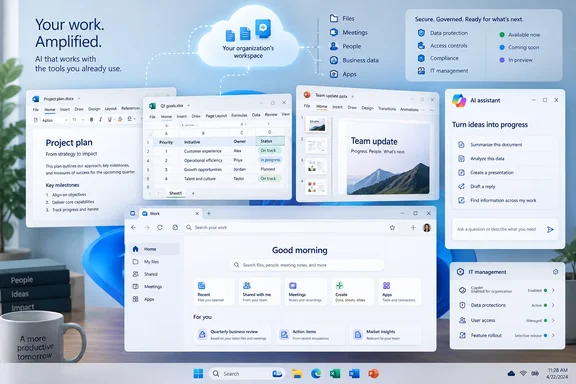
In that message, Nadella said Microsoft is executing rapidly on its vision of a new OS for work. He added that Office would be fully embedded in Copilot "and vice versa", and called the previous week's launch an important milestone.
Nadella's wording does not mention Windows. Microsoft also avoided calling Copilot part of Windows 11 this time, a year after its "agentic OS" framing for Windows drew a rough reception. Read in context, "OS for work" describes a layer above your work apps. It is not a claim that Copilot replaces Windows.
What the new Copilot is meant to be
Microsoft's September 25 announcement describes three headline capabilities plus Office integration:
- Home brings Chat and Cowork together. Chat is for quick conversational requests. Cowork is for work you delegate, which runs end to end and returns a finished result.
- Office in Copilot puts Word, Excel and PowerPoint into the experience. Microsoft says Copilot creates or updates real, editable files that stay in sync with the Office apps.
- Code lets users describe an app, dashboard or workflow in natural language. Microsoft says it is powered by the same underlying technology as GitHub Copilot, runs in a sandbox, and can be hosted in the customer's tenant.
- Copilot Managed Runtime is hosting infrastructure for that code, inside the company's Microsoft 365 environment and governed by IT. Microsoft says it is now in preview.
- Autopilot, previously called Scout, is a persistent cloud-hosted agent. Microsoft says it lives in the tenant with its own identity, memory, computer and workspace, with permissions, audit and governance controls.
Almost none of this was generally available at launch:
- Home and Code were to start in the Frontier program in the coming weeks.
- Autopilot was expanding to private preview at the end of September.
- Today, a proactive command center across mail, calendar, Teams threads, meetings and tasks, enters private preview in October.
Microsoft also separates spending into two models. A user subscription license covers everyday Copilot use. Cowork, Code, Autopilot and the frontier models run on usage-based billing. Admins get FinOps tooling for it. That affects enterprise buyers: this "OS" comes with a meter.
What Windows Latest found inside the Windows app
Windows Latest inspected a Copilot installation at build 154.0.4258.37. Treat the following as the outlet's findings, not confirmed Microsoft statements.
copilotapp.exeis only about 4.99 MB and imports DLLs used by the Edge browser process.- Beside it sits an Edge 154 package of roughly 520 MB, including a 349.6 MB
msedge.dll, V8, ICU, FFmpeg and GPU components. copilotapp_proxy.exereportedly has the same hash as Edge'smsedge_proxy.exe.- The app loads copilot.microsoft.com for personal accounts and m365.cloud.microsoft/chat for work accounts.
- Windows Latest found no WebView2 references and no Electron files. It concludes that this is not the WebView2 wrapper of earlier builds. It reads the app as a Chromium browser build serving as the core.
- A second component,
copilotapphost.exe, is described as a WinUI 3 host written in C# on .NET 10 with NativeAOT. It reportedly handles the "Hey Copilot" wake word, voice composer, vision consent, screen sharing and the floating composer. It talks to the browser side over a named pipe. - The tester's Copilot RAM use was reported at more than 700 MB while idle. That is one machine's observation, not a benchmark.
The tester signed in with a work account on M365 Copilot (Basic). Their app showed only Search, Library, Agents and Notebooks, with no Home, Code or Autopilot yet. That matches Microsoft's staged rollout. It is one user's experience and says nothing about every tenant.
Why this matters, and why it is not a scandal
"Desktop app" describes how software is packaged and launched. It does not say how the interface is drawn. Teams, VS Code and many other Windows programs use web technology for the main window, and a browser core makes it easy to ship one experience across Windows, web, Mac and mobile. Windows Latest itself concedes that cross-platform consistency is probably the priority.
A browser-based app is not inherently bad, though the costs are real:
- Memory and footprint. A bundled browser engine means a large install and a hefty baseline of processes.
- Integration. Anything Windows-specific, like microphone or screen capture, needs a native bridge. That appears to be the job of the small WinUI host.
- Servicing. If the Chromium core really tracks Edge builds, it inherits browser-style patching. Edge's release notes list 154.0.4258.37 as a September 24, 2026 stable build. That shows the number is a current Edge version, but it does not prove what Copilot bundles or confirm the file sizes and hashes.
For IT admins, the practical takeaway is to treat Copilot as a Microsoft Store-delivered app that carries browser-class components and can have browser-class resource use. Watch memory on shared or low-spec devices, and validate it in a pilot ring before broad deployment.
The WinUI irony, labelled correctly
Windows Latest contrasts Copilot's design with Microsoft's native-Windows messaging. It points to Windows App SDK 2.5 Experimental. Microsoft's release notes list it as released on September 29, 2026. They say it fixes a WinUI resource-tracking issue that could grow memory when apps repeatedly created visual-state storyboards or resolved static or theme resources. The outlet says it also adds TableView and Chart controls, though that detail was not visible in the excerpt of Microsoft's notes I reviewed.
Experimental releases are not for production use, and their APIs may change. The release is a sign of platform investment. It is not proof that Copilot could or should be rewritten in WinUI.
The "Copilot OS" lineage
Commentators have drawn comparisons to Project Aion. TechSpot says Nadella's claim sounds like the supposedly defunct Project Aion, a Copilot-centred OS that would have run within an Edge shell. I would treat that as commentary, not evidence of intent. Microsoft has not said the new Copilot is related to any such prototype.
Bottom line
- Verified: Nadella used "new OS for work" in an October 1 official post, and Microsoft's September 25 announcement supports the product direction.
- Reported, not confirmed by Microsoft: the Windows app is mainly a Chromium-based shell with a small WinUI host.
- Caveat: most headline features are in Frontier, private preview or preview, not general availability.
- Fair framing: Copilot is an application and service that Microsoft wants to be the common layer for work. By any technical definition it is not an operating system, and Microsoft's own materials never say it replaces Windows.
The strategic question is whether people will accept an "OS" that lives in the tenant, answers to IT and bills by usage. The engineering question is whether a browser-core Copilot can run lean enough on ordinary PCs. Microsoft has not yet answered either.