

For WindowsForum readers, the Copilot redesign matters most. It's the one story here that will show up in Microsoft 365 tenants, admin centers and budgets. The other three explain where that AI capacity comes from and who will set the rules for it. We'll start with Copilot.
Microsoft Copilot: Home, Code and Autopilot
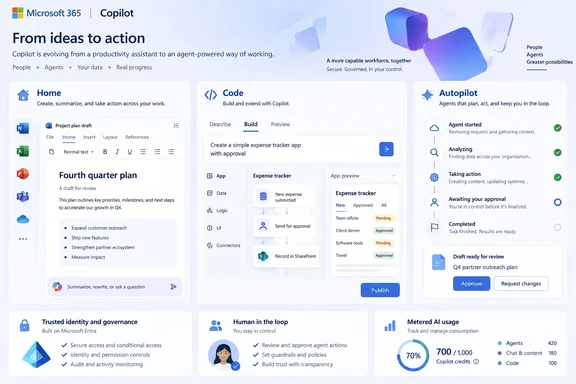
On September 25, Jared Spataro, Microsoft's chief marketing officer for AI at Work, announced a rebuilt Copilot app with three parts.
- Home is the new starting screen, where Chat and Cowork sit together. Chat handles quick questions and drafts. Cowork takes a task you hand off and runs it through to a finished result. With Office in Copilot, Word, Excel and PowerPoint are built into the experience, so you can create and edit real documents, workbooks and decks without leaving Copilot.
- Code lets ordinary users build apps and automations. It runs in a sandbox and uses the same underlying technology as GitHub Copilot. Microsoft says your software developers continue to use GitHub Copilot for their day-to-day work with more connectivity into the Copilot platform.
- Autopilot is a persistent, cloud-hosted agent. You give it a name, a role and a goal. It then watches channels, follows up on threads and runs recurring work without waiting to be prompted.
Microsoft is pitching all of this as the "OS for work." That's marketing language, not a new operating system, and nothing here is a Windows 11 feature update. As WindowsForum's earlier coverage put it, ask in Chat; delegate a multi-step task to Cowork; build a tool with Code. Microsoft says Copilot will eventually route each request to the right mode on its own, but that feature is listed as coming soon.
Scout is now Autopilot
Autopilot is the renamed version of Microsoft Scout, the always-on agent Microsoft introduced on June 2. In that announcement, Microsoft called Scout its first "Autopilot agent" and described Autopilots as a category of agents that work on their own under their own identity. Each agent runs under a governed Entra identity, not a shared service account. Sensitive actions can require a human to sign off. Purview sensitivity labels and data loss prevention policies are enforced before anything is sent or written.
The early Scout preview had real setup requirements. Microsoft said access needed Frontier enrollment, an Intune policy configuration and an opt-in attestation, and users with a GitHub Copilot license could then download the desktop experience. Scout was also built on the open-source OpenClaw project. Microsoft said it was contributing policy-conformance tooling back to that project.
The September version adds more. Microsoft says Autopilot lives in your tenant with its own identity, memory, computer and workspace. It shows up in Teams, Outlook, chats and documents, and you can @mention it like a coworker, with permissions, auditing and governance behind it.
Who can actually use it
Most of this is not generally available yet. Microsoft's EMEA newsroom says Home and Code will be rolled out gradually to the Microsoft Frontier program over the coming weeks. Autopilot will expand to Private Preview at the end of the month. Microsoft's own wording on timing varies. In one place the main blog says Code is rolling out to Frontier at the end of the month, with broad availability in the coming weeks. Microsoft also plans a Code preview for Microsoft 365 Premium and Pro subscribers later this year.
Frontier is Microsoft's early-access program, and admins control it at the tenant level. A DEV Community explainer quotes Microsoft documentation saying "users without a Microsoft Copilot license aren't presented with Frontier features." These are preview features. Microsoft can change, suspend or remove them.
| Capability | Status Microsoft has announced |
|---|---|
| Home (with Office in Copilot) | Rolling out to Frontier in the coming weeks |
| Code | Frontier first, then broader availability; Premium/Pro preview later in 2026 |
| Autopilot (formerly Scout) | Expanding to private preview at end of September |
| Copilot Managed Runtime | Preview |
| Fabric IQ grounding | Generally available in Chat and Cowork, with Code integration coming through the Frontier program soon |
| Dynamics 365 / Power Platform grounding | Rolling out over the next month in public preview |
| "Today" in Home, @Copilot in Teams | Private previews announced |
Two ways to pay
The licensing change matters more than the new tabs. Microsoft is splitting Copilot spending into two buckets:
- User subscription license (USL): a fixed cost for everyday use. It covers Chat, Copilot in Word, Excel, PowerPoint, Outlook and Teams, plus model selection. Microsoft's "Auto" router sends each request to whichever model best balances accuracy, speed and cost.
- Usage-based billing (UBB): metered spending for agent work. Cowork, Code, Autopilot and frontier models all run on UBB.
To keep the meter from running wild, Microsoft announced "FinOps for AI" tools in Agent 365. Admins can:
- set spending policies through an API
- route users' credit requests into existing approval workflows
- limit which model families each group can use
Users will also see their credit usage and remaining balance inside Copilot.
What IT should do now
Based on what Microsoft has published, a sensible prep list looks like this:
- Check your Frontier enrollment. Know which users will see Home and Code before everyone else does.
- Write an agent identity policy. Autopilot agents have their own Entra identities, so each one needs a named human owner and an approver.
- Review Purview labels and DLP. Microsoft says agents work within these controls. That only protects you if the controls are set up properly.
- Set UBB guardrails before the first Cowork job runs. That means spending caps, model-family limits and approval flows.
- Plan for central plugin governance. Microsoft says a new plugin registry will let IT approve and manage Microsoft, partner and custom plugins in one place.
Some skepticism is fair. Microsoft has published no independent data on how reliable agents are, how many people use them or what they save. Parekh notes that many enterprises were slow to pay for Copilot subscriptions and that Microsoft responded by changing pricing and terms. Agents billed by the credit will face the same question from finance teams: is this worth it?
Section summary: Copilot is becoming a platform for handing off work and building tools, with metered billing for agent features. Most of it is still in Frontier or private preview, so now is the time to prepare governance.
Anthropic's reported IPO timetable
Bloomberg reported on October 1, citing people familiar with the matter, that Anthropic could start formal IPO marketing as soon as the week of November 9. That would let trading begin before Thanksgiving on November 26. The same sources said a debut is still expected no later than year-end. This is a target date, not a confirmed listing.
Here's what is confirmed:
- June 1: Anthropic said it had confidentially submitted a draft Form S-1 to the SEC. Share count and price had not been set, and any offering would depend on market conditions.
- May 28: Anthropic announced a $65 billion Series H at a $965 billion post-money valuation. It said run-rate revenue had crossed $47 billion earlier that month.
Parekh reports investors discussing a valuation of $1.8 to $2 trillion. That figure is market talk, not an offering price. His estimate that Anthropic's 2026 revenue will top $100 billion is his own projection, not company guidance.
He also lists the obstacles: a shaky IPO market, the safety and regulatory climate, and rapidly growing compute costs. Investors will look at all of it.
This matters to Microsoft shops for a practical reason. Anthropic says Claude is available on Azure as well as AWS and Google Cloud. Claude models also appear among the options in Microsoft's own products, so Anthropic's finances and access to compute affect the model choices Microsoft customers get.
Washington's AI czar 2.0
CBS News reported on October 1 that President Trump is likely to name Jay Clayton as AI czar. Its sources said the administration has discussed keeping Clayton on as director of national intelligence at the same time. Clayton is a lawyer who was the top federal prosecutor in Manhattan and led the SEC for most of Trump's first term. A White House official told CBS that personnel announcements come from the president and called earlier reporting speculation. As of now, the appointment is not confirmed.
Clayton would follow David Sacks, who stepped down earlier this year but still co-chairs the President's Council of Advisors on Science and Technology. The new czar arrives just after the September 29 White House summit. There, leaders from OpenAI, Anthropic, Google, Meta, Nvidia and SpaceXAI signed voluntary safety standards. According to CBS, those standards include internal evaluations, external audits and board reviews.
Trump called the accord "morally binding," but it is not law. Sen. Mark Warner called for mandatory testing and incident-reporting rules. Parekh expects Clayton to take a more procedural approach than his predecessor.
SpaceXAI becomes a cloud provider as data center debt gets pricier
The Information reports that SpaceX's AI unit now sells compute to other companies. Anthropic has committed nearly $84.5 billion to that capacity, and Google is also a customer. That's a commitment, not money already paid. The Information also reports that SpaceXAI held talks over the summer about leasing capacity to Microsoft. The status of those talks is unclear, and Microsoft declined to comment. Anthropic's Series H announcement separately confirms a deal for GPU capacity in Colossus 1 and Colossus 2.
SpaceX plans to bring about 420,000 Nvidia GPUs online in Memphis in November, according to The Information, which cautions the schedule could slip. Parekh adds that The Information reported drainage flooding at the Colossus II site, with a possible two-to-three-week delay. We could not independently confirm that detail.
Financing is getting harder. The Information reports that all four high-yield data center bond deals since July sold at a discount, including a CleanSpark deal for a Meta data center, and that some banks are becoming choosier about loans. Oracle has also sent a force majeure notice on a New Mexico project delayed by power problems. That notice doesn't mean Oracle has escaped its lease obligations. It does show how a power delay can push risk onto lenders.
The bottom line
The theme across all four stories is ambition running into constraints. Copilot agents are arriving as metered, governed previews. Anthropic's listing date is still only reported. The AI czar pick is unconfirmed, and the White House safety deal is voluntary. Every new GPU cluster depends on financing from increasingly cautious lenders.
For Windows and Microsoft 365 admins, the practical step is clear. Get your Frontier enrollment, agent identity policy and spending controls in order before Autopilot shows up in Teams. If an agent is going to work while you sleep, you'll want to know who it reports to and how much it can spend.
Update: Additional details (October 5, 2026)
International Business Times Singapore reports that Microsoft 365 Copilot had surpassed 30 million paid seats by July, citing Microsoft, after the company had said in its fiscal 2026 third-quarter earnings call that the total was above 20 million. The outlet also cited Sensor Tower data showing the consumer Copilot app at roughly 6 million daily active users in February, versus 440 million for ChatGPT and 82 million for Gemini.
The report says Microsoft has put Jacob Andreou in charge of the Copilot experience across consumer and commercial products, while Mustafa Suleyman is focusing on AI models and superintelligence work. It also quotes Copilot business chief Charles Lamanna saying Microsoft does not intend to build Copilot as a personal-companion chatbot, reinforcing the workplace-first direction described in the September overhaul.
References
- Microsoft Copilot Reboot: Why Microsoft Is Leaving Personal AI to OpenAI and Google - International Business Times, Singapore Edition International Business Times, Singapore Edition · 2026-10-05T17:56:10+00:00
- ‘Come Hell or High Water’ in AI. Anthropic, DC & SpaceXAI. ARD #176 - AI: Reset to Zero AI: Reset to Zero · 2026-10-02T06:27:32+00:00
- Anthropic confidentially submits draft S-1 \ Anthropic anthropic.com