

Microsoft’s feature describes a network of more than 30 colleges, technical institutes and nonprofit partners. Its significance for prospective technicians is the combination of equipment-based learning, career preparation and potential work experience. The enrollment total measures participation, however; it does not establish how many students graduated or secured employment.
What Datacenter Academy actually teaches
Datacenter Academy is a partnership with local training institutions, rather than one standardized Microsoft course with identical admissions, fees and qualifications worldwide.
Microsoft’s program documentation identifies five components: curriculum alignment, simulation labs, mentorship, work experience, and scholarships or financial grants. Local partners administer courses, certifications and financial aid. That arrangement makes the participating institution—and the particular course it offers—the relevant starting point for an applicant.
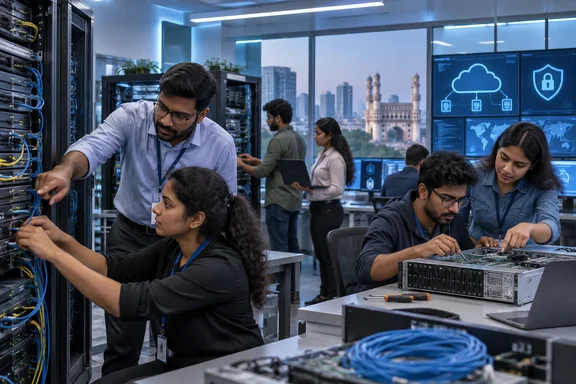
The technical instruction described in Microsoft’s feature covers datacenter operations, networking, cloud services, cybersecurity and systems management. Donated equipment lets students work with physical infrastructure in dedicated simulation labs, connecting classroom instruction to the equipment they may encounter in employment.
According to Microsoft’s Datacenter Academy program documentation, a typical lab contains at least three rack cabinets with a mixture of servers, storage devices and networking equipment. Lab deployments vary with the institution’s space and needs. Students can explore, configure and troubleshoot enterprise equipment without treating a production datacenter as a classroom.
The curriculum support also includes a vendor-agnostic, six-module “Introduction to Datacenters” course covering design, operations, sustainability and community impact. This is useful context for applicants: participation in a Microsoft-supported academy does not mean every lesson is Microsoft-product training or that every associated qualification is a Microsoft certification.
The documented work-experience pathways include several distinct roles:
| Role | What the documented pathway involves |
|---|---|
| Datacenter Technician | Internships can include rotations through deployment, inventory and break/fix work. |
| Datacenter Inventory and Asset Technician | Microsoft also describes rotations through deployment, inventory and break/fix functions for this internship pathway. |
| Critical Environment Technician | The Melbourne training profiled by Microsoft covers power, cooling and mechanical systems that keep a datacenter operating. |
These distinctions help applicants choose a course. Someone interested in enterprise computing equipment has a different training objective from someone pursuing the electrical and mechanical infrastructure supporting it. The academy’s broad subject coverage should not be read as a promise that every location offers every specialization.
Hyderabad connects training with local employers
Microsoft identifies Hyderabad as the latest community in its global academy network. The local partnership includes the International Institute of Information Technology Hyderabad, Young India Skills University, Telangana’s regional government and Don Bosco Tech Society. United Way of Hyderabad supports student recruitment, employer connections and preparation such as mock interviews.
That employment preparation addresses a separate challenge from learning technical material: helping students understand available roles and present their skills to employers.
Microsoft illustrates the pathway through Huziafa Bin Yahiya Ibees, a 26-year-old electrical engineering graduate from the Hyderabad area. According to the company’s account, he completed academy training in April and subsequently began a paid internship at a new Microsoft datacenter. The feature’s photo caption places his technician internship in Chennai; it should not be assumed that a Hyderabad training place necessarily leads to work in the same city.
His experience demonstrates one route from an existing engineering background into datacenter work. It does not establish an engineering degree as a universal entry requirement, nor does one paid placement establish that all academy students receive paid internships.
For an applicant, the meaningful local questions are therefore the course’s entry requirements, the role it prepares students for, and the location of any available work experience.
Different countries offer different training routes
The global expansion retains substantial local variation. Microsoft’s feature describes programs in the United States, Australia and Sweden alongside Hyderabad, with different schedules and career entry points.
At Southside Virginia Community College in South Hill, Virginia, where Microsoft says the first academy opened in 2018, the emphasis includes preparing local residents for jobs that previously drew technicians from outside the area. Instructor Wendy Ezell describes the academy as a route for both new entrants and career changers. A current student profiled by Microsoft, Hannah Reed, enrolled in January 2026 and expects to graduate in May 2027.
In Australia, Microsoft reports that the first academy opened in Sydney in February 2025 with TAFE NSW. A Melbourne academy followed in March 2026 at Victoria University’s Footscray Nicholson campus. Microsoft’s feature reports 107 Melbourne completions and profiles a student taking a 16-week critical-environment course.
In Sweden, the feature describes both nine-month and concentrated three-month training options. Those examples make clear why applicants should not assume that “Datacenter Academy” denotes a fixed-duration qualification.
Course duration also needs to be separated from internship duration. Microsoft’s program documentation says internships typically last 16 weeks in regions such as the Americas, while durations vary more widely in Europe, the Middle East and Africa, and Asia-Pacific. That internship guidance does not make every academy course a 16-week program.
Where training ends and hiring begins
Microsoft’s program documentation says eligible students from partner schools can apply for structured internships or apprenticeships. Availability depends on whether the local datacenter is ready to host participants and whether staff are available to supervise and mentor them.
Mentorship, guest instruction and mock interviews likewise depend on local capacity. Students enrolled in aligned courses receive information about available opportunities through their schools.
The practical boundary is straightforward: training admission, work-experience selection and permanent hiring are separate stages. Microsoft explicitly states that work experience does not guarantee a full-time role; students who complete it still need to apply for open positions.
Financial support is also locally determined. Microsoft says scholarships and grants may cover tuition, fees, certification costs or essential learning resources, depending on community needs. This does not establish that every course is free or that every student receives the same support.
A prospective applicant can use those boundaries to evaluate an offering:
- Apply directly to the participating college or training provider, as Microsoft’s enrollment guidance specifies.
- Establish the exact course title, qualification, entry requirements and timetable. Global examples show that these are not uniform.
- Confirm which costs any scholarship or grant covers before treating the course as fully funded.
- Distinguish classroom training and simulation-lab access from an actual internship offer.
- Confirm the location and duration of available work experience, and plan for a separate job application afterward.
What the community-impact claims establish
Microsoft presents the academy as a way for communities hosting datacenters to participate in the resulting employment opportunities. The feature includes accounts from educators and nonprofit partners who describe local career changes, employer connections and opportunities to remain in their home regions. Those are useful examples, but they are not a program-wide employment evaluation.
The same distinction applies to the Swedish workforce figures in Microsoft’s feature. The company reports approximately 370 full-time employees at its Swedish datacenters, another 175 people working on-site through suppliers and partners, and more than 3,000 people engaged in ongoing expansion projects. These figures describe different categories of work; they are neither a count of academy graduates hired nor a single total of permanent datacenter jobs.
For someone considering enrollment, the strongest documented benefit is access to practical infrastructure education with potential employer exposure. The decision should rest on the local course’s equipment access, qualification, financial support and available placements—not on global enrollment totals or the assumption that a nearby datacenter guarantees a job.